
Palladium Market Outlook: Trim Smart, Reload on Signals
Nov 17, 2025
Two questions clog every inbox at turning points: “It’s running—should we sell?” and “It’s about to explode—why sell at all?” Both outsource judgment to adrenaline. A serious palladium market outlook starts from posture, not prophecy. You don’t guess the future; you prepare for the tape that’s already printing: trim into strength to buy yourself control, then reload only when receipts—not rhetoric—say the edge has flipped back in your favor. Palladium is a thin, volatile market shifting from multi-timeframe compression into early expansion. That is where discipline beats narration. Trim smart, then let rules—your rules—call you back in.
We reduced risk after doubling normal exposure—banked a quarter, kept one-and-a-half lots—because the first obligation of a tactical investor is survival. Power without discipline burns out fast. Strategy here is simple: keep a durable core through the trend, turn the rest into a campaign sleeve you can trim and reload, and ban “all-in” drama unless you truly thrive under drawdown. From this posture, every dip is a potential invitation, not a referendum on your courage.
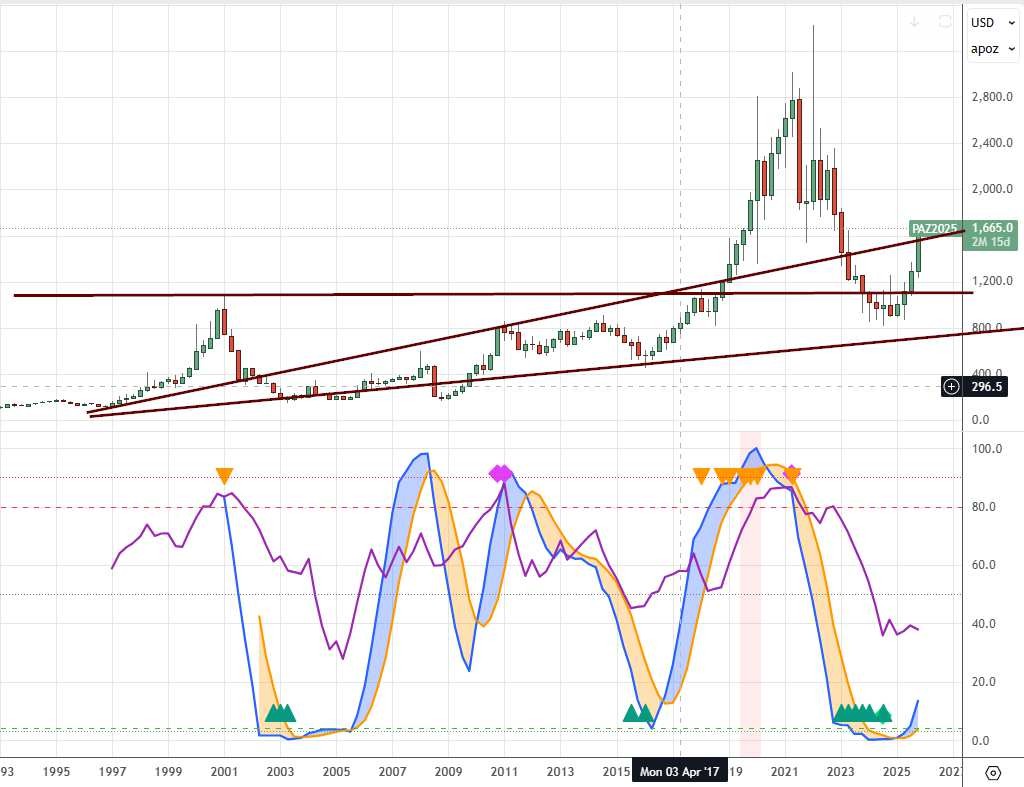
Write your triggers before the tape gets loud. Breakout confirmation: a monthly close at or above 2,400 with expanding volume and tightening lease/forward spreads. That is the cleanest signal that the next leg is alive. Pullback buy: staged re-entries in the 1,200–1,280 zone if momentum cools and structure holds, with confirmation on a 20/50-day moving average reclaim on rising volume. Add-ons when the curve flattens or slips into backwardation, ETF outflows stall or reverse, and the Shanghai–London premium stays bid—those are receipts, not vibes.
Tranche plan and sizing you can follow
Split exposure into core and campaign. Keep 60–75% as core metal/miner exposure you do not micromanage. Deploy the remaining 25–40% in thirds: first 0.5R on the initial tag of your buy zone, second 0.5R on the second swing (or assignment if you’re using options), and the final 0.5R only after a reclaim of the 20-day with participation. Cap fresh risk per ticker at 1.5R; cap daily portfolio risk at 1.5R; stop after two losses in a day. Max three correlated names per theme. These are boredom guards; they keep you solvent long enough for “early” to become “right.”
Cash secured puts near your preferred entry turn waiting into yield and lower basis; strike at your buy zone, collateral equals strike times 100 shares per contract, breakeven equals strike minus premium. Use them only if you want assignment. For breakouts, prefer defined-risk call spreads (debit) over naked leverage; accept capped upside in exchange for bounded loss when palladium gaps overnight. Do not sell puts into binary catalysts (sanctions headlines, major OEM guidance, South African grid shocks). In illiquid names with wide spreads, skip overlays entirely—let equity tranches do the work.
The weekly watchlist (receipts, not headlines)
Inventories: track NYMEX/COMEX palladium stocks and ETF/ETP holdings; small markets speak through inventory changes before price screams. Spreads and term structure: watch lease rates and the forward curve—flat to backwardated is tightness, sticky contango is complacency. Regional premium: Shanghai versus London differentials—persistent premium implies non-Western tightness. Supply pulse: updates on South African power curtailments and labor actions, Russian shipment cadence, North American recycling throughput. Demand pulse: automaker substitution notes (palladium to platinum), China’s ICE/HEV/EV mix, chemical/electronics catalyst orders. Miners: AISC trends, balance sheet health, jurisdiction risk, and capex discipline for names like SBSW and peers. Tie three signals together before you act; one data point is temptation, not authorization.
Base case—stair-step higher: palladium grinds up with noisy pullbacks. Then maintain core, buy dips in thirds on your zone, prefer defined-risk structures for breakouts, and trim parabolic candles but keep skin in the game. Stress case—policy/risk-off slam: a sanctions scare, an OEM shock, or a broad de-risking day. Then hedge beta, buy only where spreads tighten and inventories draw, keep cash to avoid forced sells, and prioritize the highest-quality exposure. Squeeze case—real supply disruption: South Africa or Russia interrupts flow; off-exchange deals proliferate. Then never chase the first vertical; wait for the second swing (a 10–15% cool-off) to add; accept slippage and trade smaller. Thin markets punish heroism.
Targets are guides, not dares
Above a clean monthly 2,400 print, the next leg has room. A reasonable initial upside zone sits in 3,600–3,900 with a potential overshoot toward 4,200 if the squeeze script runs. The “ultimate” line belongs in your private notes, not in your mouth; publishing fantasy numbers creates pressure where you need patience. Targets are landing lights—not dares to abandon risk rules.
Structural invalidations: sustained official-sector net selling; real yields and the dollar rising in tandem while palladium fails to hold higher lows; miners’ all-in sustaining costs rising faster than realized prices for a full quarter; faster-than-expected autocatalyst substitution from palladium to platinum that shows up in OEM guidance and recycler throughput. Tactical invalidations: failure to reclaim the 20/50-day cluster after your trigger fired; forward curve stuck in contango while ETF outflows accelerate; inventory builds during “scarcity” narratives. Write these down. Truth hurts less on paper than in P&L.
Execution hygiene for thin, jumpy tape
Two execution windows: mid-morning and mid-afternoon—avoid the open and close where headlines love to bite. Use limit orders and smaller clips; slippage is part of the toll. Rule-of-Three: act only when three independent receipts agree (e.g., your level hit, volume stabilized, curve tightened). Emotion gate: rate your state 1–5; above 3, pause 90 seconds, breathe 4-4-4-4, halve size or pass. On macro-event days, run orders-only—trade the plan you wrote yesterday. And the last filter, the one that saves accounts: the recognition tax—if you need an audience to take the trade, don’t.
You trimmed 30% at 2,050 after a weekly stretch. Your reload zone is 1,280–1,200. At 1,275 with elevated implied volatility, you sell a 1,200 cash secured put for 45. Collateral $120,000 per contract; credit $4,500; breakeven $1,155. Simultaneously, you buy a small 0.5R equity tranche at 1,275 once intraday selling dries up. If assigned at 1,200, your second 0.5R arrives at $1,155 net. Your third 0.5R triggers only on a reclaim of the 20-day with higher volume. If price bounces and the put expires, you keep the premium and reassess—either resell the put or add on a moving-average reclaim. Every action was written before the first click.
Worked example: breakout participation without bravado
Monthly closes at 2,410 with firming volume and tighter forwards. Rather than chase futures outright, you buy a defined-risk call spread three to six months out—say 2,500/3,300—risk capped to the debit, upside exposure to the leg. As price accelerates, you trim 10–25% of winning deltas into a weekly parabolic candle, roll remaining exposure up and out if the tape stays constructive, and keep your core metal/miner exposure intact. If the breakout fails, your loss is bounded and survivable; if it runs, you participate without taking on account-killing tail risk.
Palladium’s geography is concentration risk dressed as opportunity: South Africa and Russia are the two critical producers, and thin markets do not forgive complacency. Off-exchange deals, sanction workarounds, power curtailments, labor actions—these are not headlines to debate; they are flow constraints to price. The broader trust fracture—custody doubts, export controls, and politicized supply chains—keeps a bid under strategic metals generally. Respect the regime, but don’t mythologize it. Scrutinize your receipts every week.
A credible palladium market outlook is not a dare to be a hero. It is a list pinned to your wall: trim into strength; reload in thirds at pre-written levels; use cash secured puts to get paid for waiting; favor defined-risk structures over naked leverage; act only when three receipts agree; and protect your core so a thin tape can’t bully you out of the trend you earned. Above all, remember why you trimmed in the first place—to buy back control. When the next clean signal prints, you won’t be asking “sell or explode?” You’ll be doing what your plan told you to do yesterday.

Timeless Wisdom: Articles for the Modern Thinker