

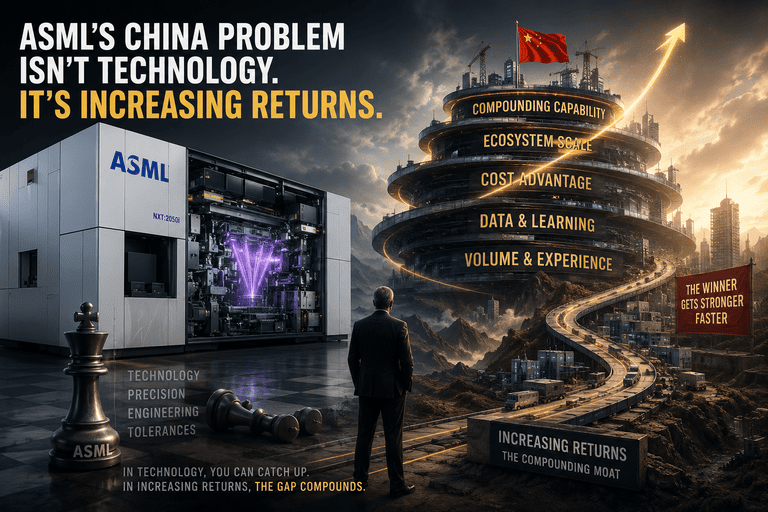
ASML’s China Problem Isn’t Technology. It’s Increasing Returns.
July 29, 2026
The market’s reaction to reports that China has begun producing advanced domestic immersion DUV lithography systems reflects a familiar analytical error. Investors immediately framed the development as a technological contest, asking whether Chinese machines have finally reached ASML’s level of precision. That question matters, but it is no longer the decisive one. The more important question is whether China has reached the point where industrial scale, cumulative learning, engineering density, and optimisation begin reinforcing one another faster than competitors can maintain their lead. Once a technological race reaches that threshold, history suggests the winner is determined less by superior invention than by whose industrial system compounds faster.
Markets consistently underestimate this transition because they analyse the current state instead of the direction of the optimisation process. Financial models comfortably extrapolate observable variables such as throughput, overlay accuracy, defect density, and installed capacity, yet struggle to value systems whose rate of improvement itself accelerates. George Dantzig’s work on optimisation demonstrated that complex systems evolve by solving interacting constraints rather than maximising isolated variables. Semiconductor manufacturing exemplifies this principle because progress depends on the simultaneous optimisation of optics, materials science, software, precision engineering, manufacturing, logistics, and capital allocation. The competitive advantage therefore lies less in any single breakthrough than in the speed at which the entire system learns.
This distinction separates structural analysis from timing analysis. Timing asks whether China’s lithography machines equal ASML’s today. Structural analysis asks whether the underlying drivers increasingly favour convergence regardless of today’s technological gap. Investors often assume present superiority implies future dominance because it is easier to compare existing products than evolving systems. Industrial history repeatedly demonstrates the opposite. Once the optimisation engine begins accelerating, technological leadership becomes progressively harder to defend even while the incumbent remains technically superior.
Industrial Systems Produce Increasing Returns
Traditional economics assumes diminishing returns, where each additional unit of capital contributes slightly less than the one before it. W. Brian Arthur demonstrated that many technology industries operate according to the opposite principle because cumulative knowledge, specialised suppliers, manufacturing experience, and customer feedback reinforce one another over time. Theodore Wright observed the same mechanism empirically decades earlier, showing that every doubling of cumulative production reduced costs because production itself generated knowledge. Semiconductor manufacturing combines both principles, making every lithography machine shipped not merely a piece of equipment but another iteration in the industry’s learning process.
China increasingly possesses the conditions under which increasing returns emerge naturally. It graduates more engineers than any other country, maintains the world’s deepest manufacturing base, commands one of the largest semiconductor markets, and continues allocating patient capital to strategic technologies despite uncertain short-term returns. These advantages matter because they interact rather than because they exist independently. Every additional engineer expands research capacity, every supplier improves manufacturing efficiency, every production run generates operational data, and every customer deployment feeds information back into equipment design. What appears to be incremental progress is often the visible expression of a compounding optimisation system.
This explains why technological competition rarely occurs between individual firms. It increasingly occurs between industrial systems capable of improving faster than their rivals. ASML competes through an exceptionally sophisticated European production network spanning optics, software, precision engineering, and semiconductor manufacturing. China is attempting to construct a comparable capability at national scale by integrating universities, suppliers, equipment manufacturers, foundries, materials companies, and downstream customers into one continuously learning system. Investors naturally compare companies because financial statements are observable, but history suggests they should compare the learning capacity of competing industrial networks.
Optimisation Matters More Than Invention
Public discussion often portrays semiconductor competition as a sequence of dramatic technological breakthroughs. Reality is considerably less dramatic and far more demanding. Most industrial leadership emerges through relentless optimisation, where thousands of incremental engineering improvements ultimately produce outcomes that appear revolutionary only in retrospect. Dantzig’s optimisation framework explains why this occurs, as complex systems advance by resolving interacting constraints rather than pursuing a single technical objective. Every improvement in optics alters manufacturing tolerances, every gain in throughput affects alignment, every reduction in cost introduces new engineering trade-offs, and every solution reshapes the optimisation landscape for the next generation.
China’s comparative advantage increasingly lies within this optimisation process rather than isolated invention. Its engineering scale allows thousands of independent constraints to be addressed simultaneously across research institutes, universities, suppliers, software developers, equipment manufacturers, and semiconductor fabs. Optical specialists improve coatings while materials companies refine photoresists, laser manufacturers stabilise power output, software teams enhance alignment algorithms, and production engineers return operational data directly into equipment development. None of these improvements appears transformative in isolation, yet together they compress development cycles and continuously expand the capability of the entire system. Industrial leadership ultimately belongs to the organisation that solves constraints faster than competitors, not necessarily the one that invents the most spectacular technology first.
Industrial Systems Produce Increasing Returns
Traditional economics assumes diminishing returns, where each additional unit of capital contributes slightly less than the one before it. W. Brian Arthur demonstrated that many technology industries operate according to the opposite principle. When knowledge, specialised suppliers, manufacturing capability, and customer feedback reinforce one another, every improvement increases the probability and speed of future improvements. Theodore Wright observed the same phenomenon empirically decades earlier, showing that every doubling of cumulative production consistently reduced manufacturing costs because production itself generated knowledge. Semiconductor manufacturing combines both mechanisms, meaning every lithography machine shipped manufactures two products simultaneously: semiconductor equipment and engineering experience.
China is steadily assembling the conditions under which increasing returns emerge naturally. It graduates more engineers annually than any other country, possesses the world’s deepest manufacturing base, commands one of the largest semiconductor markets, and continues directing long-term capital toward strategic industries despite uncertain short-term returns. These advantages should not be viewed independently because their value comes from interaction rather than magnitude. Every additional engineer expands research capacity, every supplier improves manufacturing efficiency, every installed machine generates operational data, and every production cycle feeds new information back into the design process. What appears to be incremental progress is often the early stage of a self-reinforcing optimisation engine.
This distinction explains why investors frequently underestimate industrial convergence. They compare today’s machines instead of comparing tomorrow’s rate of improvement. The first comparison measures current capability. The second measures the speed at which capability compounds. History repeatedly demonstrates that once learning curves become self-sustaining, the rate of improvement matters far more than the size of the remaining technological gap.
Optimisation Determines Industrial Leadership
Most commentary portrays semiconductor competition as a contest of technological breakthroughs. Reality is considerably less dramatic. George Dantzig’s work on optimisation demonstrated that complex systems evolve by solving interacting constraints rather than maximising isolated variables. Lithography is therefore not a single engineering challenge but a continuous optimisation problem involving optics, materials science, software, precision machining, vibration control, metrology, logistics, manufacturing, and capital allocation. Improving one variable inevitably changes the constraints governing every other variable.
China’s greatest strategic advantage may therefore lie less in invention than in optimisation capacity. A sufficiently large engineering base allows thousands of independent constraints to be attacked simultaneously across universities, equipment manufacturers, suppliers, foundries, and research institutes. One company improves optical coatings while another refines laser stability. Materials suppliers develop better photoresists as software teams improve alignment algorithms and semiconductor fabs generate production data that immediately feeds back into equipment development. No individual improvement appears revolutionary, yet collectively they compress the optimisation cycle and accelerate the performance of the entire system.
This is why industrial competition increasingly occurs between production networks rather than individual companies. ASML competes through an exceptionally sophisticated European network of optics specialists, precision manufacturers, software developers, and semiconductor customers. China is attempting to construct an equivalent network at national scale. Investors often compare companies because balance sheets are easy to analyse. History suggests they should compare optimisation systems because they ultimately determine who improves fastest.
“Good Enough” Usually Wins
One of Clayton Christensen’s most important observations was that incumbents rarely lose because challengers build better products. They lose because products initially regarded as inferior gradually become economically sufficient. Once performance exceeds the threshold required by most customers, additional technical superiority generates progressively smaller economic benefits while cost, availability, integration, and supply security become increasingly valuable. At that point competition shifts from engineering perfection toward industrial efficiency.
The semiconductor equipment industry may be approaching exactly this transition. ASML does not need to lose technological leadership for its economic advantage to weaken. If a domestic Chinese immersion DUV scanner eventually delivers eighty-five or ninety percent of ASML’s performance while offering lower acquisition costs, unrestricted availability, local servicing, and seamless integration into China’s semiconductor ecosystem, many domestic fabs will make the economically rational choice. Their objective is not to purchase the world’s best lithography machine. Their objective is to maximise return on invested capital.
This distinction changes how investors should evaluate competitive risk. Pricing power usually erodes before market share. Market share often weakens before technological leadership disappears. By the time the incumbent visibly loses its dominance, valuation multiples have frequently been compressing for years because markets recognised that technical superiority no longer translated into monopoly economics.
Markets Misprice Non-Linear Change
The greatest weakness of financial markets is not their inability to analyse technology but their tendency to project linear trends onto non-linear systems. During the early stages of technological development, progress appears frustratingly slow because cumulative learning has yet to dominate the optimisation process. Once increasing returns begin reinforcing production, knowledge, engineering, and manufacturing simultaneously, capability accelerates far faster than conventional forecasting models anticipate. Investors therefore spend years underestimating the rate of improvement before suddenly concluding that disruption has arrived overnight.
This pattern explains the market’s response to recent reports of Chinese lithography progress. The sell-off in ASML does not imply that investors believe China has already matched Dutch engineering. It reflects a reassessment of the durability of ASML’s future monopoly. Equity markets discount expected cash flows rather than current technical rankings, meaning valuation multiples begin adjusting as soon as the probability of future competition increases. Markets rarely wait for technological convergence because they reprice when the direction of compounding changes.
Artificial intelligence illustrates precisely the same mechanism. Only a short time ago, investors assumed frontier capability would remain concentrated among companies capable of spending tens of billions of dollars on computational infrastructure. More efficient architectures and increasingly capable open-weight models demonstrated that engineering optimisation could narrow competitive gaps without matching absolute compute budgets. Frontier models remain technologically superior, yet the perceived economic moat has become materially smaller because optimisation diffused faster than expected. Lithography may ultimately follow a similar trajectory.
The Question Has Already Changed
Most discussions continue asking whether China can eventually match ASML’s technology. That is increasingly yesterday’s question. The more relevant question is whether China’s optimisation engine now compounds faster than ASML’s. Once an industrial system reaches sufficient engineering density, every additional machine, supplier, researcher, production run, and customer expands the capability of the entire network. Improvement ceases to depend upon isolated breakthroughs and instead becomes an emergent property of the system itself.
This is precisely how ASML rose from a relatively obscure challenger to the dominant supplier of advanced lithography. It is how TSMC transformed contract manufacturing into the centre of the semiconductor industry. Neither company won because it possessed an insurmountable technological lead at inception. Both won because they built optimisation systems that learned faster than their competitors. China is now attempting to construct the same type of industrial machine.
Markets continue asking whether China can build a lithography system capable of matching ASML. History suggests that is no longer the central issue. The decisive question is whether China’s production network has reached the point where increasing returns, cumulative learning, and continuous optimisation reinforce one another faster than external constraints can slow them. Once industrial competition reaches that stage, superiority becomes less about who built the better machine and more about who improves the next generation faster. Financial markets understand this instinctively, which is why they begin repricing long before the outcome becomes obvious.

Interesting Articles