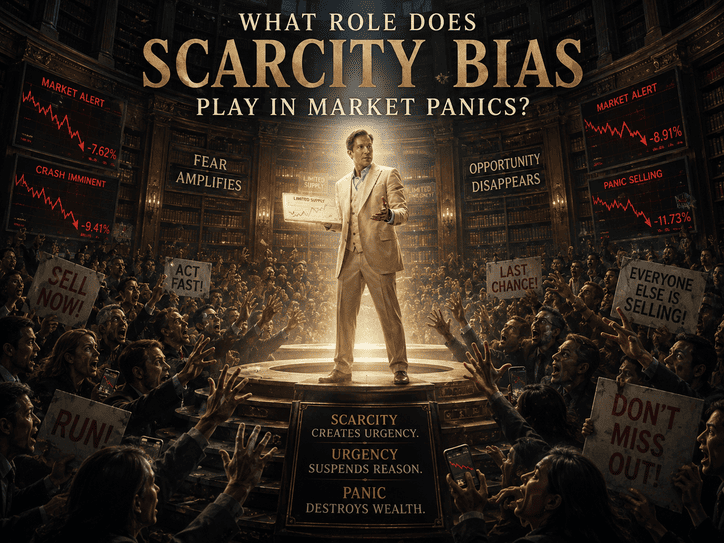
When Empty Shelves Create Full Panic: The Scarcity Bias That Breaks Markets
Cast your mind back to March 2020. Grocery shelves were stripped bare, hand sanitiser disappeared and people bought whatever they could find because tomorrow seemed uncertain, even though supply chains were still functioning and warehouses had not suddenly emptied. The scarce commodity was not toilet paper; it was composure, and once enough people believed something was becoming unavailable, their behaviour created the shortage they feared.
Markets operate on the same psychological machinery. Scarcity bias makes people assign greater value to things they believe are disappearing, while perceived scarcity of time, liquidity or opportunity can turn ordinary uncertainty into urgency, and urgency is where rational analysis begins to lose control. An investor who thinks an asset is becoming impossible to obtain may chase it at absurd prices, while an investor who believes the exit door is closing may sell at any price simply to escape before everyone else.
That makes scarcity bias more than another behavioural quirk. It is an accelerant that can transform orderly buying into mania and orderly selling into capitulation, because the crowd is no longer evaluating value; it is responding to the perceived disappearance of something it believes it needs.
The Ancient Wiring Behind Modern Panic
Scarcity detection is ancient survival software. When food, shelter or safety genuinely became scarce, hesitation could carry a real cost, so the human brain developed a powerful preference for immediate action when resources appeared to be disappearing. Modern markets exploit the same circuitry even though the consequences are usually financial rather than physical.
The problem is that perceived scarcity and fundamental scarcity are entirely different things. During a market panic, investors can become convinced that liquidity is disappearing, that there will be no buyers tomorrow, or that a particular asset will never again trade at its current price, even when none of those conclusions has been established. The feeling of urgency becomes evidence in its own right, and once enough participants respond to it, their collective behaviour can create the very conditions they feared.
This is the feedback loop that makes scarcity bias dangerous: perceived shortage creates urgency, urgency changes behaviour, changed behaviour alters price and availability, and the new price then appears to validate the original fear. Markets do not need a genuine shortage to produce a scarcity-driven panic; they need enough people to believe they are running out of something.
Scarcity Has Three Weapons
The first is liquidity. During a violent sell-off, investors can begin treating the ability to exit immediately as a scarce resource, which changes a normal decision into an emergency. The thought is no longer “Is this asset undervalued?” but “If I do not sell now, will anyone still buy it later?”, and that shift from valuation to escape accelerates selling precisely when prices are deteriorating fastest.
The second is confidence. Markets need buyers willing to absorb selling, and panic damages that willingness because every new decline appears to confirm that the previous decline was justified. Once confidence disappears, even fundamentally sound assets can be sold alongside damaged ones because investors stop differentiating between them and begin treating cash itself as the only safe position.
The third is time. Scarcity bias manufactures urgency with extraordinary efficiency, convincing investors that a decision must be made immediately even when the underlying investment thesis developed over years. An investor who would normally spend days analysing a company can liquidate a position in minutes during a panic because waiting suddenly feels more dangerous than acting, allowing a temporary emotional state to overrule a long-term process.
This is why crashes can become nonlinear. The initial problem may be manageable, but once investors believe they are running out of liquidity, confidence or time, behaviour becomes the problem.
The Same Bias Creates Bubbles
Scarcity bias is not exclusively bearish. It may be even more powerful during euphoric markets because investors begin fearing that they will miss an opportunity permanently.
GameStop and other meme stocks demonstrated the mechanism during 2021. The narrative was not simply that prices could rise; it was that something extraordinary was happening and anyone who failed to participate immediately would miss a once-in-a-generation opportunity. The perceived scarcity was therefore not the stock itself but the chance to become part of the event, and that psychological distinction helped turn buying into a social competition.
The same mechanism appears whenever investors hear that there is a limited supply of an asset, a shrinking window of opportunity or a revolutionary technology that must be owned before everyone else discovers it. Bitcoin’s fixed supply is central to its scarcity narrative, but scarcity alone does not establish value, because an asset can be limited in quantity and still fall dramatically when demand, liquidity or confidence collapses.
That distinction matters because scarcity is a property, while value is a relationship between supply, demand, utility, expectations and price. Confusing the two is how investors end up paying extraordinary prices for something merely because they fear someone else will obtain it first.
Panic Creates Abundance
Here is where the contrarian sees what the crowd cannot: market panics often create abundance, not scarcity. When investors are desperate to sell, assets that were previously difficult to acquire can suddenly become available at deeply reduced prices. The crowd sees fewer buyers and assumes opportunity is disappearing, while the contrarian sees sellers offering ownership at prices that may eventually prove irrational. The market has not necessarily lost its underlying value; it has temporarily lost its tolerance for uncertainty.
March 2020 provided a brutal example. High-quality companies were sold alongside weak businesses because investors were not conducting detailed assessments of future cash flows while markets were collapsing; they were reducing exposure to uncertainty. The opportunity came from recognising that a decline in price does not automatically represent an equivalent decline in intrinsic value.
But this is where contrarian thinking requires discipline. Not every falling asset is cheap, and not every panic is irrational. A company can genuinely be running out of cash, customers or relevance, while a financial institution can genuinely face insolvency, meaning that what appears to be psychological scarcity may actually reflect fundamental deterioration.
The critical question is therefore not “Is everyone panicking?” It is “What exactly has become scarce?” If the answer is liquidity, confidence or patience, the dislocation may create opportunity. If the answer is cash flow, solvency or economic viability, buying simply because the crowd is frightened can be catastrophic.
The Scarcity Test
A useful defence begins by separating four different forms of scarcity: physical scarcity, financial scarcity, informational scarcity and psychological scarcity.
Physical scarcity concerns the actual availability of something. Financial scarcity concerns liquidity and access to capital. Informational scarcity concerns uncertainty about what is happening, while psychological scarcity concerns the feeling that an opportunity, resource or escape route is disappearing.
Markets become especially unstable when psychological scarcity is mistaken for one of the other three. An investor feels that there will be no buyers tomorrow and treats that feeling as proof of financial scarcity; an investor sees a stock rising rapidly and assumes the opportunity is disappearing, confusing psychological urgency with actual informational advantage.
The cure is to slow the vector down. Ask what changed fundamentally, what changed psychologically, what has already been priced in, and what would have to happen for the current fear or excitement to reverse. Those questions force the brain away from urgency and back towards analysis.
Build Time Into the Strategy
Scarcity bias thrives when investors have no room to wait. Excessive leverage, concentrated positions and permanently invested capital create artificial urgency because a market decline becomes a threat to survival rather than an event to evaluate.
Liquidity therefore has a second function beyond purchasing power: it creates psychological freedom. Cash is not merely ammunition for the next opportunity; it gives an investor the ability to wait while others are being forced to act, and that difference becomes extraordinarily valuable during periods of disorder.
Position sizing performs the same function. If one position can destroy the portfolio, fear will eventually overpower analysis regardless of how intelligent the original thesis was. A position small enough to survive a severe drawdown allows the investor to remain rational long enough for the underlying thesis to either recover or reveal itself as wrong. The objective is not to eliminate urgency from markets. It is to prevent artificial urgency from controlling your decisions.
The Real Scarcity
The deepest lesson is that markets rarely run out of opportunity as quickly as investors imagine. They run out of patience, perspective and independent thinking.
Scarcity bias tells the investor that the last chance is disappearing, that everyone else knows something they do not, and that immediate action is safer than careful thought. That message becomes especially persuasive when prices are moving violently because speed creates the illusion that the decision itself must also be fast.
But markets are vectors, not moments. A single price movement tells you where capital moved; the sequence of movements tells you whether the underlying force is strengthening or weakening. When panic accelerates while fundamentals remain relatively intact, the divergence deserves attention, because psychological pressure may be moving faster than economic reality.
The March 2020 grocery-store panic provides the perfect metaphor. The shelves became empty because people believed they would become empty, and their behaviour converted perceived scarcity into temporary reality. Markets can do exactly the same thing: investors fear that liquidity is disappearing, sell aggressively, create deeper illiquidity and then point to the resulting conditions as proof that they were right to panic.
That is the trap and the contrarian does not assume abundance. They investigate it. They ask what is genuinely scarce, what merely feels scarce, who is being forced to act, and who has the luxury of waiting. When the crowd is rushing towards the exits, the greatest opportunity may not be the asset everyone is fighting to obtain, but the time and clarity that everyone else has temporarily surrendered. In markets, opportunity rarely disappears as quickly as fear claims. Clarity is the scarce asset.