
The Euphoria Phase of the Stock Market: Why Every Bull Market Ends the Same Way
July 29, 2026
Markets Don’t Peak on News. They Peak on Conviction.
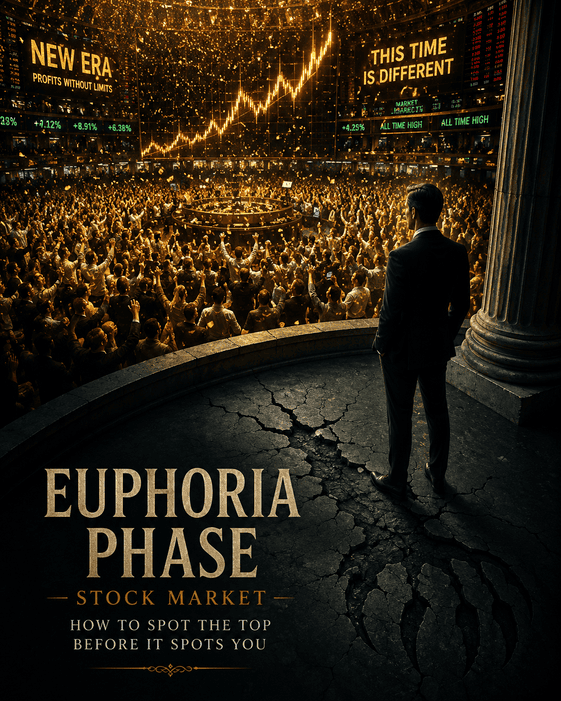
Every bull market appears to end with a surprise, yet history suggests something different. Markets rarely peak because bad news suddenly arrives. They peak because conviction becomes universal. Every dip is treated as an opportunity, every setback dismissed as temporary and every warning viewed as evidence that sceptics simply fail to understand the new era. By the time uncertainty disappears, risk has already migrated beneath the surface. Bull markets do not die of bad news. They die of certainty.
The euphoria phase is therefore not defined by where the S&P 500 trades or by a particular valuation multiple. It is a psychological condition in which confidence overwhelms doubt and investors become convinced that the rules have permanently changed. Optimism itself is never the danger. The danger emerges when optimism hardens into certainty because certainty quietly removes the caution that previously limited risk.
The Primitive Isn’t Euphoria. It’s Conviction.
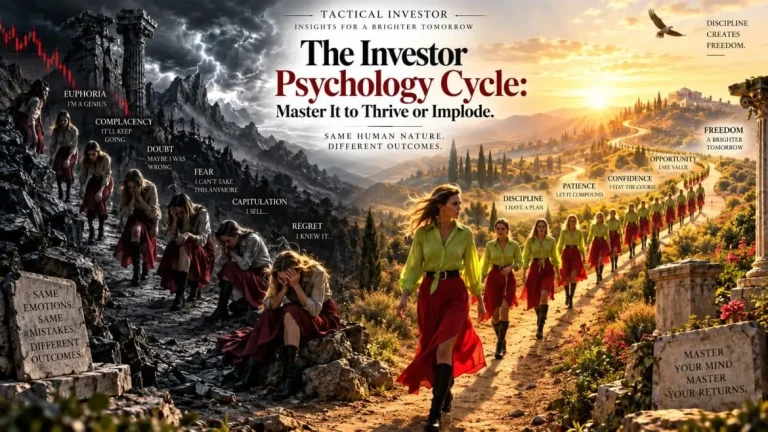
Most investors describe disbelief, hope, optimism, belief and euphoria as separate emotional states. They are better understood as successive stages in the expansion of conviction. Rising prices strengthen confidence, confidence attracts fresh capital and additional capital validates the original thesis, creating a feedback loop that gradually replaces uncertainty with certainty.
| Stage | Dominant Mood | Market Psychology |
|---|---|---|
| Disbelief | Fear and scepticism | “This rally won’t last.” |
| Hope | Cautious optimism | “Perhaps the worst is over.” |
| Optimism | Confidence | “The bull market is real.” |
| Belief | Strong conviction | “Buy every dip.” |
| Euphoria | Absolute certainty | “This time is different.” |
Every stage reinforces the next until confidence evolves into leverage and leverage quietly becomes fragility. Markets often appear strongest immediately before they become most vulnerable because conviction continues expanding long after the underlying margin of safety has disappeared.
Every Bubble Leaves the Same Footprints
Although every speculative boom tells a different story, they all display remarkably similar behaviour. Market conversations spread far beyond professional investors, narrative begins replacing earnings, leverage expands, valuation is dismissed as outdated and scepticism becomes socially expensive. None of these developments matters individually. Together they reveal that conviction has become nearly universal.
History repeats this pattern because bubbles are not driven by technology or asset classes but by human behaviour. Whether the story involves railroads, internet stocks, housing, cryptocurrencies or artificial intelligence, investors eventually stop asking whether prices justify expectations and begin assuming rising prices are proof that expectations must be correct. Consensus gradually replaces analysis, making the crowd itself the primary source of evidence.
Why Smart Investors Still Get Trapped
Euphoria rarely traps ignorant investors. It traps disciplined ones. Social proof encourages intelligent people to assume widespread agreement must reflect superior information even when prices already incorporate overwhelming optimism. Remaining cautious becomes psychologically difficult because every additional gain appears to reward the very behaviour experience tells them to avoid.
Risk therefore expands gradually rather than dramatically. Investors stretch valuation assumptions, accept additional leverage or justify one more speculative position until they discover they have become participants in the same behaviour they originally intended to resist. Professional investors face the same pressures because career risk often rewards following consensus more than challenging it. The market never forces discipline to disappear. It simply persuades investors to lower their standards one compromise at a time.
When Conviction Stops Learning
The final warning sign appears when markets stop updating beliefs and begin defending them. Weak earnings become temporary, tighter monetary policy becomes bullish because future rate cuts are expected and every negative development somehow reinforces the prevailing narrative. Once evidence can no longer change expectations, conviction has detached from reality. The market is no longer processing information objectively; it is protecting a belief system.
History shows that these periods rarely end because investors suddenly become rational. They end because reality eventually introduces information that confidence can no longer explain away. The catalyst itself is often less important than the psychological conditions that existed beforehand. Crashes rarely create fragility. They expose fragility that excessive optimism spent months concealing.
Preparation Beats Prediction
Recognising this phase does not require predicting the exact top. It requires increasing optionality before uncertainty returns. That means trimming oversized winners instead of abandoning the market, reducing leverage rather than increasing it, allowing cash reserves to grow naturally and preparing a watchlist of exceptional businesses before fear creates attractive valuations.
Being cautious during euphoria almost always feels premature because prices frequently continue rising after risk has become obvious. That discomfort is the price of discipline. Investors who compound wealth across multiple cycles understand that preserving flexibility is more valuable than capturing the final stages of an ageing bull market.
The Bottom Line
Every generation believes its bull market is different because every generation discovers a new story capable of justifying extraordinary valuations. The narrative changes, but the psychology does not. Confidence expands into conviction, conviction hardens into certainty and certainty quietly transforms strength into fragility.
Markets do not punish optimism; they punish certainty. Every bull market convinces investors that caution has become obsolete immediately before uncertainty returns. Those who build lasting wealth are rarely the last people dancing. They are the ones who recognise that conviction always reaches its maximum just before reality reasserts itself.
Why Smart Investors Still Get Trapped
Recognising euphoria is far easier than resisting it. Investors often assume bubbles are driven by ignorance, yet history suggests the opposite. Many of the people caught in the final stages fully understand that valuations have become stretched and speculation has become excessive. They participate anyway because remaining disciplined becomes psychologically expensive. While everyone else appears to be making effortless money, caution begins to feel less like wisdom and more like failure.
The real force at work is social proof. Human beings instinctively assume that widespread agreement must contain valuable information because, throughout most of our evolutionary history, following the group improved the odds of survival. Markets reverse that relationship. The larger the consensus becomes, the more likely expectations have already been fully priced in. Yet our brains continue interpreting popularity as confirmation rather than exhaustion. Investors gradually stretch their standards, justify higher valuations, accept greater leverage and convince themselves that one more trade will not matter. Discipline rarely disappears overnight. It erodes through a series of perfectly reasonable compromises.
The same process affects professionals. Fund managers face career risk if they underperform while speculative markets continue climbing. Analysts who remain cautious risk appearing out of touch, while those embracing the prevailing narrative are rewarded with attention, assets and influence. The result is a feedback loop where institutional money and retail enthusiasm reinforce one another, creating the illusion that consensus itself has become evidence.
The final warning sign appears when markets stop processing information objectively. Bad earnings become “temporary.” Rising interest rates become proof that future cuts are inevitable. Geopolitical shocks become buying opportunities. Weak economic data become bullish because central banks might intervene. Once every headline, regardless of its content, is interpreted positively, investors are no longer analysing reality. They are defending a belief. At that point, conviction has become detached from evidence, and markets have entered their most fragile stage.
Preparing While Everyone Else Celebrates
The objective during euphoria is not to predict the exact top. That is a game almost nobody wins consistently. The objective is to recognise that future returns are becoming increasingly dependent on optimism remaining perfect, while downside risk continues to expand quietly beneath the surface. Preparation therefore matters far more than prediction.
That preparation is remarkably simple. Trim oversized winners rather than abandoning the market completely. Gradually increase cash instead of making dramatic all-or-nothing decisions. Eliminate unnecessary leverage because borrowed money magnifies mistakes far more effectively than gains. Tighten risk controls on speculative positions, and spend more time building a shopping list of exceptional companies than searching for the next momentum trade. The best opportunities usually emerge after euphoria has collapsed, not while it is accelerating.
Being cautious during the final phase of a bull market almost always feels premature. Prices may continue rising for weeks or even months after risk has become obvious. That discomfort is the cost of discipline. Investors who survive multiple market cycles accept missing the final few percentage points because they understand that preserving capital gives them the ability to exploit the opportunities that inevitably follow.
The Bottom Line
Every generation believes its bull market is different because every generation discovers a new story capable of justifying higher prices. Sometimes it is railroads, sometimes internet stocks, sometimes housing, cryptocurrencies or artificial intelligence. The narrative changes, but the psychology does not. Confidence expands into conviction, conviction hardens into certainty and certainty quietly transforms strength into fragility.
Markets do not usually collapse because bad news suddenly appears. They collapse because confidence has already reached its limit and there is nobody left to keep pushing prices higher. The catalyst simply exposes a weakness that excessive optimism had spent months hiding.
You do not need to identify the exact top to outperform over the long run. You simply need to recognise when conviction has become detached from evidence and adjust your behaviour before the crowd is forced to do the same. The investors who compound wealth across decades are not those who dance the longest at the loudest party. They are the ones who quietly walk towards the exit while everyone else is still convinced the music will never stop.