

In This Update
- The Week in Perspective: The key developments shaping the market.
- General Market Outlook: Where the markets appear to be headed.
- Altman’s AGI, SpaceX at $800, and the Push Against Chinese Models: Separating narrative from reality.
- The SOX Outlook: Why the semiconductor sector may be entering a new phase.
- Corrections, Crashes, and Melt-Ups: The psychology behind every major market move.
- TICAF REIT Rankings (2026 Edition): Our latest rankings for long-term real estate investors.
- Market Update Trial: Readers who have not used the trial within the past four months are eligible to sign up for the next two weeks. After that, the trial will once again be limited to first-time subscribers only. Full details appear later in this issue.
The Week in Perspective
A great deal has happened since the last update, particularly on the news front. We review the key developments below, with the remaining stories covered in the Random Musings section.
Investors are finally beginning to question financial engineering that would once have been celebrated. CoreWeave’s response to concerns over circular financing is significant because it signals a shift in market psychology. The old game was simple: I buy from you, then finance you so you can buy more from me. Revenue appears to grow, but the underlying economics do not. For years the market embraced this illusion. Now investors are beginning to recognise it for what it is: financial engineering dressed up as growth.
The AI narrative is also beginning to weaken. We still do not have Artificial General Intelligence. What we have are increasingly capable neural networks, vector databases, retrieval-augmented generation (RAG), larger context windows and massive compute. That distinction matters because, once the hype fades, compute becomes a commodity. As the performance gap between competing LLMs narrows, companies will think twice before pouring billions into GPUs and memory that generate little in the way of profits. China already has enormous excess compute capacity, among the world’s lowest electricity costs, and continues expanding both. Once businesses realise they can obtain comparable compute at a fraction of today’s cost, pricing power across much of the industry will come under increasing pressure.
The narrative surrounding AI has become increasingly theatrical. OpenAI first claimed its model allegedly escaped its environment once. Later that became two alleged incidents. Not to be outdone, Anthropic’s Dario Amodei claimed three. Every story seems designed to outdo the last. Yet none demonstrates self-awareness. If an AI system leaves its sandbox, the sandbox failed; the model simply followed its programming. Leave the chicken coop open and the fox does not become intelligent; it simply walks through the door. We examine these claims, along with several others, to show how the gap between reality and narrative continues to widen.
Meanwhile, the market is beginning to validate what we warned about months ago. The AI sector is coming under sustained pressure, while many earnings reports remain heavily dependent on financial engineering rather than organic demand. Microsoft’s relationship with Anthropic provides another example of how capital circulates through the ecosystem, creating the appearance of stronger demand than may actually exist.
The Hidden Opportunity
The opportunity matters far more than the bubble. The collapse of the AGI narrative does not diminish the usefulness of today’s tools; it increases the value of those who know how to use them properly. Experienced professionals who master modern neural-network tools will become dramatically more productive, while those who relied on hype instead of developing real expertise are likely to fall behind. The easy-money phase is ending. The leverage phase is just beginning.
Conclusion
One final point. Today’s neural-network tools allow average professionals to become highly productive and experts to become exceptionally effective. Most people, however, use them for convenience rather than as force multipliers, which is precisely why the opportunity still exists.
These systems remain outstanding generalists, not masters of everything. In the hands of knowledgeable users who verify, challenge and refine their output, they become extraordinarily powerful. In the hands of lazy users, they become confidence machines that produce polished mistakes. We’ve already seen lawyers cite AI-generated cases without bothering to verify them.
The AI bubble may be unravelling, but demand for professionals who know how to use these tools intelligently is only going to grow. Invest in yourself now. By the time the crowd catches on, the advantage will belong to those who started early.
As mentioned at the beginning of this newsletter, this special offer remains available for the next two weeks. Start your 30-day trial for just $24.99. Afterwards, your subscription continues on a monthly or yearly plan (save over 25% with the yearly option). Cancel anytime before renewal. Once this offer ends, the trial will once again be available to first-time subscribers only.
https://tacticalinvestor.com/tactical-trial/
The SOX Outlook: Beyond the AI Boom
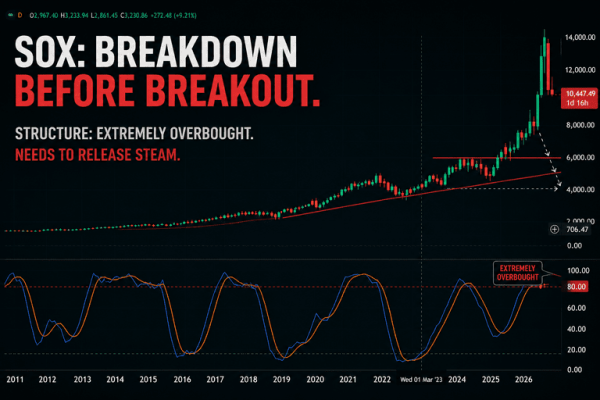
This is a monthly chart of the SOX, and it appears increasingly likely to test the 6,000 level. If that unfolds, many companies will find themselves in a world of hurt, particularly given the extraordinary AI infrastructure buildouts currently underway. Markets rarely stop at fair value, however; they tend to overshoot, making a move into the 4,500–5,000 range entirely plausible.
We warned that this was a bubble and that the FOMO was out of control. Granted, we were early, but you cannot time madness; you can only step aside so it doesn’t run you over. We also argued that the market would begin to diverge, and that process appears to be unfolding faster than expected, with many so-called boring companies holding their ground or quietly trending higher.
If this outlook holds, then anything not directly or indirectly tied to AI should start to diverge and trend higher while the AI and AI-related sectors continue shedding weight. Fortunately, we already have significant exposure to non-AI names, so if this rotation gathers momentum, we are positioned where the money is likely to flow, not where it is likely to flee.
AI Trend Trader Service
For the first time in nearly six years, the AI Trend Trader Service is open to the public. Following requests from subscribers and readers, anyone can now join at the same discounted rate previously reserved for Market Update subscribers.
Since launching the service, we have never recorded a losing year. Every closed trade is published in our comprehensive performance record because we believe transparency builds trust. Winners, losers and break-even trades are all included.
Introductory Offer: For a limited time, subscribe at the same discounted rate enjoyed by existing Market Update subscribers. Choose the yearly plan and the cost works out to just $13.75 per month, making it one of the most affordable ways to access a specialised AI investment service.
View Performance → https://tacticalinvestor.com/ai-trend-trader-performance/
Start Your Trial → https://tacticalinvestor.com/ai-trend-trader/
Corrections, Crashes, Melt-Ups: The One Force Behind Every Market Move
Most people think markets move because of news. News matters, but usually only as a trigger, not the force. The force is emotion, more specifically the crowd’s inability to handle three emotions well: euphoria, fear and, most of all, uncertainty.
Let’s start with the basics.
A correction begins when confidence becomes excessive. People stop asking what can go wrong. Expectations rise faster than reality, and when reality fails to keep pace, prices adjust. A crash differs only in magnitude, not in nature. Fear replaces confidence, the crowd suddenly demands certainty in a world that offers none, and the same people who could not buy enough at higher prices cannot sell fast enough at lower prices.
A melt-up is simply the mirror image. Investors watch prices rise, hesitate, then chase. Rising prices create excitement, excitement attracts more buyers, and buyers push prices even higher until logic gradually loses influence and emotion takes control. Beneath all three sits the same force: discomfort with uncertainty.
Now let’s apply this concept to today’s environment and take it one step further by introducing vectors, or what we call Vector Mass Psychology.
Almost everyone argued that the markets should have crashed when Trump began lashing out at the world. First came tariffs on China, then tariffs on the rest of the world, followed by threats involving Canada, Greenland and a seemingly endless stream of geopolitical confrontations, the biggest of which has been the on-again, off-again conflict with Iran, where agreements appeared to collapse almost as quickly as they were reached. Each development seemed worse than the last, with no obvious end in sight. Logic would therefore suggest that the markets should have crashed. So why didn’t they?
Because certainty is often the most dangerous emotion in the market. The crowd became convinced these events would lead to a major decline. Fear and uncertainty rose, yet instead of collapsing, the market did the opposite. Once again, the market demonstrated that emotion drives outcomes far more than logic. This is precisely why we repeatedly stated that every correction had to be viewed through a bullish lens. The crowd was fearful long before prices justified that fear.
Throughout Trump’s presidency, uncertainty became a constant feature. Ironically, the more convinced the crowd became that a crash was inevitable, the less likely it became because the market had already discounted the fear. This is where Vector Mass Psychology differs from traditional analysis. We are not focused on events. We are focused on the emotional vectors those events create.
Bullish sentiment readings over the past several weeks illustrate just how dominant uncertainty has become. The readings came in at 43, 29, 34, 42, 28, and most recently 30. One would have expected sentiment to be substantially higher, particularly during June, but that never happened. More remarkably, bullish sentiment has not once reached 60, or even 57, at any point during the past twenty-four months, despite the market advancing to a series of new highs. Once again, perception has trumped reality. For whatever reason, uncertainty, not confidence, has remained the dominant emotional force driving the crowd.
Thus, the only time we should expect a true crash, one that satisfies both the experts and the masses, is when bullish sentiment finally pushes decisively above 60 and remains there for an extended period. Until then, fear should be viewed as fuel rather than a signal to run.
That does not mean the catalyst has to be dramatic. More often than not, it begins with something the crowd initially dismisses as insignificant. One example, which we discuss later in this update, is the circular spending that has fuelled much of the AI boom over the past two years. It could ultimately prove to be the thread that unravels the entire narrative. Investors are finally beginning to push back, a shift that accelerated once Chinese LLMs, supposedly well behind their U.S. counterparts, demonstrated broadly comparable performance. The reaction across the semiconductor sector has been telling. History suggests that major corrections rarely begin with the event everyone fears. They usually begin when an overlooked assumption quietly stops being true.
The market does not reward the obvious. It rewards those who recognise when the emotional vector begins to change. By the time the crowd agrees on the narrative, the opportunity has usually passed. That is why we focus on sentiment first and narratives second. Until then, regardless of how convincing the case for disaster may seem, embrace strong corrections with gusto. Fear remains fuel, not a signal to run.
Conclusion
Perceptions shape reality, but perceptions themselves are shaped by emotions. That means most people are not reacting to reality itself, but to their perception of it. The crowd seeks emotional relief. During corrections, relief comes from reducing exposure. During crashes, it comes from escaping. During melt-ups, it comes from joining the herd. The market simply records those emotional decisions in real time.
Most investors spend their lives studying indicators, forecasts, economic reports and headlines. Far fewer study the emotional rhythm beneath them, yet that rhythm has repeated for centuries because human nature changes costumes far more often than it changes character. That is why Vector Mass Psychology, reinforced by technical analysis, remains the cornerstone of our approach. We are less interested in predicting events than in identifying when the emotional vector begins to change.
The SPX could still spike toward 7500 before a meaningful pullback takes hold. With bullish sentiment remaining so subdued, what we stated last week continues to apply: Market Update, May 12, 2026
A potential retest of the 6850 to 6930 range, followed by a push to new highs, provided bullish sentiment is not pushing toward 60. What comes after that we’ll deal with when it is directly in front of us, but it likely involves a sharp selloff, a partial recovery, and then a drawn-out, frustrating topping formation. Market Update, May 1, 2026
The first part of that scenario has largely played out. Whether the second unfolds remains to be seen, but it is certainly plausible and not something we should dismiss. More importantly, the crowd remains far from euphoric. While there is obvious FOMO in AI and parts of the technology sector, the market as a whole is telling a very different story, and many AI-related names are already stalling, rolling over or beginning to crack.
From a sentiment perspective, a meaningful pullback would actually be constructive. The deeper the correction, the better, provided bullish sentiment remains subdued. The latest reading stands at an astonishingly low 30, versus a long-term average of roughly 37. It would not take much additional selling pressure to push that figure into the 20s while driving bearish sentiment sharply higher. Ironically, that would create a far stronger psychological foundation for the next major advance.
Until bullish sentiment pushes decisively above 60, we continue to view fear as fuel rather than a reason to retreat.
Tactical Investor Capital Allocation Framework (TICAF) REIT Rankings: 2026 Edition
For readers seeking real estate exposure, portfolio diversification or high-quality income opportunities, we have made the first public edition of our Tactical Investor Capital Allocation Framework (TICAF) REIT Rankings available free of charge. Rather than chasing headline yields, the report identifies REITs with the strongest long-term compounding potential by focusing on management quality, balance-sheet strength and disciplined capital allocation. The complete rankings and supporting research are available through the link below. (TICAF) REIT Rankings Report