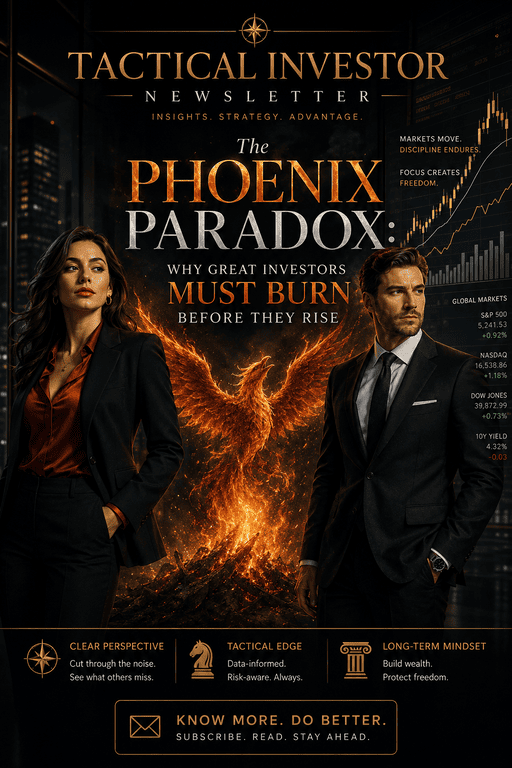
The Phoenix Paradox: You Cannot Rebuild Until Something Burns
Aug 28, 2026
There is a point in every investor’s life when knowledge stops being the solution and quietly becomes part of the problem. You can accumulate charts, study cycles, read biographies, understand behavioural finance and memorise the mistakes of investors who came before you, yet still repeat the same behaviour because the thing that needs to change is not your information. It is the psychological structure using that information, and that distinction is where most investors never look.
That is the Phoenix Paradox. The investor thinks the market needs to be conquered, but eventually discovers that the real battle is with the version of themselves that the market has exposed. Addiction, overconfidence, fear, compulsive trading, the need to be right and the need for recognition are not separate problems; they are different vectors emerging from the same underlying force, the desire to make the market confirm something about you.
This is why some investors can survive a crash financially while emerging psychologically unchanged, while others lose money and somehow become better investors afterwards. The difference is not necessarily the size of the loss. The difference is what the loss destroys.
The Market Does Not Break You, It Reveals You
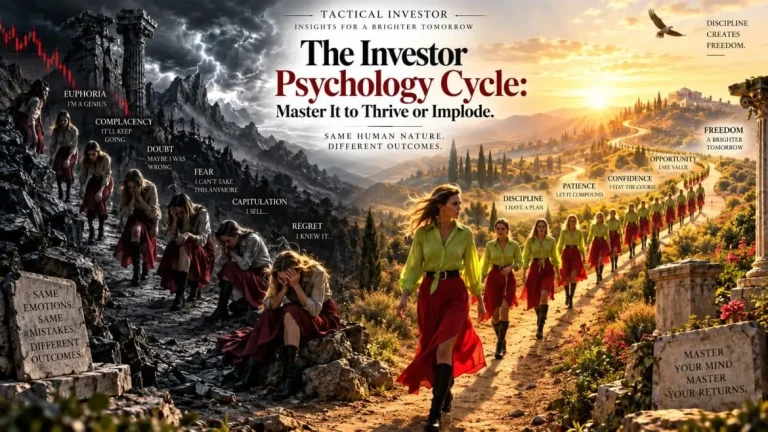
A market collapse is usually described as destruction, but destruction is only half the story. When prices fall violently, the market removes the comfortable distance between belief and consequence, forcing investors to discover whether their conviction was based on analysis or simply on the emotional comfort of being right. The same event can therefore destroy one investor and transform another, because the market does not determine the lesson; the observer determines what the event means.
The dot-com collapse destroyed enormous amounts of speculative capital, but it also produced a generation of investors who became far more sensitive to cash flow, valuation and business quality. The crypto collapses performed a similar function, separating people fascinated by price movement from those interested in building systems that could survive after the excitement disappeared. The event was the same, but the psychological vector changed depending on what the investor was willing to learn.
This is why reinvention is rarely comfortable. The old identity has to become inconvenient before the new one becomes possible, because people rarely abandon a behaviour simply because someone explains that it is irrational. They abandon it when continuing to behave that way becomes more painful than changing.
Livermore and Soros: Two Relationships With the Same Beast
Jesse Livermore provides one of the most fascinating examples because he possessed extraordinary market intelligence while repeatedly demonstrating how intelligence can become almost useless when it is subordinated to psychology. The legendary “Boy Plunger” understood momentum, speculation and crowd behaviour at a level few could match, yet his enormous successes were repeatedly followed by enormous failures, and his eventual bankruptcy revealed the difference between understanding the market and controlling one’s relationship with it.
George Soros offers a useful contrast, not because he was immune to psychological pressure, but because his framework placed far greater emphasis on uncertainty, reflexivity and the possibility that his own assumptions could be wrong. His famous trade against the British pound was not simply a bet that a currency would fall; it was an attempt to understand the interaction between policy, market expectations and the constraints facing the system, then position around the resulting imbalance.
The difference is subtle but enormous. Livermore often appeared to be wrestling with the market, while Soros approached the market as an adaptive system whose behaviour could change as participants changed their beliefs. One relationship seeks mastery through prediction, while the other seeks advantage through adaptation, and that distinction becomes increasingly important as markets become faster and more reflexive. The market is neutral. Your interpretation is not.
The Burning of the Old Investor
Reinvention therefore begins when the investor stops asking, “How do I make this strategy work?” and starts asking, “What is this strategy revealing about me?” The second question is far more dangerous because it removes the protection of technique, and once technique can no longer absorb responsibility, the investor is forced to examine the motives sitting underneath the trade.
A failed indicator can be replaced, a bad stock can be sold and a poor analyst can be ignored, but discovering that you were using analysis to protect your ego is far more uncomfortable because there is nowhere else to hide. The investor who believes they are brilliant will defend their trades, the investor who believes they are disciplined will defend their process, and the investor who believes they are a contrarian can even become contrarian simply because being different has become part of their identity.
The market eventually finds the weakness because every strong conviction creates a potential blind spot. The question is not whether you have biases, because you do, but whether you can see the vector created by those biases before the market forces you to see it.
From Prediction to Adaptation
The strongest investors eventually discover that they do not need to predict everything; they need to recognise changes in the vector. A market can rise while becoming increasingly fragile, a stock can fall while becoming increasingly attractive, fear can increase while underlying risk decreases, and optimism can increase while the underlying opportunity deteriorates. The surface tells you what is happening, while the vector tells you where the pressure is travelling.
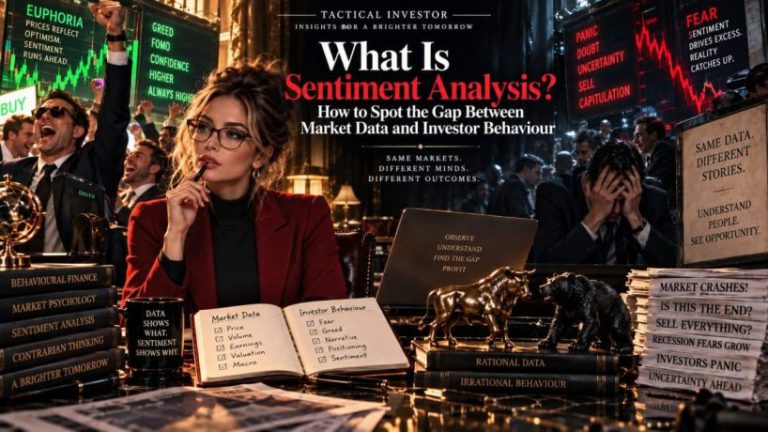
This is where mass psychology becomes more useful than conventional forecasting. When everyone is euphoric, the important question is not necessarily whether the story is true, but how much of that story has already been absorbed into expectations; when everyone is terrified, the important question is not whether the headlines are frightening, but whether the emotional response has become disproportionate to the underlying reality.
The investor who understands this does not automatically buy fear or sell euphoria. Instead, they watch for the point at which the psychology begins changing, because extremes matter most when the force sustaining them starts weakening. Fear becomes interesting when selling pressure begins exhausting itself, while euphoria becomes dangerous when additional buyers become increasingly difficult to find. That is why the crowd is not your enemy. It is your dataset.
The Sovereign Investor
The sovereign investor represents the next stage because the market no longer functions as a source of identity. A winning trade does not prove intelligence, a losing trade does not prove stupidity, and another investor’s success does not create an obligation to participate. Once that separation occurs, the market becomes easier to read because the observer is no longer demanding that reality produce a particular emotional outcome.
That sounds simple until money is involved. Most people believe they are trying to make money, but beneath that objective sit other motives such as recognition, security, status, validation, excitement and the desire to escape the feeling that everyone else is moving faster, and these hidden motives distort perception because they alter the vector of attention.
The sovereign investor removes much of that interference. They can watch NVIDIA explode without needing to own it, watch a favourite stock collapse without needing to defend it and watch the crowd become euphoric without becoming euphoric themselves, because their objective is not to participate in the emotional experience but to understand the forces producing it.
The Visible Winner Is Not Always the Real Opportunity
This becomes particularly interesting when examining major technological transitions. In 2023, NVIDIA was the obvious AI winner, and the market was right to recognise its extraordinary position, but the more interesting question was what had to exist behind NVIDIA for the AI revolution to operate at scale. Taiwan Semiconductor, advanced packaging, semiconductor equipment, memory, networking and power infrastructure all represented different vectors within the same technological transition.
The crowd tends to see the visible winner because visibility itself creates attention, and attention creates additional confirmation. The more people discuss an obvious winner, the more obvious the winner becomes, which can create a feedback loop where the narrative strengthens the price and the price strengthens the narrative. That does not mean the obvious winner is wrong; it means the obvious winner is only one component of the geometry.
The sovereign investor studies the system producing the winner. They ask what must happen next, where bottlenecks exist, which supporting industries are being ignored and whether the current valuation already reflects the future everyone is discussing.
The Strange Advantage of Not Needing to Win
The deepest psychological advantage may therefore be the removal of urgency. Once you no longer need every trade to work, you can wait for conditions to become asymmetric, and waiting changes what you are capable of seeing because urgency compresses perception while patience expands it.
Urgency makes every opportunity appear important because the mind has already decided that action is necessary. Patience allows contradictory information to coexist long enough for the structure beneath it to become visible, which is why the best investors can appear inactive for long periods and then become extremely aggressive during very specific windows.
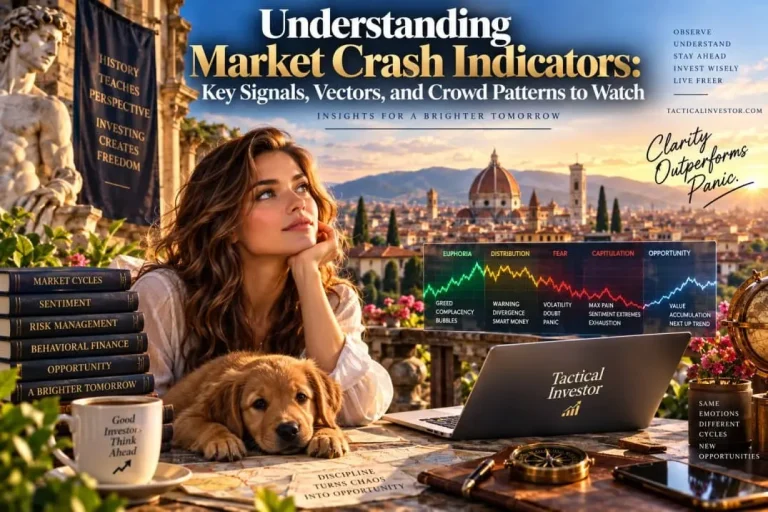
They are not doing nothing. They are waiting for the vector. A crash, panic, forced liquidation or sudden sentiment collapse can create precisely the environment where this philosophy becomes powerful. COVID was not an opportunity simply because markets fell; it was an opportunity because extreme fear created a temporary separation between perception and reality across large parts of the market, and the investor capable of distinguishing emotional price from structural value could exploit that distortion. You do not buy the crash. You buy the distortion created by the crash.
Feed the Addiction, Starve Your Own
The final evolution is therefore not becoming smarter than everyone else. It is becoming less psychologically dependent on the market than everyone else, because once you stop needing the market to validate you, the crowd becomes easier to observe and far harder to manipulate you.
Let the crowd chase excitement, let them argue over which narrative will win and let them celebrate every percentage point or panic over every correction. Their emotional participation creates the volatility, liquidity and mispricing from which the disciplined investor can eventually benefit, and there is no requirement to participate in the emotional process simply because you are participating in the market.
The sovereign investor does not need to manipulate the crowd. They simply need to understand its behaviour well enough to avoid being manipulated by it and that is the paradox.
The market becomes more useful when you stop asking it to make you feel successful. Euphoria is not an instruction, fear is not an instruction and uncertainty is not a problem that must immediately be solved; they are signals describing the state of the system, and once you treat them as vectors rather than commands, your relationship with the market changes.
The Phoenix does not rise because the fire was pleasant. It rises because the fire destroyed what could no longer survive, and perhaps that is the deeper lesson of investing: the greatest reinvention does not occur when you discover a better strategy, but when you finally destroy the psychological need that made the old strategy necessary.