
The Trend Indicator: Finding Structure in Market Noise
Dec 18, 2025
Introduction: When Psychology Leads, and Price Follows
Since the 2008 housing bubble, and again after 2020, markets have lived under permanent intervention. Quantitative easing, suppressed rates, and liquidity engineering reshaped price discovery. The result is not chaos, but distortion. Data still matters, yet it arrives filtered through policy, incentives, and crowd reaction.
That is why isolated tools fail. Fundamentals lag. Pure technicals react. What leads is behaviour. We have always anchored our work in mass psychology, but the modern market demands integration. The Trend Indicator emerged from that necessity, combining crowd behaviour with technical structure to identify direction before consensus settles.
What the Trend Indicator Actually Does
The Trend Indicator does not predict headlines or news events. It identifies directional pressure early, when psychology tilts but price has not fully responded. That single shift changes everything.
Once direction is established, monitoring becomes simpler. You are no longer glued to screens, reacting to every dip or rally. Time becomes an ally rather than an enemy. Decisions move from emotional reflex to structured execution.
Most importantly, the indicator neutralises cognitive bias. Fear and greed lose authority when direction is already defined. You stop improvising under stress and start acting with context.
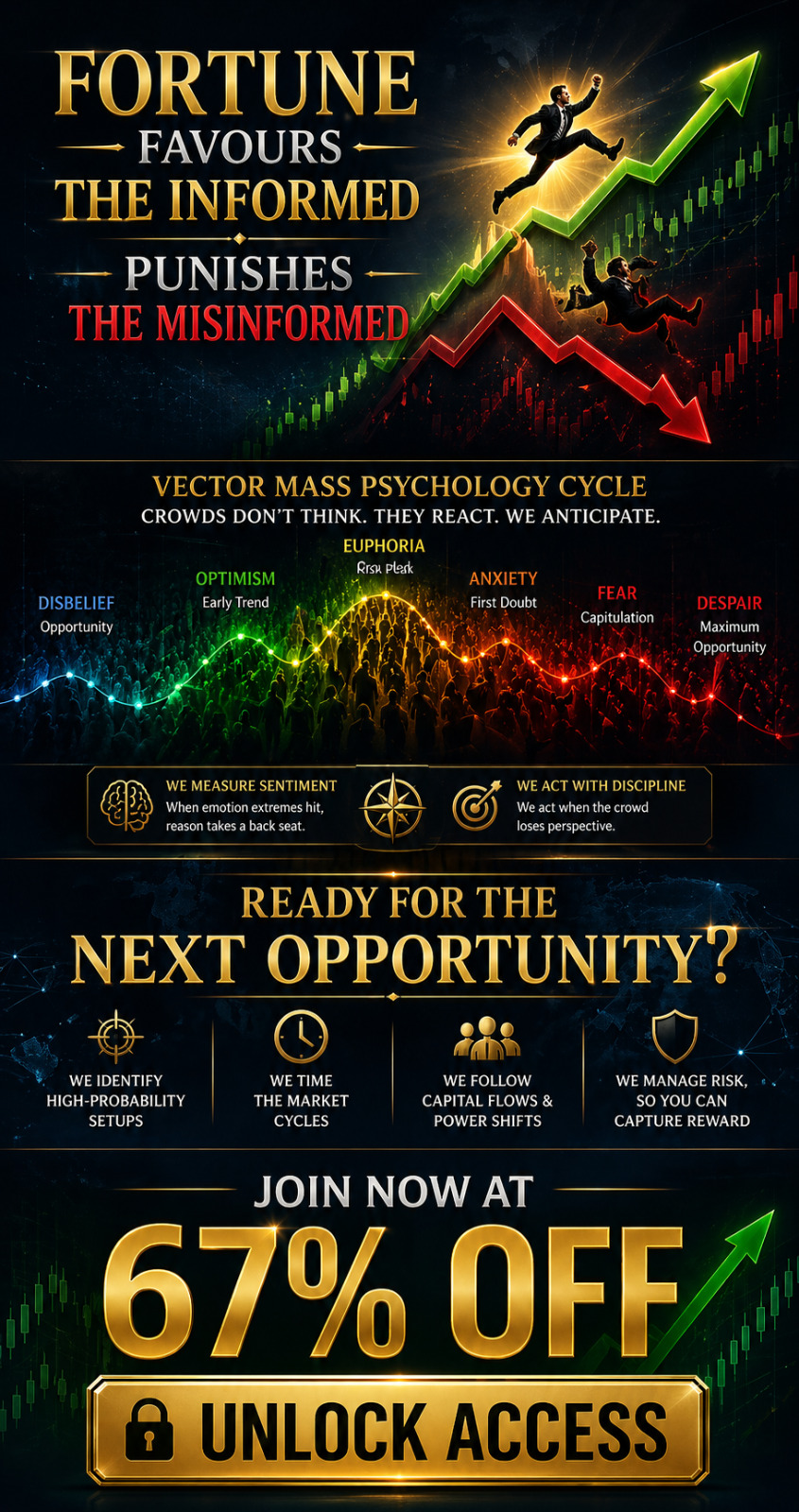
Herd Behaviour and Trend Formation
Trends form when participation expands, not when opinions improve. Empirically, sustained advances require broad capital commitment: rising volume on upswings, improving advance–decline lines, and persistent inflows. Late-stage trends show a different signature. Price continues higher, but breadth narrows, volume diverges, and positioning becomes crowded. Optimism no longer attracts new buyers; it recycles the same ones.
Herd behaviour amplifies this process. As prices rise, perceived risk falls, even though objective risk increases. Valuations stretch, volatility compresses, and leverage builds. On the downside, fear works faster. Liquidity evaporates, correlations rise toward one, and selling cascades. These are not anecdotes; they are repeatable patterns observed across cycles from 1987 to 2000 to 2008 to 2020.
The Trend Indicator tracks these dynamics through structure rather than narrative. It monitors participation, persistence, and pressure. Strengthening trends show alignment between price, breadth, and volatility. Fracturing trends show directional continuity with declining internal support. That distinction defines whether a trend can be ridden or should be reduced.
This is vector mass psychology. Direction may remain positive, but magnitude decays and coherence weakens. Price advances become fragile. Risk accumulates silently before it expresses violently.
Focus on Market Action, Not Noise
Markets do not reward precision fantasy. Chasing exact tops and bottoms increases error rates and reduces discipline. Data shows that most long-term returns come from staying aligned with dominant trends, not from frequent reversal attempts.
In confirmed uptrends, pullbacks tend to be mean-reverting rather than trend-ending. In confirmed downtrends, rallies are statistically more likely to fail. The indicator frames these moves correctly, preventing emotional misclassification.
By focusing on direction instead of prediction, you replace guesswork with positioning. You stop reacting to headlines and start responding to structure. That shift is where consistency begins.

On Tops, Bottoms, and False Precision
We do not claim to identify exact turning points. Markets do not reward that arrogance. What the Trend Indicator does is recognise when a market is transitioning from accumulation to distribution, or vice versa.
That distinction is critical. Being early is survivable. Being emotionally wrong is not. Once the trend context is clear, stock selection becomes straightforward. You align exposure with direction and let time do the work.
This alone saves enormous mental energy and eliminates dependence on media narratives that exist to provoke reaction, not clarity.
Stress Reduction Is Not a Side Effect, It Is the Edge
Stress degrades judgment measurably. Under volatility, investors shorten time horizons, increase turnover, and accept worse prices. Studies on behavioural finance consistently show that drawdowns trigger loss aversion, forcing exits near local lows and knowing the trend context in advance changes that response. Volatility becomes expected movement within structure, not an existential threat.
When the dominant trend is defined, drawdowns carry information. You can distinguish corrective pressure from regime change. That distinction prevents panic selling, reduces overtrading, and improves execution quality. Fewer emotional decisions translate directly into lower transaction costs and better compound outcomes.
The Trend Indicator has been tested across more than 50 years of market history, spanning inflationary shocks, rate cycles, bubbles, crashes, and policy distortions. It does not aim for precision tops or bottoms. It consistently identifies meaningful transitions in direction early enough to act. It has also functioned in live markets for over five years, across multiple volatility regimes, with stable behaviour and repeatable results.
Why Knowing Direction Early Matters
Early direction alters behaviour before it alters price. Investors anchored to trend context show greater patience, reduced turnover, and higher adherence to plans. Fear loses authority when exposure is aligned with direction rather than opinion.
Time begins working for you. Instead of reacting to headlines or intraday swings, you prepare. You build watchlists. You size positions deliberately. You wait for pullbacks that fit structure rather than chasing momentum driven by emotion.
This shift matters because most losses do not come from being wrong. They come from acting poorly while being uncertain. Direction reduces uncertainty. Reduced uncertainty improves discipline. Discipline compounds.
Conclusion: Discipline Over Drama
The Trend Indicator is not designed to entertain. It is intended to clarify. By integrating mass psychology with technical structure, it restores orientation in markets shaped by intervention, narrative, and crowd pressure.
You trade less because you need to. You think more because you can. Reaction gives way to preparation. Fear fades because context replaces impulse.
Markets will always fluctuate. Crowds will always overshoot. The advantage belongs to those who see structure where others see chaos, and who act with discipline while others search for certainty in noise.

Other articles of interest












tor