Tariff Wars? Fear, Leverage, and the Price of Control
Updated Mar 20, 2026
Tariff wars are sold as policy. In reality, they are economic pressure campaigns. One country taxes imports to protect a domestic industry, punish a rival, or force concessions. The other side retaliates. Then the cycle escalates, and what began as a trade dispute turns into a test of endurance, leverage, and political will.
On paper, tariffs can offer short-term relief. In practice, they raise costs, distort supply chains, inflame retaliation, and drag entire economies into slower growth. The public gets a simple story about protection and patriotism. The market gets a more brutal truth: uncertainty has entered the system, and uncertainty never stays contained.
Here’s a clearer breakdown:
1. What are Tariffs?
Tariffs are taxes imposed on imported goods. They raise the cost of foreign products and make them less competitive against domestic alternatives.
Governments use tariffs for several reasons: to protect local industries, respond to national security concerns, or gain leverage in trade negotiations. In theory, that sounds strategic. In practice, the cost usually gets passed along—to businesses first, then to consumers.
2. What Happens in a Tariff War?
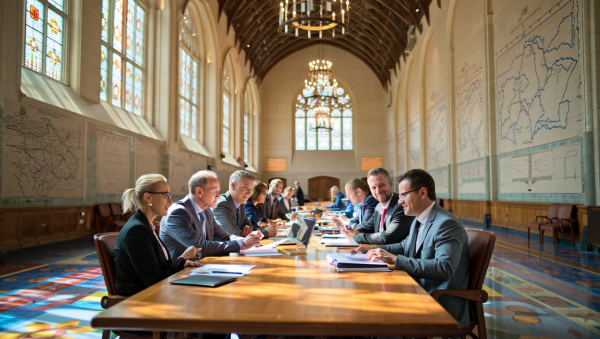
A tariff war usually starts when one country imposes tariffs on imports from another, often to pressure that country to change its trade practices or industrial policies.
The targeted country retaliates with tariffs of its own. Then both sides widen the list of affected goods, deepen the penalties, and harden their political posture. At that point, it stops being a one-off measure and becomes a cycle of escalation.
3. Examples of Tariff Wars:
- The U.S.-China trade war (2018–present): The U.S. imposed tariffs on Chinese goods, and China retaliated with tariffs on U.S. products.
- The Smoot-Hawley Tariff Act (1930): The U.S. imposed high tariffs, prompting retaliation from other countries and worsening the global trade collapse during the Great Depression.
4. Impacts of Tariff Wars:
- Economic Disruptions: Tariffs disrupt trade flows fast. Exporters lose foreign customers, importers face higher costs, and consumers pay more at home. Business confidence weakens as uncertainty rises, freezing hiring and long-term investment. Retailers, manufacturers, and logistics firms feel the squeeze first, but the damage doesn’t stay there.
- Supply Chain Disruptions: The ripple effects are brutal. Companies dependent on global components—semiconductors, steel, rare earths—face rising costs and delivery delays. Tariff-driven rerouting means inefficiency, inventory shocks, and thinner margins, if not outright losses.
- Escalating Tensions: Tariff wars do not happen in a vacuum. They spill into diplomacy, turning trade partners into strategic rivals. Trust erodes, bilateral deals stall, and even alliances outside trade—defense, technology, climate—take collateral damage.
- Potential for Recessions: History shows that prolonged trade conflict can trigger synchronized slowdowns. When consumer spending weakens and business investment stalls, job losses and tighter credit usually follow.
5. Short-term vs. Long-term Impacts:
- Short-Term Gains: In the early rounds, tariffs can look like a win. Governments collect more revenue. Domestic producers get a temporary edge. Politicians sell national self-reliance. It plays well in headlines, and for a moment the numbers can look like proof of strength.
- Long-Term Fallout: Then retaliation hits, supply chains shift, and the protection starts to decay while the pain lingers. What began as a tactical move becomes a strategic drag. Domestic industries grow complacent without real competition. Inflation creeps in. Innovation slows. Capital drifts toward more stable markets. Consumers end up paying more for less. The final result is usually the same: a mutually assured drag on growth that spreads far beyond the trade lane where it began.
Tariff Wars, Volatility, and the Ugly Truth No One Wants to Face
This isn’t just policy gone rogue—it’s coordinated chaos dressed up as negotiation. The market knew tariffs would sting, but it didn’t expect a full-on global barrage. No region is spared. No asset class is immune. And just when markets start adapting, a sudden “reprieve” gets dangled—then yanked away like a carrot from a starving mule. Case in point: the ever-slippery deal with China. One day it’s peace. The next it’s tariffs on soybeans, tech, or whatever else is politically useful.
There’s no value in playing moral referee here. Right and wrong are illusions—tools used to soothe one side while justifying the destruction of the other. What’s righteous in one hemisphere is heresy in another. This is not about ethics. It’s about currency—fiat, flowing, ever-expanding. The more they print, the more madness unfolds. Wars become business models. Trade becomes warfare. Sanity gets exchanged for speculation.
Zoom out. Strip away the emotion. What’s left? A brutal, clear picture: nothing is off the table when the objective is extraction. The pursuit of profit has gone primal. Governments, corporations, and citizens alike are pushing past old limits. And it’s not just the U.S.—the whole world is clawing, competing, and collapsing moral boundaries for the sake of gain.
So what now? Volatility is the new baseline. Waves will rise and crash harder—some gentle, others tidal. Right now, we’re riding one of the nastier ones. Why? Because uncertainty has been weaponised. Tariffs aren’t just about trade anymore—they’re instruments of destabilisation. And where there’s chaos, there’s opportunity—but only if you stay tactical.
We move forward one week at a time. This isn’t the season for blind conviction. It’s a scalpel market—precise, deliberate moves. Position trading becomes the weapon of choice. Longer-dated options? They’re not about predictions—they’re insurance against theta decay. Time is the enemy unless you know how to disarm it.
You’ve seen the shift—we’ve been more active on the stock side. That’s intentional. Options are different animals—time premium is both a leash and a sword. But when managed right, even that leash becomes a weapon.
Technically speaking? SPX defied gravity. It should have pulled back, but it didn’t. So now we wait. A weekly close below 5700 opens the gate. 5600? Even better. Clean signal. No ambiguity. But if it fakes us out and breaks to a new high, watch for exhaustion. 6250 isn’t likely, but if it comes, it’ll be the mother of all blow-off tops—and the reversal after that won’t be gentle.
So stay fluid. Stay disciplined. Let others chase ghosts and headlines. We stay with the tape, we read the energy, and we strike where the illusion breaks down.