
May 18, 2026
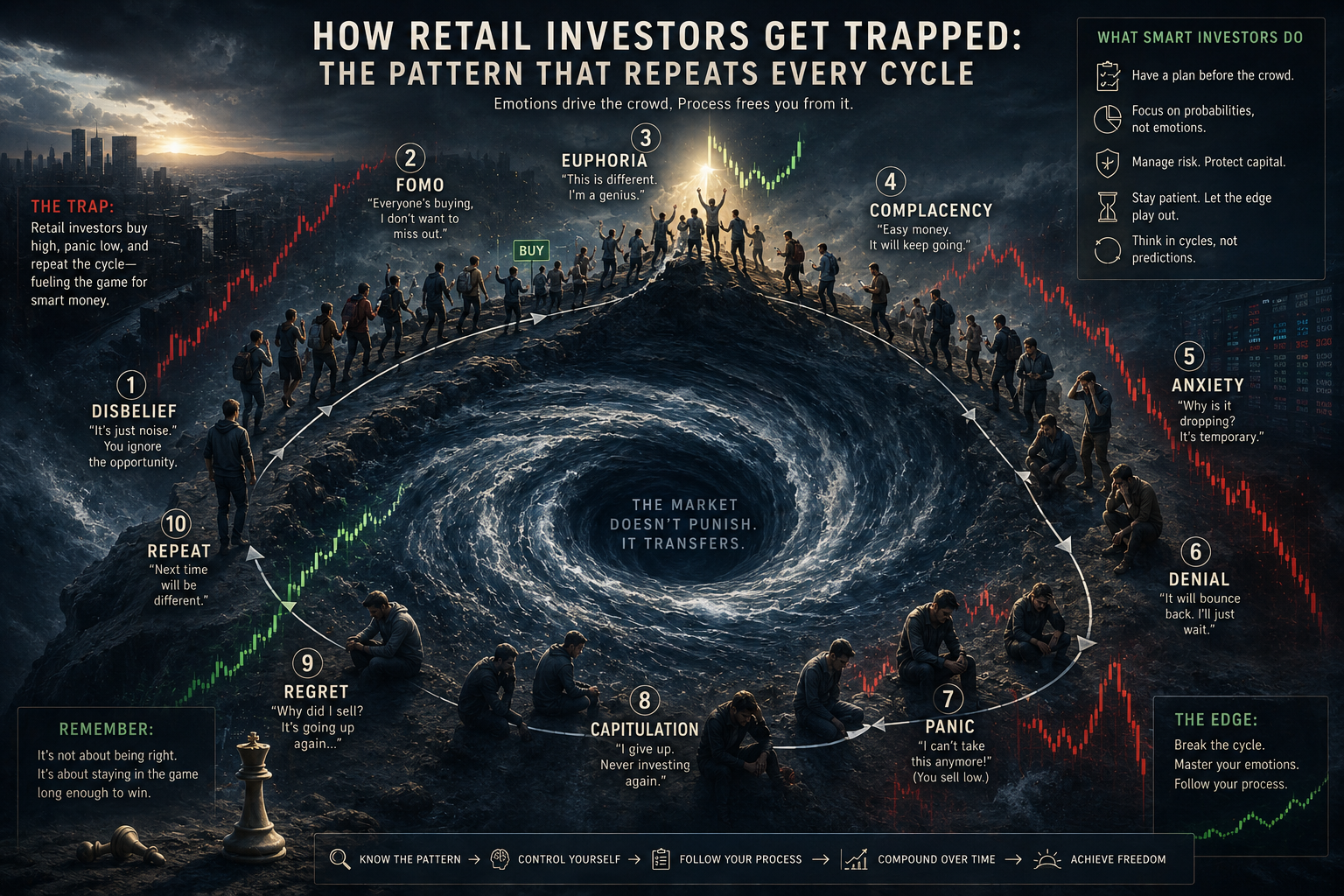
There’s an uncomfortable joke that gets passed around trading desks: “Retail is always early to the party and late to the exit.” It’s not a kind joke. It’s not entirely fair, either. But it persists for a reason — because the pattern of how retail investors get trapped has been so consistent across so many cycles that it’s stopped being random. It’s structural. It’s psychological. And it’s the same handful of mechanisms repeating themselves with new tickers, new technologies, and new euphoric narratives.
This Monday morning, May 18, 2026, with another wave of retail enthusiasm crashing into another round of institutional repositioning, it’s worth sitting down and dissecting how the trap actually works. Not as some sneering critique of small investors — most of us have been there at least once — but as a practical map of the mechanism, so you can recognize it the next time you find yourself standing inside it. Because how retail investors get trapped isn’t a mystery. It’s a recipe. And like any recipe, once you know the ingredients, you can decide whether you want to eat the dish.
The Trap Doesn’t Start With a Loss. It Starts With a Win.
Here’s the part that most articles get wrong. The retail trap doesn’t begin with a bad trade. It begins with a good one. A new investor enters the market, picks something based on a tip or a trending headline, and watches it go up. The dopamine hits. The confidence builds. The brain — being a pattern-matching machine — concludes that the investor has a “feel” for the market.
That early win is the most expensive thing that happens to most retail investors. Because it teaches the wrong lesson. The trade worked, so the process must have been right. Never mind that the process was a guess. Never mind that the broader market was lifting everything. The brain credits the win to skill and quietly raises the stakes. That’s stage one of the trap, and it’s set without anyone noticing.
The Five Stages of How Retail Gets Caught
Once the early win opens the door, the rest of the sequence runs almost on autopilot. Recognize the stages, and you’re already halfway out of the trap.
| Stage | What’s Happening | What It Feels Like |
|---|---|---|
| 1. The Beginner’s Win | An early trade succeeds, often by luck | “I’m naturally good at this.” |
| 2. The Size-Up | Position sizes grow, leverage may appear | “Why was I being so cautious?” |
| 3. The Crowded Trade | Buying what everyone else is already buying | “This is so obvious — how is it not higher already?” |
| 4. The Drawdown | The trade goes wrong, denial begins | “It’ll come back. The thesis is intact.” |
| 5. The Capitulation | Selling at the worst possible moment | “I just want this nightmare to end.” |
The cruelest part of this sequence is how rational each step feels in the moment. Nobody walks into stage 5 thinking, “I’m about to make a classic retail mistake.” They walk in exhausted, frustrated, and convinced they’re being responsible by cutting losses. They are, in fact, providing exit liquidity to whoever’s been waiting patiently on the other side. That’s the trap working as designed.
The Information Asymmetry Almost Nobody Talks About
Retail investors don’t lose because they’re stupid. They lose because the information environment is engineered against them. Institutions have access to direct management calls, private research, prime brokerage flows, dark pool data, and decades of relationship-driven context. Retail investors have headlines, tweets, YouTube videos, and Reddit threads — most of which arrive after the move has already happened.
By the time a story reaches mainstream financial media, the institutions who were going to act on it have already acted. The retail investor isn’t trading on information — they’re trading on the echo of information. That delay alone is enough to ensure that retail consistently arrives at the worst possible moment in the cycle. Not because they did anything wrong. Because the system delivers the news to them last.
The Psychological Triggers That Spring the Trap
Beyond the information gap, there are emotional triggers that retail investors fall into far more reliably than professionals. They’re worth knowing by name:
- FOMO (Fear of Missing Out). The single most expensive emotion in finance. It causes investors to buy after the move has already happened, at exactly the wrong price.
- Anchoring. Once you buy something at a certain price, your brain treats that price as “fair.” Every move below it feels like a temporary insult rather than valid information.
- Confirmation bias. You start reading only the news that supports your position and dismissing the rest as noise. Auditory pareidolia at full volume.
- Loss aversion. Studies show losses hurt about twice as much as equivalent gains feel good. That’s why retail investors hold losers too long and sell winners too early — exactly backwards.
- Sunk cost fallacy. “I’ve already lost so much, I might as well wait.” That sentence has incinerated more retail accounts than any market crash in history.
- Group synchronization. When everyone in your online community holds the same stock, dissent becomes socially expensive. The community becomes a trap that protects itself.
Each of these is human. Each is normal. Each is also the mechanism by which carefully built portfolios get quietly dismantled over the course of a few painful weeks.
The Modern Twist: Social Media as a Trap Multiplier
Twenty years ago, retail investors made these mistakes alone. Today, they make them in groups of millions, in real time, with infinite reinforcement. Social media has transformed the retail trap from a private accident into a public ritual. Communities form around specific trades. Identities get attached to tickers. Disagreement gets framed as betrayal. And the price of admitting you might be wrong becomes social, not just financial.
This is the most dangerous evolution of the retail trap, because it adds a layer of pride to a problem that used to be solvable with a simple stop-loss. When an entire community is invested in the same idea, the community itself becomes the bag. Selling doesn’t just feel like losing money — it feels like leaving the tribe. So people don’t sell. They post. They double down. They wait. And the trap closes one slow click at a time.
How to Step Out of the Trap (Or Avoid It Entirely)
You can’t outsmart the trap by being clever. You have to outsmart it by being prepared. A few rules that consistently work:
- Define your exit before you enter. Both the upside target and the downside stop. Written down. Pre-committed. No improvisation under stress.
- Size positions for survival, not for victory. If a single trade can ruin your portfolio, the trade is too big regardless of how confident you are.
- Read your thesis out loud once a month. If you can’t say it without flinching, the thesis has already broken and you’re just hoping it grows back.
- Mute the loudest voices. If a source consistently makes you feel certain, they’re probably manipulating you, not informing you. Real analysis leaves you a little uncomfortable.
- Take partial profits on the way up. The pain of selling too early is much smaller than the pain of round-tripping a winner back to your entry price.
- Accept that some trades will fail. The goal isn’t perfection. The goal is to not blow up. Survive enough cycles, and time does the heavy lifting.
The Bottom Line
How retail investors get trapped isn’t a mystery story. It’s a predictable sequence — beginner’s win, growing confidence, crowded trade, drawdown, denial, capitulation — repeated with different costumes in every generation. The market doesn’t trap retail investors out of cruelty. It traps them because the trap is the most efficient mechanism for transferring capital from impatient hands to patient ones. That’s not a moral failing. That’s just the machinery.
The good news is that the trap only works on participants who don’t see it coming. Once you recognize the stages, the triggers, and the social pressures, you can short-circuit the whole sequence by behaving differently than the crowd around you. Not heroically. Just quietly, consistently, and with a plan that survives your own emotions.
Because in the end, the retail investor who stops getting trapped isn’t the smartest one in the room. They’re the one who learned to recognize the room itself — and decided, more often than not, to walk a few steps away from the noise.

The Sculpted Mind: Forging Intelligence with Purpose