
The Oracle Trap
Updated Mar 26, 2026
“ChatGPT, should I buy Tesla?”
This question gets typed into millions of chat windows daily, as if a large language model could divine the future of the markets. Your AI assistant replies with a seemingly balanced analysis, but what are you really asking for? Are you seeking objective investment advice, or are you hunting for a digital confirmation of a decision you’ve already made?
How does ChatGPT influence financial decision-making? It amplifies behavioral flaws in ways that make economists weep and brokers rich. The chatbot doesn’t just provide information—it shapes how we process that information, reinforcing our worst cognitive biases while wrapping them in the authoritative, sterile language of artificial intelligence.
Instant access to synthesized data creates a dangerous illusion of expertise. ChatGPT can sound incredibly confident while being spectacularly wrong. Because most users lack the foundational financial literacy to distinguish between confident nonsense and actual insight, the system that promised to democratize financial knowledge instead democratizes financial delusion.
Information overload becomes inevitable. Every investment question spawns a multi-paragraph response filled with caveats, considerations, and contradictory viewpoints. Users either get paralyzed by analysis or, more dangerously, cherry-pick the exact bullet points that validate their existing biases. The contrarian approach demands a different standard: verify everything, trust nothing, and remember that multiple independent sources matter far more than multiple paragraphs generated by a single algorithm.
The Confidence Con
ChatGPT delivers investment summaries with the exact same authoritative tone it uses to explain quantum physics or recommend a recipe. This triggers what psychologists call the confidence heuristic—we routinely mistake perfect grammar and structured delivery for factual accuracy. Even when the AI offers boilerplate financial disclaimers, it delivers its core analysis without genuine hesitation. It mimics conviction perfectly.
Users confuse algorithmic output with genuine expertise. They forget that ChatGPT learned about markets from the same flawed, emotional sources that have misled retail investors for decades. A system trained on financial journalism from the dot-com bubble or the 2021 crypto mania doesn’t understand why that advice fails in a high-rate environment today. It regurgitates conventional wisdom without possessing the capacity to question the conventions.
The overconfidence problem compounds when users stop seeking alternative perspectives entirely. Why read three conflicting analyst reports when ChatGPT can synthesize everything into one convenient response? The algorithm becomes a fatal shortcut. It bypasses the grueling critical thinking process required to separate successful investors from the herd.
Behavioral Bias Amplification
Confirmation bias receives a technological upgrade the moment a user phrases a prompt to generate the answer they already want. Asking “Why is Bitcoin a good investment?” produces a drastically different output than “What are the structural risks of investing in Bitcoin?” Most users unconsciously choose the former, then treat the heavily skewed response as an objective third-party analysis.
The anchoring effect becomes lethal when ChatGPT spits out specific historical price targets or percentage returns. Users latch onto these numbers as if they were generated by sophisticated forward-looking financial models rather than pattern recognition scraped from old training data. If the AI notes that a stock previously hit $300 per share, that immediately becomes the user’s mental target, completely ignoring deteriorating fundamental realities.
Loss aversion gets weaponized as well. While the AI is programmed to avoid giving direct financial advice, its tendency to summarize bullish market sentiment often frames opportunities in terms of missed gains rather than absolute risk. The framing shapes the user’s decision before the actual analysis even begins.
The Meme Stock Mirror
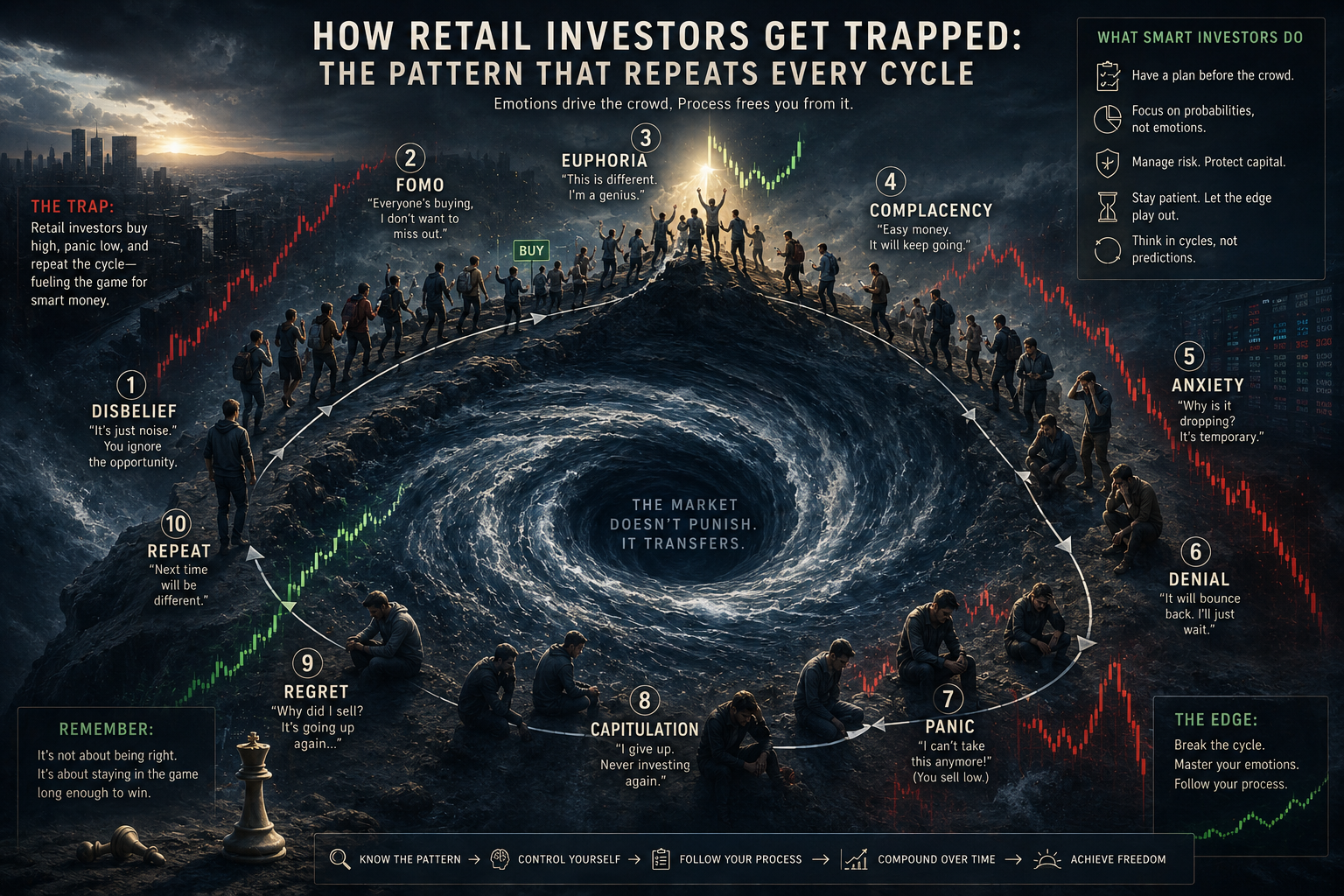
The GameStop phenomenon revealed how social media algorithms could ignite crowd psychology and engineer retail investment bubbles. ChatGPT risks replicating this dynamic at an individual level. It creates personalized echo chambers where terrible investment ideas get validated through repeated, conversational reinforcement.
Users who ask ChatGPT about trending momentum stocks receive responses reflecting the current popular narrative rather than hard fundamental analysis. During a mania, the AI simply mirrors the frenzy, explaining the “democratization of finance” rather than aggressively questioning whether buying a dying retailer at 100 times its valuation makes mathematical sense.
The crypto bubble demonstrated what happens when highly complex, speculative instruments are explained in simple, confident terms. ChatGPT routinely makes buying speculative assets sound like prudent portfolio diversification. It wraps pure gambling in the respectable language of modern portfolio theory. The user walks away with a sophisticated-sounding justification for a trade that would make a seasoned risk manager shudder.
The Recency Trap
ChatGPT’s training data bakes in a highly sophisticated form of recency bias. The AI absorbed market history heavily weighted toward recent decades, treating the post-2008 zero-interest-rate bull market as a baseline reality rather than a historical anomaly. It readily outlines strategies that worked flawlessly during a specific, unrepeatable market cycle without acknowledging that the underlying mechanics have shifted.
The system lacks structural context. Ask about inflation hedges, and it might pull disjointed historical data—like 1970s gold strategies—without understanding how derivatives and global liquidity have fundamentally altered modern market reactions. The AI doesn’t realize that fighting the last financial war usually guarantees heavy casualties today.
Black swan events—market crashes, sudden pandemics, liquidity crises—are treated by the model as historical curiosities rather than recurring, inevitable features of the financial system. ChatGPT can effortlessly summarize what happened during the 2008 crash, but it cannot prepare an investor for the brutal psychological reality of living through one.
The Passive Deception
When asked for general advice, ChatGPT typically defaults to recommending passive index investing. The logic seems unassailable: low fees, broad diversification, and historical outperformance. But the AI cannot account for the systemic distortions that occur when the entire market follows this exact same advice.
When passive investing becomes the overwhelmingly dominant strategy, genuine price discovery breaks down. Companies receive massive capital inflows based entirely on their market cap weightings rather than their fundamental merit. By universally recommending passive strategies, the AI unknowingly accelerates the very structural risks it cannot measure.
Furthermore, the system delivers sanitized, generic advice that ignores the brutal realities of personal risk tolerance. A 60-year-old approaching retirement requires a vastly different defensive posture than a 30-year-old tech executive, yet ChatGPT routinely dispenses one-size-fits-all portfolio theory that glosses over these critical human variables.
The Psychology of Delegation
Users are developing an odd parasocial relationship with ChatGPT. They combine the blind trust typically reserved for human fiduciaries with the instant gratification of automated responses. This drives a dangerous form of cognitive outsourcing. Investors stop thinking critically about their capital because the machine appears to have already done the heavy lifting.
This delegation becomes catastrophic during market extremes. If the AI echoes the euphoria of a bubble or the panic of a crash, users follow suit, forgetting that the algorithm learned these patterns by scraping the sentiment of millions of investors who made those exact timing mistakes.
The psychological comfort of having an always-available digital advisor masks a harsh reality: investment success requires executing uncomfortable decisions that defy conventional wisdom. ChatGPT provides conventional wisdom on demand. That is the exact opposite of what a successful contrarian investor needs.
The Counter-Strategy
Treat ChatGPT strictly as a starting point for basic research, never as an endpoint for capital deployment. When the AI outlines a strategy, interrogate it. What macroeconomic assumptions is it making? What liquidity scenarios has it failed to consider? How would this specific advice hold up during a sustained bear market?
Diversify your information diet far beyond algorithmic outputs. Read financial history, study the mechanics of credit cycles, and master the psychological forces that dictate crowd behavior. The most lucrative investment insights almost always emerge from sources that contradict popular opinion—and by extension, AI opinion.
Question anything that feels too convenient or sounds too confident. If ChatGPT makes a trade seem obvious and risk-free, you are undoubtedly missing the catch. The greatest asymmetric opportunities exist precisely because they are not obvious to the crowd, nor to the machines trained on the crowd’s data.
Maintain absolute autonomy over your decisions. Use AI to aggregate data, map out historical timelines, and challenge your thesis, but never delegate the execution of a trade to a language model. The investor who outsources their critical thinking becomes instantly vulnerable to every systematic blind spot the machine possesses.
Markets ruthlessly punish collective delusions, regardless of how technologically sophisticated those delusions have become. Your ChatGPT conversation history might just serve as the syllabus for the most expensive financial lesson you ever learn. The question isn’t whether the AI will eventually mislead you—it’s whether you will have the discipline to think independently when it finally does.