

Summit Therapeutics and the Gap Between Facts and Perception
June 25, 2026
Markets rarely misprice facts for long. What they routinely misprice are implications.
That distinction matters because some of the biggest winners in market history were never hidden. Investors could see the products, the earnings, the patents, the acquisitions, and the growth. The information was available to everyone. What differed was interpretation.
Summit Therapeutics may be one of those situations.
The market is rallying for the usual reasons. Oil prices are falling, geopolitical headlines are being interpreted favorably, and liquidity remains supportive. Those developments matter, but the more interesting story may be unfolding inside a small biotechnology company whose future depends largely on a single asset.
That asset is ivonescimab.
The benchmark is Merck’s Keytruda, arguably the most important cancer drug in the world and a franchise generating more than $30 billion in annual revenue. Keytruda transformed cancer treatment by helping the immune system identify and attack tumors. Ivonescimab attempts to do something more ambitious. It combines immune-system activation with a second mechanism designed to restrict the blood vessels tumors use to grow.
The concept is simple enough. Attack the cancer while simultaneously starving it.
So far, the clinical results have attracted attention for a reason.
In a Phase 3 study conducted in China, ivonescimab reduced the risk of disease progression by 49% compared with Keytruda. That result alone was enough to force investors, oncologists, and pharmaceutical executives to pay attention. Later, another large Phase 3 trial presented at ASCO demonstrated a meaningful survival benefit, showing a 34% reduction in the risk of death compared with another immunotherapy-plus-chemotherapy regimen. The findings were significant enough to earn publication in The Lancet, one of the world’s most respected medical journals.
Those facts are now widely known.
Yet the stock continues to trade as though uncertainty dominates the story.
That is where the psychology becomes interesting.
Most investors can immediately list the reasons for caution. Summit remains largely a single-asset company. It lost more than $1 billion last year. The FDA could request additional data, delay approval, or reject the application altogether. Competitors are pursuing similar approaches, and biotechnology history is littered with promising drugs that ultimately failed to meet expectations.
The risks are real.
The question is whether those risks have become so familiar that investors are no longer evaluating the opportunity objectively.
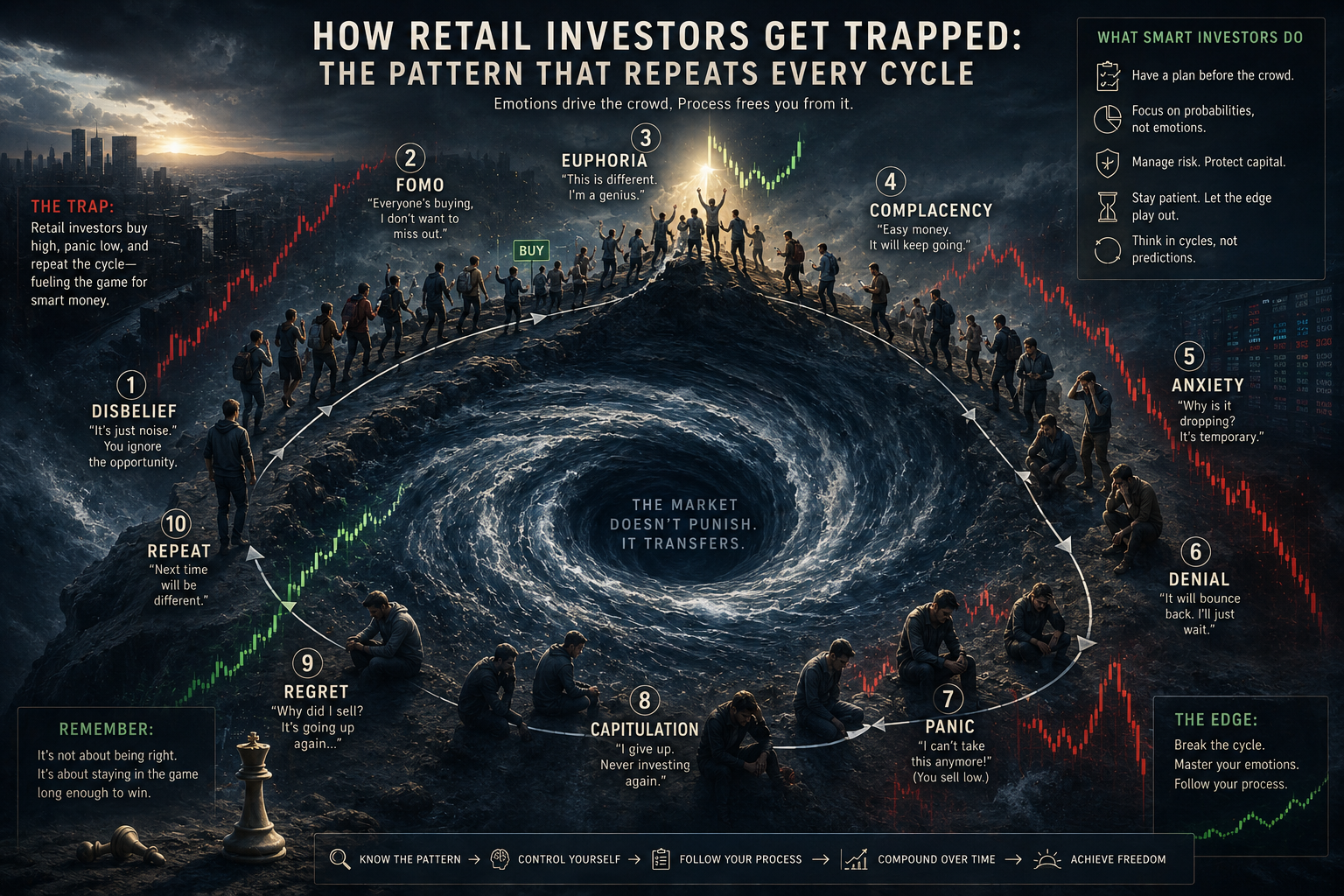
Markets have a tendency to anchor on recent experience. After years of biotech disappointments, many investors have become conditioned to focus on what can go wrong. They study failures, remember failures, and increasingly expect failure. Once that mindset takes hold, even strong evidence can struggle to overcome the emotional weight of prior losses.
This is why mass psychology often matters more than the narrative itself.
The crowd rarely misjudges obvious risks. The crowd often misjudges the consequences of success.
That brings us to Robert Duggan.
Insider buying is often discussed but rarely analyzed properly. Most purchases are too small to matter. A few thousand shares here, a symbolic transaction there, enough to create a headline but not enough to alter anyone’s financial future.
Duggan’s purchases belong to a different category.
In late 2025, he acquired approximately $262 million worth of stock at prices above where the shares trade today. More recently, he purchased roughly 3.8 million additional shares near $13.12. His wife and co-CEO, Mahkam Zanganeh, matched the purchase almost exactly. Together they committed roughly $100 million of fresh capital near the lows.
These are not public-relations transactions.
They are meaningful increases in exposure by individuals who already own substantial positions.
Most investors see insider buying and ask whether management is trying to send a signal.
The more useful question is why someone with extensive existing exposure would voluntarily add hundreds of millions of dollars more unless they believed the market’s assessment was materially wrong.
Duggan’s opinion carries weight because he has lived through a similar situation before. He helped build Pharmacyclics into one of biotechnology’s major success stories before its eventual $21 billion acquisition by AbbVie. He understands how strategic buyers evaluate oncology assets, and he understands what happens when a drug begins changing the competitive landscape.
That creates an interesting possibility.
The market may still be valuing Summit as a risky development-stage biotechnology company. Potential acquirers may already be evaluating it as a scarce strategic asset.
Those are two entirely different frameworks.
The consensus view treats FDA approval as the finish line. The more contrarian view treats FDA approval as the beginning of true price discovery.
If ivonescimab continues validating itself, the conversation changes. Investors stop debating whether the drug works and begin debating how much a potential successor to Keytruda’s economics could be worth. Pharmaceutical companies facing patent expirations stop asking whether they need new oncology platforms and begin asking how much they are willing to pay for one.
That is a much larger discussion.
This is not a certainty trade.
None of this guarantees success. Regulatory risk remains real. Clinical risk remains real. Competitive risk remains real. Biotechnology has a habit of humbling both optimists and pessimists.
It is a perception trade.
The market currently sees a speculative biotech company approaching a major regulatory decision. Duggan appears to see a potentially transformative oncology asset whose value has not yet been fully internalized.
The spread between those two perceptions is where the entire investment case lives.
And history suggests that the largest opportunities rarely emerge when the facts are hidden. They emerge when the facts are visible, but the implications remain misunderstood.