Perception Creates Reality. Reality Creates Opportunity.
Aug 14, 2026
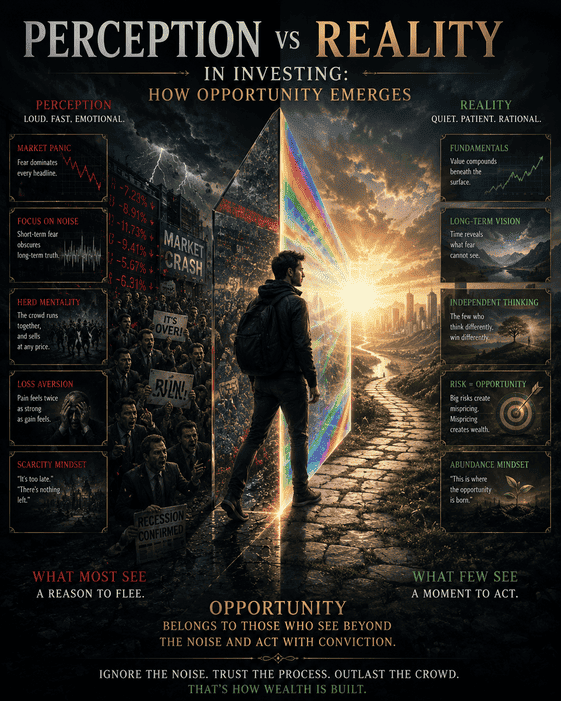
Most people assume they see reality as it is. They do not. What they experience is reality filtered through emotion, memory, belief, fear, desire, and expectation. Perception shapes reality, but perceptions themselves are shaped by emotional states, which means most individuals are not observing reality directly. They are observing an interpretation of it.
This distinction matters far more than most people realize.
A bridge cannot be built on emotion. A rocket cannot be launched on emotion. An economy cannot function indefinitely on emotion. Reality eventually demands mathematics, engineering, physics, and tangible results. Yet when it comes to markets, politics, and social movements, emotions often dominate decision-making long before reality delivers its verdict.
That creates a strange paradox. Human civilization advances through logic and structure, but human beings often make decisions through emotion and perception.
The stock market offers one of the clearest examples of this contradiction.
When prices rise, investors become increasingly optimistic. Risks that were obvious months earlier suddenly appear manageable. Valuations that once seemed absurd become justified. Weaknesses become strengths. Every piece of information passes through a positive filter.
When prices fall, the process reverses. The same investors who previously saw opportunity everywhere begin finding danger around every corner. Positive developments are ignored. Negative developments are magnified. The facts often change far less than the interpretation.
This is why two investors can observe the exact same market and reach completely different conclusions.
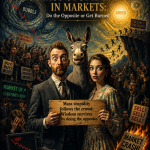
One sees collapse and another sees opportunity. The event is identical but the perception is not. The crowd rarely reacts to reality itself. It reacts to its collective perception of reality. Once enough people begin sharing the same interpretation, that interpretation starts influencing behaviour. Confidence encourages spending, investment, expansion, and risk-taking. Fear encourages contraction, caution, and withdrawal.
Eventually perception begins creating consequences that appear real. This is one reason mass psychology remains such a powerful framework. Markets are not simply collections of earnings reports, economic data, and valuation models. They are collections of emotional decisions made by millions of individuals attempting to navigate uncertainty.
And uncertainty is where the real battle occurs. Human beings crave certainty because certainty feels comfortable. Yet markets exist precisely because certainty does not.
The crowd constantly searches for emotional relief from uncertainty. Sometimes that relief comes through buying. Sometimes it comes through selling. Sometimes it comes through joining a popular narrative. The form changes. The underlying motive remains remarkably consistent.
Most investors spend decades studying indicators, forecasts, economic reports, and headlines. Far fewer study the emotional rhythm beneath them. Yet that rhythm has repeated across generations because human nature changes costumes far more often than it changes character.
Fear, greed, hope, envy, impatience, and euphoria appeared in every major market cycle long before modern finance existed. They appeared during railroad booms, commodity manias, housing bubbles, technology revolutions, and financial panics. The technology changes, but the emotions do not.
This is why perception deserves careful examination.
A fearful individual can walk into a room and sense hostility where none exists. The senses may function perfectly. The distortion occurs during interpretation. Emotion becomes the translator, and the translation changes the meaning.
Markets operate the same way. A bullish crowd translates uncertainty into opportunity. A bearish crowd translates uncertainty into danger. Neither group is observing reality directly. Both are observing reality through emotional filters.
The disciplined investor understands this distinction.
The goal is not to eliminate emotion. That is impossible. The goal is to recognize emotion before it begins distorting perception. Once that happens, an investor gains something extremely valuable. It’s called perspective.
The crowd becomes easier to understand because its behaviour follows recurring patterns. Optimism becomes excessive. Fear becomes excessive. Narratives become detached from reality. Perceptions drift away from facts.
Eventually reality reasserts itself.
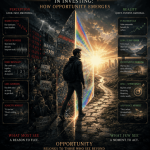
The investor who recognizes this process gains an edge because opportunity often emerges precisely when perception and reality drift furthest apart. That may be the closest thing markets offer to a lasting advantage.

Leaving a Mark: Impactful Articles