
The Savior Complex: When Helping Others Is Really About Being Needed
Aug 13, 2026
The Need to Save Can Hide a Need to Be Saved
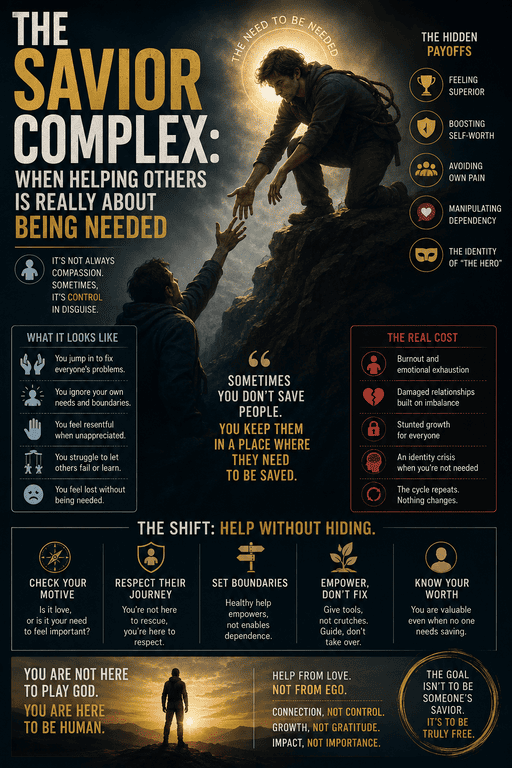
There is something deeply strange about the person who is always helping everyone else. They solve problems nobody asked them to solve, volunteer before anyone has requested assistance, carry burdens that belong to other people, and then quietly wonder why nobody seems grateful enough for everything they have done. The obvious interpretation is generosity, but psychology gives us a more uncomfortable possibility: sometimes the person doing the saving is not entirely motivated by the needs of the person being saved.
The savior complex is not a formal psychiatric diagnosis, and it should not be confused with ordinary kindness, empathy or genuine altruism. It describes a pattern in which someone feels compelled to rescue, fix or manage other people’s problems, sometimes even when the help is unwanted or ultimately keeps the other person dependent. The Cleveland Clinic describes the pattern as an often unconscious compulsion to save others and solve their problems, while research on prosocial motivation shows that helping can arise from genuinely autonomous motives as well as motives tied to psychological needs.
This matters because the uncomfortable question is not whether helping feels good. It often does. The question is what happens when the recognition disappears. If the deed itself provides satisfaction, gratitude is pleasant but unnecessary; if recognition is secretly part of the reward, the entire psychological vector changes because the helper has begun giving in order to receive something intangible in return.
The Hidden Transaction Inside the Good Deed
Most people would reject the suggestion that they help others because they want recognition. They will tell you they do it because they care, because they are decent, because somebody needed them, or because doing the right thing matters. Sometimes that is completely true, and research by C. Daniel Batson and others has provided substantial evidence that empathy can produce genuinely altruistic motivation rather than every act of helping being reducible to selfishness.
But human motivation is rarely a single clean variable. A person can genuinely want another person’s welfare while simultaneously enjoying the identity of being the person who provides the welfare, and that second component becomes important when the expected recognition does not arrive. Batson’s earlier work even examined how external incentives can alter people’s perception of their own altruism, illustrating how complicated the relationship between helping and reward can become.
This is where the vector becomes more interesting than the label. The question is not simply, “Is this person helping?” The question is, “Where is the energy flowing, and what happens when the expected return is removed?” If the energy flows toward the other person’s independence, the act is constructive; if it flows toward making the other person dependent, grateful, impressed or indebted, then something else is happening beneath the surface.
The deed should be the reward. If someone helps because helping itself is meaningful, the absence of applause does not destroy the satisfaction. But if the person repeatedly checks whether others noticed, remembers everything they have done, becomes resentful when nobody thanks them, or attacks those who fail to appreciate their sacrifices, the hidden transaction has finally revealed itself.
Why the Savior Becomes Vulnerable to Attack
This is the part that is rarely discussed. The person who constantly broadcasts themselves as the helper can unintentionally advertise a form of psychological need, because their identity becomes attached to being useful, needed and morally valuable. That creates a peculiar vulnerability: the more they need recognition for helping, the more power other people acquire over their emotional state.
A rude person can sense that vulnerability without consciously understanding it. Someone who has learned that their value comes from being needed can be manipulated simply by withholding appreciation, demanding more, or criticising the help that was provided. The helper then gives more, tries harder, explains more and becomes increasingly frustrated, while believing they are fighting for the other person’s welfare.
The vector has reversed. What began as generosity has become a search for validation, and the search for validation creates dependency on the very people whose behaviour the helper claims not to care about. The savior thinks the victim needs saving, while the savior may actually need the victim to remain in need.
That is why the pattern can become self-reinforcing. If the person being helped becomes independent, the rescuer loses the role that supplied identity and meaning, so the unconscious incentive can become keeping the relationship organised around need. The savior does not necessarily want the victim to fail, but complete independence can threaten the psychological structure that made the savior feel valuable in the first place.
Karpman’s Triangle: When the Savior Becomes the Persecutor
Stephen Karpman’s Drama Triangle provides an especially useful framework here because it describes three shifting positions: victim, rescuer and persecutor. The important insight is that these are not permanent identities; people can move between them as the emotional geometry of the interaction changes.
The sequence can be remarkably simple. Someone sees another person struggling and enters as the rescuer, the recipient accepts the assistance and becomes the apparent victim, and the rescuer begins doing more than was requested. Eventually the recipient resists, fails to express sufficient gratitude or refuses the rescuer’s preferred solution, and the rescuer feels betrayed.
Then comes the transformation.
The rescuer becomes the persecutor.
“After everything I’ve done for you” is one of the clearest sentences in this entire psychological structure because it exposes the hidden ledger. Genuine generosity does not require repayment in gratitude, obedience or loyalty, whereas transactional generosity eventually produces a bill. Karpman’s model is valuable precisely because it shows how the roles can rotate and how the interaction can continue without the original problem ever being solved.
The tragedy is that both sides can become trapped. The victim learns that helplessness attracts assistance, while the rescuer learns that helping creates significance. Each reinforces the other, and the system becomes stable precisely because neither participant is required to confront the deeper problem.
The Messiah Complex Goes Further
The term Messiah complex is related but carries a stronger meaning and should therefore be used carefully. In everyday language it can describe an exaggerated belief that one is destined to save others, while in more clinical contexts it can overlap with grandiose or delusional beliefs; it is not itself a formal DSM diagnosis.
The savior complex is therefore the better framework for most ordinary behaviour. You do not need to believe you are literally chosen to save humanity to fall into the rescuer pattern; you simply need to derive enough identity from solving other people’s problems that their independence begins to threaten your own sense of purpose.
That distinction makes the concept much more useful because it brings the phenomenon out of the extraordinary and into everyday life. It can appear in families, friendships, workplaces, relationships, communities and even intellectual environments where one person gradually becomes the person who always knows the answer and therefore begins requiring everyone else to remain confused.
The most sophisticated version is particularly difficult to detect because it can look like competence. The person genuinely may be capable, generous and intelligent, yet the hidden problem is that they cannot tolerate allowing another person to struggle, make mistakes or solve their own problems. They confuse assistance with control.
The Difference Between Helping and Rescuing
The dividing line is agency. Healthy help increases another person’s ability to stand independently; unhealthy rescue increases the helper’s importance while leaving the underlying dependency intact. Research on autonomous motivation for prosocial behaviour similarly suggests that the quality of motivation matters for both the helper and recipient, which supports the broader distinction between freely chosen assistance and behaviour driven by psychological pressure.
A good teacher eventually becomes unnecessary. A good coach develops independence. A good parent prepares a child to function without them. A good investor does not need followers to remain permanently dependent on predictions because the objective is to teach people how to see the structure for themselves.
The savior, however, can become attached to being indispensable. That is where generosity becomes dangerous because the helper is no longer asking, “What would make this person stronger?” but “What can I do that proves they need me?” The difference looks small from the outside but is enormous psychologically.
Recognition Is a Drug the Helper May Not Know He Is Taking
This brings us back to the original problem: appreciation. Everyone likes recognition, and there is nothing pathological about enjoying gratitude, praise or acknowledgment. The problem begins when recognition becomes the hidden payment system behind behaviour that is publicly described as selfless.
Then the person becomes trapped in an invisible exchange. They give, they expect recognition, they receive less recognition than expected, they experience disappointment, and instead of questioning the expectation they increase the amount they give. The larger the sacrifice becomes, the larger the invisible bill becomes, until resentment arrives.
That is why some of the loudest complaints about ungrateful people come from people who have spent years giving without establishing boundaries. They say, “I do everything for everyone and nobody appreciates me,” when the more important question may be, “Why did you keep doing things that required appreciation in the first place?”
That question is uncomfortable because it removes the victim position from the helper. It forces the person to examine their own vector rather than blaming the crowd for failing to provide the emotional return they secretly expected.
The Mass Psychology of the Savior
The pattern becomes even more powerful when viewed through mass psychology. Crowds reward visible rescuers because people instinctively gravitate toward certainty, authority and protection during periods of uncertainty. The person who appears to have the answers can accumulate status rapidly, particularly when others are frightened, confused or emotionally exhausted.
This creates a feedback loop. The crowd identifies a rescuer, the rescuer receives attention, attention reinforces the rescuer’s identity, and the rescuer becomes increasingly certain that their role is necessary. The more successful the performance becomes, the harder it becomes for the individual to admit that the crowd may not actually need saving.
Politics, institutions, social movements and even financial communities can reproduce this structure. A market commentator can become the person who “saves” followers from every crash, a political leader can present themselves as the only person capable of fixing a broken system, and an online personality can construct an entire identity around rescuing people from supposedly hidden dangers.
The psychology is remarkably similar because the underlying geometry is the same: uncertainty creates demand for certainty, certainty creates authority, authority creates dependence, and dependence creates status.
The Real Good Samaritan Does Not Need the Applause
There is a simple test for all of this, and it is brutally effective. Remove the audience. Remove the gratitude. Remove the recognition. Remove the possibility that anyone will ever know what you did, and then ask yourself whether the deed still feels worthwhile.
If the answer is yes, the centre of gravity remains inside the deed. If the answer is no, there may be another transaction operating beneath the surface, and recognising that does not make someone evil or fake; it makes them human and gives them the opportunity to understand their own motivation.
The healthiest form of generosity therefore contains a strange kind of disappearance. You help because the act itself is aligned with your values, then you let go of the outcome. You do not keep a psychological invoice, you do not demand obedience, and you do not become angry because somebody failed to admire your sacrifice. The best Samaritan does not need to be called a Samaritan and that may be the entire point.
The Final Vector: Save Less, Empower More
The deepest lesson of the savior complex is not that helping people is bad. It is that help without boundaries can become another form of control, and control disguised as kindness is particularly difficult to recognise because everyone involved can believe they are doing something virtuous.
The strongest form of assistance does not create a permanent customer for your generosity. It transfers capability. It gives another person enough support to regain agency and then gets out of the way and that is the vector that matters.
If you need people to need you, you are not entirely helping them. If you need people to thank you, you are not entirely giving. If you become angry when people reject your assistance, you are no longer simply responding to their needs; you are defending your own identity.
And that is where the paradox closes. The person who thinks they are saving everyone else may eventually discover that the person who most needed saving was themselves.

Thought-Provoking Reads