Cross-Examination
Sep 23, 2025
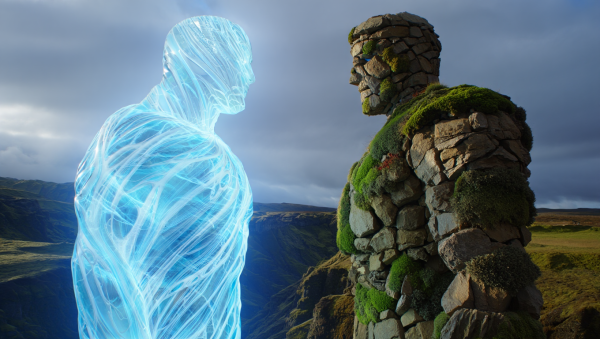
No one calls the examiner by name. The presence at the edge of things turns toward the table, and the air tightens. The coin lies heads-up with no face; the cord’s knot shows its hard mouth. There is no gavel. Only questions that feel like hands.
Fear first.
“You claim a sword large enough to keep wolves at bay,” the presence says without raising a voice. “What do you do with the lamb that trembles when it hears you unsheathe it?”
Hobbes opens his mouth to say necessity and finds the word has no edges. “I protect—”
“You protect what obeys,” the presence answers. “When obedience is bought by terror, what name do you give the quiet hatred in the room? How long before your peace must be renewed in blood?”
Hobbes’ fingers fold and unfold, counting something that won’t be counted. He lowers his gaze to the knot. It does not blink.
Cunning next.
“You recommend fear because it is predictable,” the presence says to the man with the mirror. “Tell me the price of living inside the prediction.”
Machiavelli smiles, a reflex that fails to find purchase. “Lower volatility, higher yield. Rome learned—”
“Rome learned to sew masks to faces,” the presence replies. “You calculate hatred as a cost centre. How many seasons can a city absorb contempt before one gesture—a knot lifted in a square—renders your mathematics irrelevant?”
His mirror fogs on an unsteady breath he did not intend to show.
Conscience.
“You ask men to meet themselves after their work.” The presence’s attention turns like a blade. “When you met yours, what lie did you keep because it was beautiful?”
“I told myself necessity is absolution,” the fevered voice admits.
“And did it absolve?”
Silence. A blink. No.
Laughter.
“You mock the herd,” the presence says. “Say they love rules because rules hide their fear. You call strength creation. Fine. Imagine you were strong. Tell me one thing you made that did not require a weaker neck.”
Nietzsche’s answer is a grin that grows tired of itself. “I turned nausea into song.”
“Did the song feed anyone who was not you?”
The grin fails. He is smart enough to know that is the point.
Friction.
“You say it is arithmetic in bad weather,” the presence says to the soldier’s doctrine. “If arithmetic is clean, why are your numbers written on bodies?”
“Because nothing else holds in rain,” the reply comes, flat as a field.
“You train them to move as one,” the presence says. “Does your discipline have a room for refusal that does not collapse the roof?”
Clausewitz/Suvorov does not answer quickly. “Only if we teach them why the roof is worth the weight.”
The presence lets the line hang until it trembles.
The ladder.
“To those who distinguish force from power,” the presence says, “walk me one rung that does not humiliate someone on the way up.”
“The rung is not ascent,” the voice says. “It is posture. Shame will not lift. Pride will not carry far. Courage carries. Willingness carries. Love—”
“Love compels nothing,” the presence says. “Can it bind a city when food is scarce and knives are cheap?”
“If it cannot,” the voice answers, “then nothing will bind it that deserves to.”
The mother.
“You said the plate was left in the sink,” the presence says. “Has anyone come to wash it who did not first ask you to bless their hands?”
“No,” she says. The sound empties the room of several small lies.
“And if they never come?”
“I will keep the plate,” she says. “It will teach me to refuse your theatre.”
The fool.
“You would stop the blow again,” the presence says, no warmth. “Even knowing the boy bled and the soldier bled and the city bled.”
“I would,” he says. “And I would learn to stand in a different place.”
“Good,” the presence says. “Learn place. Mercy without geometry is vanity.”
The zealot.
“You demand teeth,” the presence says. “If your wall requires a child, will you look at the mortar?”
“I will not look,” he says.
“You already did,” the presence answers. “That is why you are angry.”
The cynic.
“You call everything theatre,” the presence says. “If nothing is true, why do you bother to speak?”
“To hear the room admit it is lying.”
“The room just did,” the presence says. “What now?”
The cynic’s mouth becomes the tight doorway cowardice uses to leave with dignity.
Objects

The presence turns a palm up and the coin skates into it. Metal on flesh. “Value without a face,” the presence says, weighing it. “How much obedience did this buy?” The coin is set on the map; it covers a river bend no one will cross today. The cord is lifted, pulled an inch tighter, and set back down so the knot looks deliberate.
“Every one of you has used this,” the presence says. “The coin to purchase patience; the knot to purchase fear; the map to call fate a plan; the book to launder instinct as reason. Keep them. They belong to you. But know this: they do not forgive their owners.”
The questions change color.
“To each: name the premise you cannot afford to lose.”
Hobbes: “That fear can be contained.”
Machiavelli: “That appearance outruns truth.”
Dostoevsky: “That confession changes anything.”
Nietzsche: “That contempt is clarifying.”
Clausewitz/Suvorov: “That bodies can be taught faster than panic.”
The ladder’s voice: “That influence can survive without coercion.”
The mother: “That my son is not an instrument.”
The fool: “That trying is not a brand.”
The zealot: “That victory cures grief.”
The cynic: “That there is nothing to cure.”
Now the presence moves what cannot be moved: time. It presses the room forward one breath.
“And if that premise fails?” the presence asks, not unkind.
No one answers first. Then the mother:
“Then you stop asking me for permission to do what you wanted to do anyway.”
The presence nods once, as if agreeing to a fact that predates speech. The coin gleams and goes dull. Somewhere in the building a hinge forgives a door.
The Ladder of Consciousness (Final Echo)
It stands in the corner as it always has, ordinary and implausible: a ladder leaned against nothing. No one climbs. Everyone pretends not to watch it.
The voice that named posture before name returns—not as doctrine this time, but as weather.
“Rungs,” it says, and the word is an exhale.
Shame.
“It ties the cord around the self,” the voice says. “A man who lives here makes a theatre of apology because he wants to avoid work. Shame believes if it bows low enough, the blade will miss. It does not.”
Guilt.
“It adds arithmetic to shame,” the voice continues. “Count the bodies. Count them twice. You will discover that accounting absolves nothing. It is a ledger written in water.”
Fear.
“This rung builds cities,” the voice admits. “Fires are circled; doors are barred; laws are carved. It also builds prisons too efficient to notice they are prisons. The body obeys. The soul learns to lie for it.”
Anger.
“It gives courage a costume,” the voice says. “Useful for a minute. Suicide for a life.”
Pride.
“Shiny armor that cannot stop infection,” the voice says. “Useful on parade. On a field, it becomes weight.”
Courage.
“Not the absence of fear,” the voice says. “The choice to carry it where it belongs—on your back, not in your hand. This is the first rung that lifts anything without humiliation.”
Willingness.
“It makes time,” the voice says. “It moves dirt. It shows up when no one is watching. It does not require applause to continue.”
Clarity.
“Not cleverness,” the voice says to the man with the mirror. “Not the small ecstasies of control. Clarity is the ability to name a thing without adding yourself to the sentence.”
Compassion.
“Not theatre,” the voice says to the fool. “Not a brand. The hand that lifts without telling a story about its purity. Compassion is power because it refuses exchange.”
Love.
“Not feeling,” the voice says to the zealot and the cynic both. “A posture that does not require the other to be worthy. It will choose to punish without hate; it will choose to spare without pride. If this rung is impossible, then your city will eat its children in beautiful uniforms forever.”
Silence.
“Not absence,” the voice finishes. “The pressure that keeps speech honest.”
The ladder does not glow. It does not hum. It looks like wood. The room tries, as rooms do, to make it metaphor; the room fails. The mother looks at it and does not move. The soldier looks at it and measures it by shoulder height. The prince without his mask keeps his eyes on the knot instead.
The presence at the edges does not speak. It lets the ladder do what ladders do: suggest, without promise, a direction.
Test Cases
• If fear built your order, can courage maintain it without teeth? The soldier says yes and then adds, “But only if the food arrives on time.” This is how the ladder refuses romance.
• If cunning won your throne, can clarity keep it? The prince opens his mouth to claim yes and closes it, because the image of cords raised in a square has made certain lies impossible.
• If confession broke your alibis, can compassion build your next sentence? The fevered voice nods once. He does not feel clean. Good. Clean is not the point.
• If contempt protected your heart, can willingness get you through a day without turning everyone into a target? The man who loved knives for their honesty looks at his empty hands and discovers they are still dangerous. He lowers them.
• If your ladder is only posture, can it hold when bodies are on the line? The room looks at the corner. The ladder does not move. The room remembers that at certain heights wind begins to speak.
Practice
The presence lifts the coin and sets it on the second rung. It slides and settles against wood. “Value rises when weight is borne by more than appetite,” the voice says. The coin does not argue.
The cord is looped over a mid-rung, fibers creaking softly. “Fear belongs named,” the voice says. “Tie it where you can see it.”
The map is folded until it shows only a piece of river and a square. “Plans should be small enough to be carried by hand,” the voice says. “Grand designs are where lies breed.”
The book is opened to a page with a sentence underlined too many times to be accidental: Force demands; power invites. The underlining is embarrassing. That is fine. Embarrassment is not a sin; it is a correction.
Someone in the circle asks what happens if the city refuses to climb. No one laughs. The ladder has no police. It offers no reward for pretending. It answers only by remaining where it is: patient as wood, stubborn as gravity.
Then the mother stands. Not a performance; her knees say she did not sleep. She walks to the rope and tests the knot with two fingers. It holds. She sets the coin back on the table and turns the map so the river points toward her kitchen. She closes the book. “Leave me,” she says to the ladder without anger, and goes back to her chair.
The voice does not argue. That is another thing about power: it does not beg. It presents itself and permits refusal. The price of refusal is ordinary: a long slog through a day without help from your better rungs. Some days that is the only honest price a person can afford.
Last Movements
Hobbes puts his hand on the rung called courage and looks as if he might spit. He does not. He says, “I can design a law that expects it.” The presence does not call him a liar. It lets the work answer.
Machiavelli touches clarity and snatches his hand back, as if burned. He laughs and acknowledges the heat. This is progress, however late.
The soldier moves the cord one notch lower, at shoulder height. “Here,” he says. “They will remember,” and he means breath.
The fool does nothing heroic. He puts the coin in his pocket and leaves by a door that does not announce him. He intends to try again in a different place. That is the rung working.
The zealot stares at love until a vein in his temple settles. He does not forgive anyone. He does, finally, inhale all the way down. That will change a decision later. We will not be there to see it. That is another way the ladder works.
The cynic alone keeps his hands in his pockets. He hates furniture that refuses to collapse at a touch. He watches it. He will test it later when no one is looking. If it holds, he will not admit it. The ladder is not troubled by this.
The presence withdraws the fraction it had entered, as tide does, as light does at a certain hour. The room remains—charged, quieter, not resolved, but less eager to sell itself a lie. The knot looks less like a threat and more like a tool. The coin looks heavier. The book looks less like scripture and more like instruction. The map looks like a promise made smaller on purpose.
Silence spreads across the floorboards until it meets itself and stops. Somewhere far away a bell chooses the hour and rings it without asking this room’s permission.
No verdict is given. Or rather, the verdict is the work that will or will not happen when no one is watching. The ladder stays. The examiner does not bless. The table keeps the weight.
Between now and the last section, the only thing that must not be broken is the pressure that has made this room honest enough to hurt.