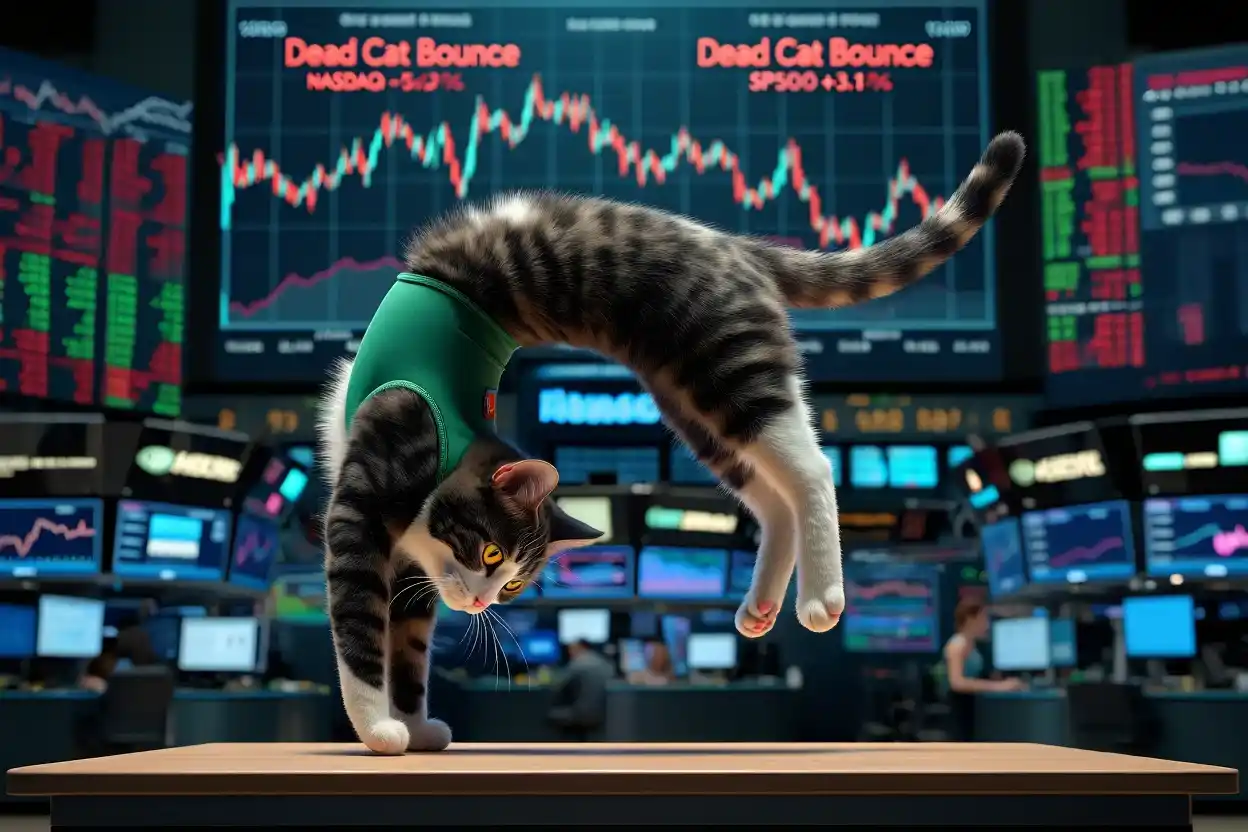
Dead Cats Bounce: Wall Street’s Favorite Zombie Gymnastics Routine
Updated Feb 11, 2026
The Concrete Kiss
It starts not with a whisper, but with a sickening thud—the sound of value slamming into reality at terminal velocity. A stock, a sector, an entire market falling in a dizzying free‑fall, shedding points like feathers ripped from a bird in a hurricane. Panic paints the tape red. Fear, raw and unfiltered, grips the herd. Margin calls howl. The air carries the ozone of evaporating wealth.
Years of gains vanish in hours, leaving behind the acrid smell of burnt capital and shattered conviction. This is not a correction; it’s a purge—a violent expulsion of excess. The asset lies motionless on the chart, seemingly lifeless. Traders drift away, muttering curses or clinging to prayer, unsure whether the worst is over or if the cliff continues just out of sight. A heavy silence follows, thick with the threat of deeper collapse.
Then something twitches—a flicker. An anomaly.
Echoes in the Abyss
Wall Street, never short on dark humour, christened this phenomenon the “Dead Cat Bounce.” The name is brutal and perfect: even a dead cat bounces if dropped from high enough. It’s not resurrection. It’s reflex.
This fleeting rise is a glitch—an echo of upward momentum after the fall. A phantom signal that convinces the unwary the worst has passed. It masquerades as recovery, offering false comfort while the foundation beneath it crumbles. This is not a return to life; it’s the last involuntary spasm before the downtrend resumes. It is Wall Street’s favourite zombie gymnastics routine, staged atop the grave of broken trends.
The Quantum Twitch
What animates the corpse? What force gives the dead a brief second wind? The bounce forms from a collision of desperation and opportunism—a disturbance in the market’s quantum field.
Short sellers, fat with profit, often rush to cover as the fall slows. Their buying creates artificial demand, a temporary upward push. For a moment, polarity reverses.
Then come the bargain hunters. They mistake catastrophe for discount. They see the wreckage and imagine opportunity. Their buying adds another thin layer of fuel. Technical traders arrive next, spotting “oversold” signals or price tagging historical support. Algorithms fire. A confluence of triggers lifts the corpse a few inches from the pavement.
It’s a moment of profound uncertainty—a psychological observer effect. The mere act of watching influences the motion. For a brief second, the asset occupies two states: possible recovery, probable collapse.
But the underlying truth—the cause of the original fall—exerts its pull. The bounce is a statistical anomaly, not salvation. A twitch, not a turning point.
Necrotic Alchemy
The real power of a Dead Cat Bounce comes from the human mind. It takes the trauma of loss and turns it into fragile hope. Those who endured the crash cling to the bounce as redemption, convincing themselves their pain might yet be rewarded.
Greed awakens. The early sellers or sideline spectators feel the sting of FOMO. “Maybe that was the bottom,” they whisper. “Maybe this is the comeback.” Hope becomes accelerant, burning bright and fast.
But in that heat, memory fades. Investors forget why the asset collapsed. They ignore revenue decay, failed products, rotten balance sheets, and sector-wide deterioration. In the bounce, the mind rewrites the story—turning disaster into “opportunity,” replacing hard truths with seductive fiction.
This is the alchemy of deception—turning leaden fundamentals into golden fantasies.
Ghosts in the Machine
Modern markets make this ritual even more treacherous. High-frequency trading algorithms—ghosts with no fear, no hesitation—detect the flicker long before humans do. They rush in, amplifying the rise, adding a false sense of conviction through volume.
But these silicon predators are not betting on recovery. They’re harvesting volatility. They inject momentum when it suits them and withdraw it the moment it fades. Once short covering dries up and bargain hunters finish their buying, the algorithms flip. The same systems that inflated the bounce accelerate the collapse.
They give the corpse its twitch—and then help slam it back into the ground.
The Reaper’s Gambit
While the hopeful rush toward the bounce, the seasoned traders—the cynics, the predators—wait with patience sharpened by experience. To them, the bounce is not a lifeline. It’s bait.
They study volume, watch momentum weaken, and wait for resistance to hold. They know the bounce is psychological, not fundamental. They’re not looking for resurrection—they’re preparing for the second kill.
This is the Reaper’s Gambit. It demands discipline, timing, and a cold read of sentiment. Shorting a Dead Cat Bounce is high‑stakes work. Misjudge it, and the zombie claws higher than expected. Get it right, and you profit from the inevitable: the return to gravity, the deeper plunge.
It is contrarianism weaponised with surgical precision.
Gravity’s Embrace
Like Newton’s apple, what rises in a Dead Cat Bounce must fall back—often with greater violence. The forces behind the bounce are temporary. The rot underneath remains untouched.
Short covering ends. Bargain hunters realise they caught a falling anvil. Algorithms flip to selling. Technical traders spot reversals. Hope evaporates, replaced by the slow horror of recognition: the first collapse was the warning shot, not the bottom.
The second leg down is the real damage. It breaks the bounce’s lows and crushes any lingering optimism. Those who bought the bounce become trapped, forced to choose between pain now or more pain later.
The dead cat, having twitched, returns to the dust.

Beyond the Veil
The Dead Cat Bounce is more than a chart pattern—it’s a recurring parable embedded in market behaviour. It exposes the eternal struggle between fear and greed, pain and denial. It reveals how easily motion is mistaken for recovery.
To navigate it requires more than technical ability. It demands scepticism, psychological resilience, and the discipline to ignore the siren call of quick profits.
Understanding the bounce is stepping behind the curtain—seeing how emotion distorts price and how narrative rewrites memory. It teaches that price without context is just noise, and that easy‑money narratives often bloom in the shadows of ruin.
This routine will repeat as long as markets exist. Tickers change. Human nature doesn’t. Recognise the pattern, respect its violence, and treat it as the survival lesson it is. Fail, and you become another casualty—another hopeful trader crushed beneath a falling corpse, swallowed by the echo of the concrete kiss.