

Mass Psychology and Health: How the Herd Shapes Your Body and Your Wealth
Aug 22, 2026
“Those who understand the herd but walk apart from it gain twice—first in their bodies, then in their wealth. Those who merely follow gain neither but believe they risk nothing.”
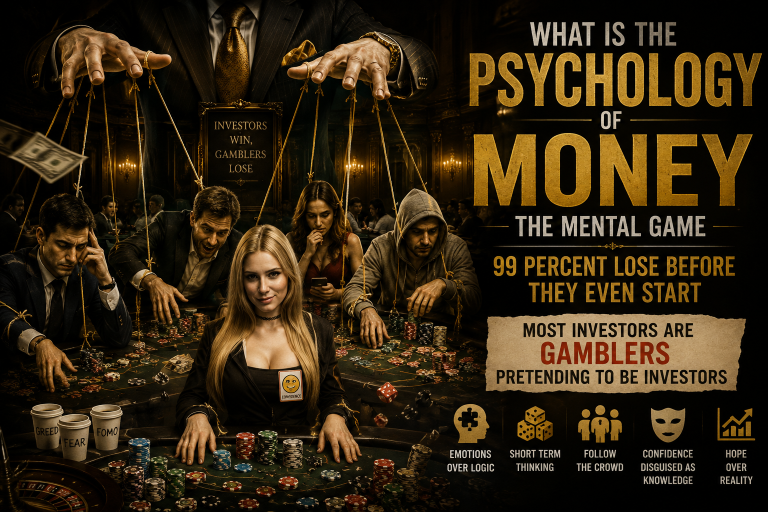
Mass psychology does not merely move markets; it also influences what people eat, drink, supplement, fear, avoid, and eventually accept as unquestionable truth. The same emotional machinery that drives investors into bubbles and out of markets at precisely the wrong moment also drives societies toward fashionable diets, miracle supplements, wellness movements, and health protocols that often become more popular than the evidence supporting them.
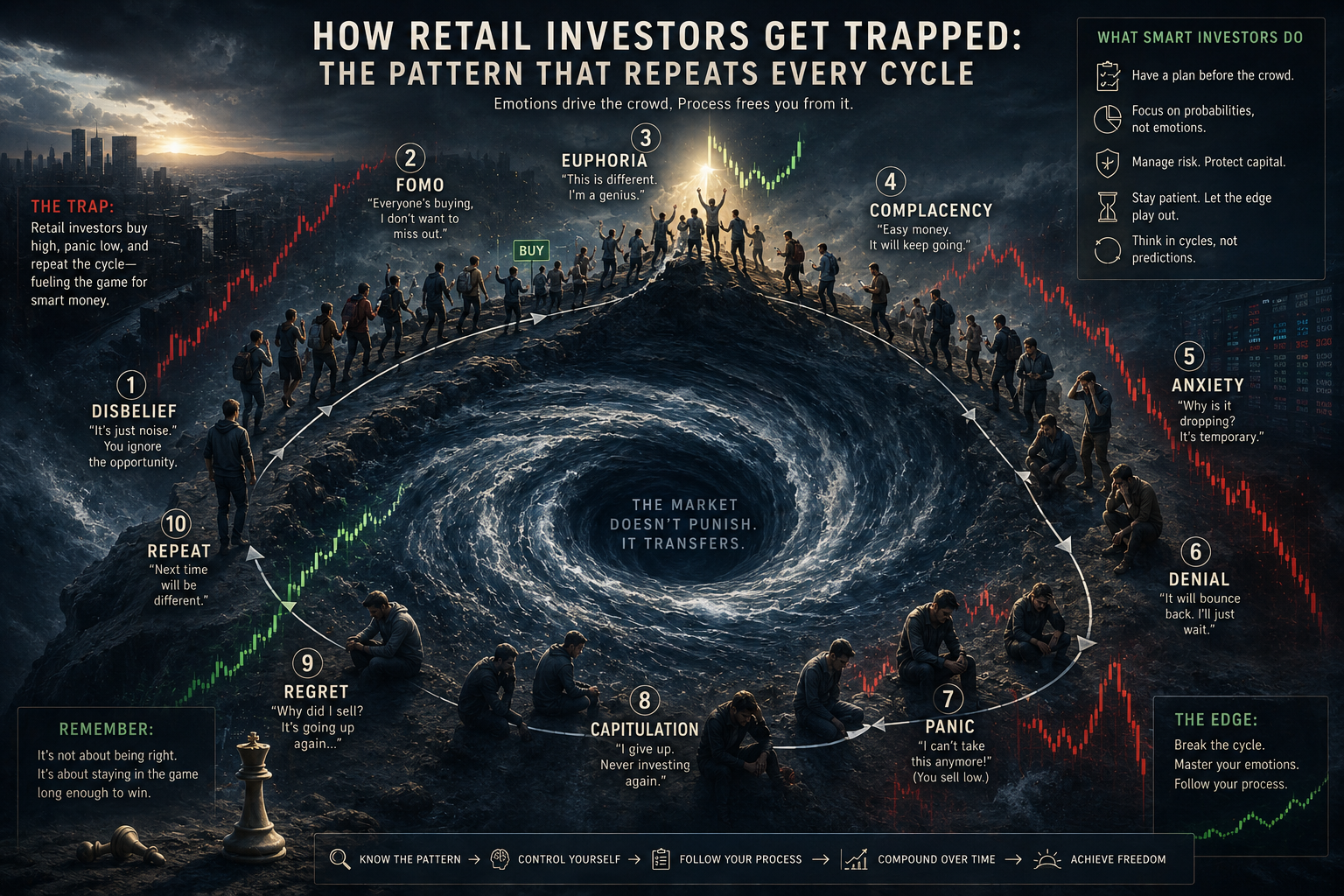
Understanding that connection offers an advantage because crowds rarely behave randomly. Whether people are chasing a supposedly revolutionary diet or piling into a stock that everyone believes can only rise, the underlying sequence is remarkably familiar: uncertainty creates anxiety, a compelling narrative offers relief, early adopters gain social status, media attention accelerates adoption, and eventually participation becomes less about evidence and more about belonging.
After watching these cycles unfold across markets and public behaviour, the pattern becomes difficult to ignore. Fear, conformity, narrative addiction, greed, and the desire for social acceptance repeatedly shape collective decisions, while individuals often convince themselves that they are acting independently even when their choices closely mirror those of everyone around them.
This is not simply random cultural drift. It is mass psychology operating through different channels, and once the pattern becomes visible, you can begin positioning ahead of the crowd rather than being carried wherever the emotional current happens to flow.
Mass Health Vectors: Reading the Emotional Current Behind Popular Choices
At scale, health decisions are rarely as coolly rational as people imagine. They are often emotional responses dressed in scientific language, personal testimony, selective evidence, and persuasive narratives that make a complicated problem appear to have a simple solution.
The pattern usually begins when a new health idea emerges and gains attention among early adopters who see themselves as better informed than the public. Their adoption creates visibility, visibility creates curiosity, curiosity produces fear of missing out, and eventually media coverage transforms a specialised idea into a mass movement. By the time the majority arrives, questioning the trend can become socially uncomfortable because the idea is no longer merely a health choice; it has become part of an identity.
If this sounds remarkably similar to a financial bubble, that is because the psychological structure often is. Consider the gluten-free movement of the 2010s. A medically necessary dietary approach for people with celiac disease gradually expanded into a much broader cultural phenomenon, with millions of people avoiding gluten despite having no diagnosed medical reason to do so. For many participants, the attraction was not solely about the food itself but about what the decision represented: control over personal health, membership in a wellness-oriented community, and a simple explanation for vague or frustrating physical complaints.
Vector analysis helps reveal what was actually being purchased. Consumers were not simply buying gluten-free products; many were buying certainty in an uncertain health environment, participation in a socially validated movement, and a narrative that promised greater control over their bodies.
The same psychological forces appear in financial markets. The GameStop phenomenon, for example, was not primarily driven by discounted cash-flow analysis or traditional valuation metrics. It was driven by identity, narrative, rebellion, community, and the powerful human desire to belong to something larger than oneself. The dominant vector was psychological, and that is precisely why it was capable of moving so many people so quickly.
The Temporal Disconnect: Why People Fail at Both Health and Wealth
Many health initiatives fail for the same reason that many investment strategies fail: human beings are poorly designed for long-term optimisation when immediate rewards and emotional pressures are competing for attention.
Our emotional systems evolved to respond quickly to immediate threats and rewards, not to manage problems whose consequences may emerge decades later. A sugary meal produces immediate pleasure, while the potential consequences of consistently poor dietary choices remain distant and abstract. Similarly, selling during a market panic can produce immediate emotional relief, while the long-term financial consequences of abandoning a sound investment strategy may not become obvious until years later. The same temporal disconnect operates in both domains.
People frequently sacrifice long-term health for short-term comfort, just as investors frequently sacrifice long-term returns for short-term emotional security. The immediate reward feels real, while the future consequence remains theoretical until it is too late.
The underlying mathematics of the psychological vector is remarkably similar: immediate emotional relief often defeats long-term optimisation when fear, temptation, or social pressure becomes sufficiently intense.
This pattern appears repeatedly in everyday life. Someone may maintain healthy habits for years and then abandon them during a relatively short period of emotional stress, holidays, travel, or social pressure. Investors can behave almost identically, following a disciplined strategy for years before abandoning it during a few weeks of market volatility.
The time horizon collapses under emotional pressure. Those who succeed over the long term in either health or investing learn to resist this distortion by giving future consequences greater psychological weight than immediate discomfort. They develop the ability to tolerate temporary inconvenience without allowing it to destroy a strategy designed to produce results over years or decades.
Strategic Discipline: The Skill That Transfers Between Health and Wealth
Building a healthy body and building long-term wealth require remarkably similar psychological infrastructure. Both demand the ability to resist immediate impulses, maintain consistency when excitement fades, ignore unnecessary distractions, and continue following a sensible process even when short-term results are disappointing.
This ability does not come naturally. It is developed. Consider Warren Buffett. While his investment knowledge is extraordinary, one of his greatest advantages has always been psychological independence. He was willing to remain outside popular market trends when valuations no longer made sense, even when doing so created temporary periods of underperformance and criticism.
During the technology bubble of the late 1990s, Buffett’s refusal to participate heavily in the speculative frenzy caused many observers to question whether his approach had become outdated. The crowd appeared to be winning, and resisting the crowd appeared foolish, which is often exactly what psychological independence feels like before the cycle reverses.
The same principle applies to health. The communities commonly associated with the Blue Zones have attracted attention not because they discovered a secret supplement or revolutionary diet but because their lifestyles tend to emphasise long-term consistency rather than constant experimentation with fashionable health trends. Their habits compound over decades through ordinary behaviours rather than dramatic interventions.
This is the same principle that separates disciplined investing from speculation. Long-term results often come from consistency, patience, and the willingness to remain committed when a more exciting alternative appears. Complexity can feel sophisticated, while consistency often feels boring, but the crowd’s preference for novelty does not necessarily improve outcomes. Both examples demonstrate what might be called vector independence: the ability to maintain directional integrity despite the emotional crosscurrents generated by collective behaviour.
Mass Psychology and the Health Industry: How Trends Become Bubbles
The health industry frequently follows the same emotional cycle seen in financial markets, although the language changes. A legitimate discovery or useful intervention attracts attention. Early adopters begin experimenting with it. Media coverage simplifies the message. Commercial interests recognise an opportunity. Products multiply. Marketing claims become increasingly ambitious. The original evidence is gradually buried beneath exaggerated promises.
The cycle often looks something like this:
- Innovation: A legitimate scientific finding, nutritional idea, or health intervention emerges.
- Early Adoption: Informed individuals begin incorporating the idea carefully and selectively.
- Mass Awareness: Media coverage simplifies the message and exposes it to a much larger audience.
- Exuberance: Companies rush to create products and marketing campaigns built around the trend.
- Overextension: Claims begin exceeding the available evidence as magical thinking replaces careful analysis.
- Backlash: Disappointing results or contrary evidence emerge, and public enthusiasm begins to fade.
- Normalisation: The genuinely useful elements survive and eventually find a more appropriate place within mainstream practice.
Smart health consumers, like disciplined investors, attempt to distinguish between the underlying value of an idea and the emotional excess surrounding it. The supplement industry provides repeated examples of this process. Resveratrol, turmeric, CBD, antioxidants, and numerous other health trends have experienced periods when legitimate scientific interest was followed by aggressive commercial expansion and increasingly extravagant claims.
The opportunity for the independent thinker is not necessarily to reject every popular idea. That would simply be contrarianism for its own sake. The real advantage comes from separating legitimate value from speculative enthusiasm.
Psychological Positioning for Health and Wealth
The disciplined investor understands that confidence should influence position size. No matter how compelling a story appears, concentrating everything on an uncertain outcome creates unnecessary vulnerability.
The same principle can be applied to health decisions. A disciplined individual does not completely restructure their life around every new study, supplement, or fashionable protocol. New information can be incorporated gradually while proven fundamentals remain at the centre of the strategy.
Consider exercise. Someone with a strong long-term approach does not abandon years of productive activity simply because the latest training trend promises faster results. They may experiment with new techniques, but the foundation remains consistent movement, progressive challenge, adequate recovery, and sustainable habits.
Investing works much the same way. A disciplined investor may adjust asset allocation or reassess opportunities when circumstances change, but they do not completely abandon a long-term strategy every time a new sector becomes fashionable or market sentiment shifts. The mechanism behind both behaviours is closely related. Maintaining a sensible position requires resisting the emotional pressure to make dramatic changes merely because everyone else appears to be doing so.
The Contrarian Advantage in Health and Investing
Success in both health and investing sometimes requires the willingness to diverge from the crowd precisely when social pressure is strongest. During periods of extreme enthusiasm, independent thinking can look unnecessarily cautious. During periods of extreme fear, disciplined action can look reckless. The crowd often mistakes emotional intensity for evidence, which creates opportunities for individuals capable of maintaining psychological distance.
The advantage is not found in automatically doing the opposite of everyone else. Blind contrarianism is simply another form of emotional dependence because your decisions are still being determined by the crowd. The real advantage comes from recognising when collective behaviour has pushed perception far away from reality.
When extreme low-fat dietary advice dominated public discussion, questioning the broader narrative required independence. When technology valuations reached extraordinary levels during the late 1990s, maintaining discipline required the willingness to tolerate being left behind temporarily. These moments are uncomfortable because mass psychology rewards conformity before reality eventually restores balance.
This is where vector analysis becomes useful: it examines the direction of crowd belief, the speed of emotional acceleration, the strength of the narrative, and the degree to which perception may have become detached from underlying reality. The objective is not to predict every turning point with precision. It is to recognise when emotional momentum has become so powerful that independent analysis becomes increasingly valuable.
The Real Edge: Learning to See the Crowd Without Becoming It
The most important lesson is that health and wealth are not separate psychological battles. Both are heavily influenced by the same internal forces: fear of loss, desire for immediate gratification, conformity, impatience, overconfidence, and the constant temptation to follow whatever appears to be working at the moment.
Crowds can provide useful information, but they can also become dangerous when agreement replaces analysis. The person who blindly follows every health trend risks becoming a consumer of endless promises. The investor who blindly follows market enthusiasm risks becoming the buyer who arrives when the opportunity is already crowded.
Neither health nor wealth requires perfection. Both require something far more difficult: consistency combined with independent thought. The greatest advantage belongs to those who can observe collective enthusiasm without immediately joining it, recognise fear without becoming paralysed by it, and evaluate new ideas without surrendering to the emotional pressure surrounding them.
The herd will always move. The question is whether you can understand its direction without allowing it to choose yours.