Group Mind: Where Bad Ideas Go Viral and Capital Gets Torched
Updated 18, 2026
Each generation believes itself uniquely enlightened, yet every generation succumbs to the same ancient folly—placing faith in the wisdom of crowds. But crowds possess no wisdom. They magnify human irrationality, turning private uncertainty into public delusion. Carl Jung warned that “group mind is always inferior to individual consciousness,” yet investors, politicians, and pundits continue ignoring the warning, embracing consensus until it destroys them. Ask the herd a foolish question and you will receive a foolish answer. Follow that answer into financial markets and you win only foolish prizes: loss, ruin, regret. History makes the lesson clear—markets punish conformity and reward those bold enough to doubt the crowd.
The Illusion of Collective Intelligence: Machiavelli’s Warning
Niccolò Machiavelli, whose grasp of human nature remains unmatched, cautioned rulers never to trust the emotional whims of the masses. “The vulgar crowd,” he wrote, “is always taken by appearances, and the world consists chiefly of the vulgar.” Yet centuries later, investors repeat the very error he warned against: mistaking consensus for insight.
Machiavelli understood the crowd mind as an echo chamber—loud but shallow, driven by surface impressions and fleeting emotion. Investors who rely on this mirage discover the truth only at collapse. Markets prove this repeatedly: as confidence peaks, skepticism disappears, and the group mind becomes most certain precisely when it should be most cautious.
Consider the 2008 financial crisis. Bankers, economists, and regulators—brilliant individually—collectively embraced the delusion that housing prices could never fall nationwide. Groupthink permeated the entire system. Hypnotized by rising profits, the collective mind failed spectacularly when reality intruded. Machiavelli would have recognised the pattern instantly: the crowd’s confidence always precedes its collapse.
Sherlock Holmes and the Art of Contrarian Observation
If Machiavelli warns against the herd, Sherlock Holmes teaches how to escape it—with disciplined observation and relentless skepticism. Holmes solved mysteries by ignoring consensus and studying the overlooked. “You see,” he said, “but you do not observe.” Investors face the same distinction. Seeing markets is easy; observing them is mastery.
Technical analysis acts as Holmes’s magnifying glass. It forces investors to read clues instead of narratives—fear in volume spikes, greed in parabolic charts, complacency in narrowing breadth. Price becomes a crime scene; indicators become evidence.
Look at the dot-com bubble of 1999–2000. While the group mind celebrated “new economy” fantasies, technical signals showed stark warnings: deteriorating breadth, exhausted momentum, and heavy-volume distribution. Those who observed rather than believed sidestepped disaster. Holmes would approve—the truth was visible to anyone willing to examine the evidence rather than the headlines.
The Vector of Mass Psychology: Markets as Emotional Ecosystems
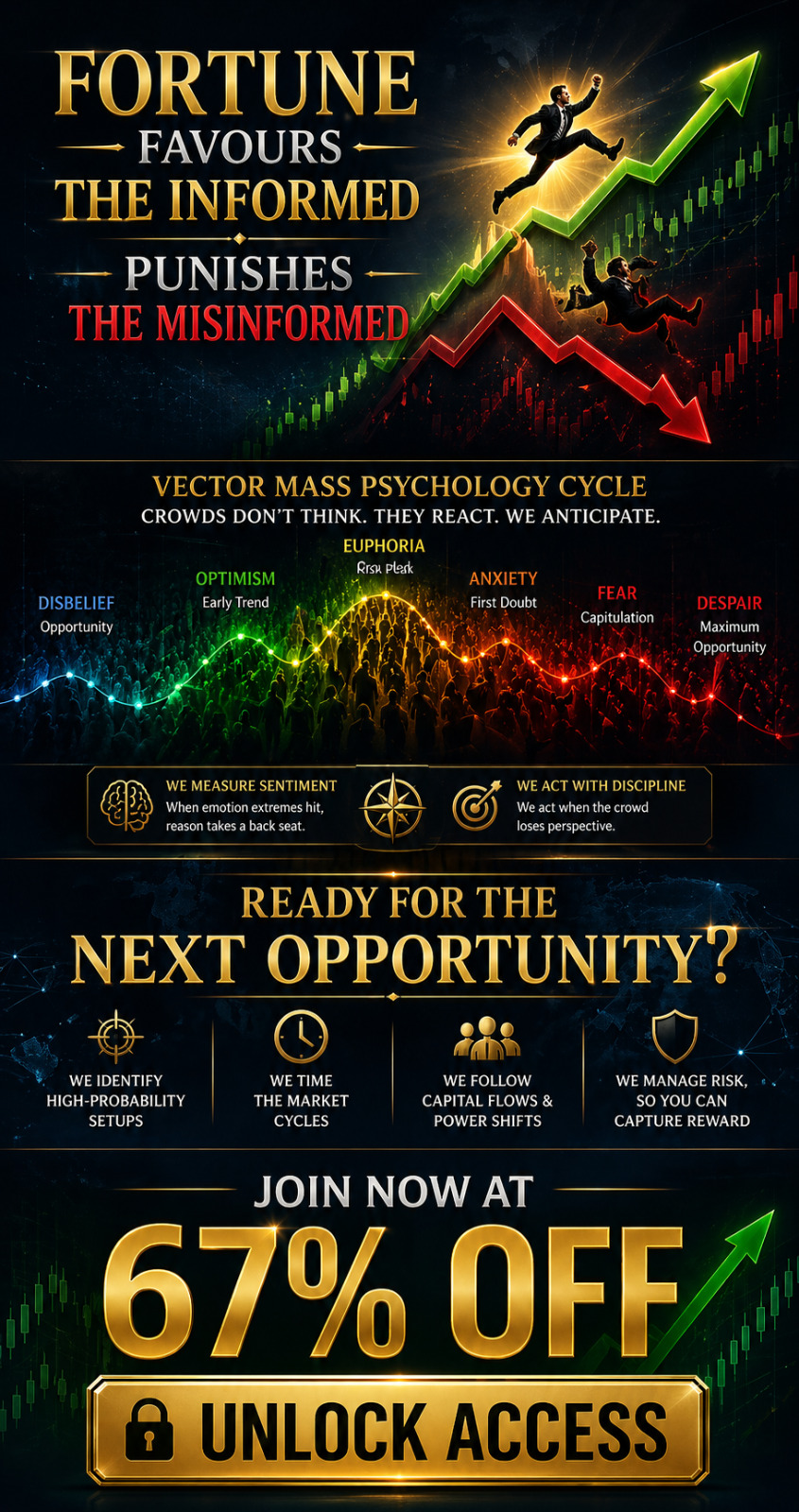
The market is not rational machinery. It is an emotional ecosystem shaped by collective psychology. Mass psychology—not economic models—drives cycles of euphoria, denial, panic, and despair. Casual observers miss these emotional currents, but technical analysis reveals them clearly.
Fear and greed follow a predictable sequence: disbelief → optimism → thrill → euphoria → anxiety → denial → panic → capitulation → despair → recovery. Every phase leaves technical fingerprints. Euphoria carves vertical price spikes; panic etches violent selloffs with record volume.
Take Bitcoin’s dramatic cycles. Mass psychology powered its ascent: optimism, excitement, mania. Technical tools—RSI divergence, parabolic curves, exhausted momentum—signaled emotional excess long before the reversal. Those who trusted the crowd believed the rally could never end. Those who trusted psychology saw the danger clearly.
Understanding mass psychology as a vector—direction and magnitude—gives investors the ability to measure sentiment and act strategically. Technical analysis becomes the compass that reveals when emotional energy has become unsustainable.
The Silly Questions of Pundits, Prophets, and Charlatans
Despite all evidence, pundits continue asking the group mind silly questions, then act surprised when the answers are worthless. “Is this a new economic era?” “Has inflation been defeated forever?” “Is Bitcoin the future of money?” Each generation repeats identical questions and receives identical illusions in return.
These questions betray a fundamental misunderstanding: markets are not rational calculators but emotional organisms. They do not respond to novelty—they respond to psychological excess. Investors who track emotional patterns ignore the noise and watch the indicators that actually matter.
Consider the evergreen question “Is this time different?” asked in every bubble—from 1929 to 1999 to today’s tech manias. The herd always insists yes. Technical analysis always reveals no. Breadth fractures. Momentum wanes. Price accelerates unsustainably. Those who trust data escape. Those who trust the crowd drown.
The Disease of Conformity: Symptoms, Diagnosis, and Cure
Conformity disease spreads quickly and leaves wreckage behind. Intelligent individuals become irrational mobs, swept up by greed or terror. Its symptoms—groupthink, confirmation bias, emotional contagion—are predictable. Its cure is discipline.
Technical analysis diagnoses this disease with precision. When conformity manifests as greed—everyone bullish, risks dismissed, charts vertical—technical warnings appear: extreme overbought levels, weakening breadth, divergence. When conformity flips to panic—mass selling, despairing headlines—technical tools reveal oversold conditions, irrational pricing, and contrarian opportunity.
March 2020 offered a perfect case study. As pandemic fear reached an apex, investors sold anything not nailed down. Yet indicators screamed that sentiment had reached absurd extremes. Those who diagnosed conformity disease saw opportunity; those who surrendered to panic locked in losses.
Machiavellian Contrarianism: Exploiting the Herd’s Folly
Machiavelli advised rulers to exploit the crowd’s emotions, not share them. Investors must do the same. Rejecting groupthink isn’t enough—you must actively profit from it. Markets reward those who stand opposite the herd at emotional extremes.
Technical analysis provides the tools. Indicators like volatility spikes, put‑call ratios, and breadth collapses reveal when emotion has reached its breaking point. These are not warnings—they are invitations.
Warren Buffett’s distilled version remains timeless: “Be fearful when others are greedy, and greedy when others are fearful.” This is not advice—it is a strategic doctrine. Exploit the herd’s mania. Exploit the herd’s terror. That is Machiavellian contrarianism in action.
Closing the Circle: Escaping Group Mind’s Eternal Recurrence
And yet, despite centuries of evidence, humanity returns again and again to the group mind’s warm embrace. Investors ask the same silly questions, receive the same foolish answers, and march into the same traps. Conformity is comfortable; skepticism is lonely.
Only those who embrace Machiavellian contrarianism break this cycle. Technical analysis becomes their map, mass psychology their compass. They diagnose herd madness, recognise emotional extremes, and position themselves at the precise points where the crowd becomes most dangerous to itself.
Markets reward neither obedience nor neutrality. They reward strategic defiance—contrarianism executed with discipline and supported by evidence.
In the end, conformity disease never disappears. But individual investors can immunize themselves: ignore foolish questions, reject foolish answers, refuse foolish outcomes. Machiavelli and Sherlock Holmes—separated by centuries, united in method—offer the same timeless directive:
Trust the herd, and you perish. Question it, and you prevail.