Stock Market Psychology Cycle: The Real Chart Behind Every Crash
Aug 19, 2026
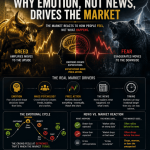
Financial markets are often described as weighing machines over the long run and voting machines in the short run, yet both analogies miss the force that truly drives prices. Markets are not rational machines processing information with cold precision but living psychological systems in which millions of participants, each carrying different objectives, fears and expectations, continually shape one another’s perceptions until belief itself becomes more influential than the underlying facts. A Federal Reserve announcement, an earnings report or a geopolitical crisis does not possess a single objective meaning because every participant interprets the same event through an entirely different psychological framework, making markets less a reflection of reality than a reflection of how reality is collectively perceived.
This explains why identical news can produce radically different outcomes. Companies frequently report exceptional earnings only to see their shares decline because investors expected even more, while businesses delivering mediocre results often rally because expectations had already become excessively pessimistic. Markets therefore respond less to events than to the constantly shifting relationship between expectation and reality, a distinction that lies at the centre of every major boom, crash and recovery.
The greatest mistake investors make is believing they are studying markets when they are merely studying prices. Prices are only the visible expression of a much larger psychological process unfolding beneath the surface, and if you want to understand why markets repeatedly swing between euphoria and panic, you must first understand how expectations expand, saturate and eventually collapse.
Markets Price Expectations, Not Reality
Every transaction represents a comparison between what investors expected to happen and what actually occurred. Prices therefore function less as measures of present value than as constantly evolving forecasts, incorporating assumptions about earnings, interest rates, technological progress, monetary policy and economic growth long before those developments fully materialise. As optimism expands, investors gradually project increasingly favourable outcomes further into the future until perfection becomes embedded within price, leaving remarkably little room for ordinary disappointment.
This is what we call expectation geometry. Markets become fragile not because businesses suddenly deteriorate but because expectations eventually outrun reality, creating a widening gap between what investors believe will happen and what can realistically occur. Strong companies can therefore suffer substantial declines without any meaningful deterioration in their operations simply because optimism had already discounted years of future success. The larger the gap between expectation and reality becomes, the greater the market’s vulnerability, regardless of how positive the prevailing narrative appears.
The Psychology Cycle Behind Every Market
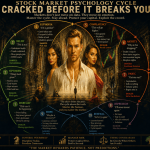
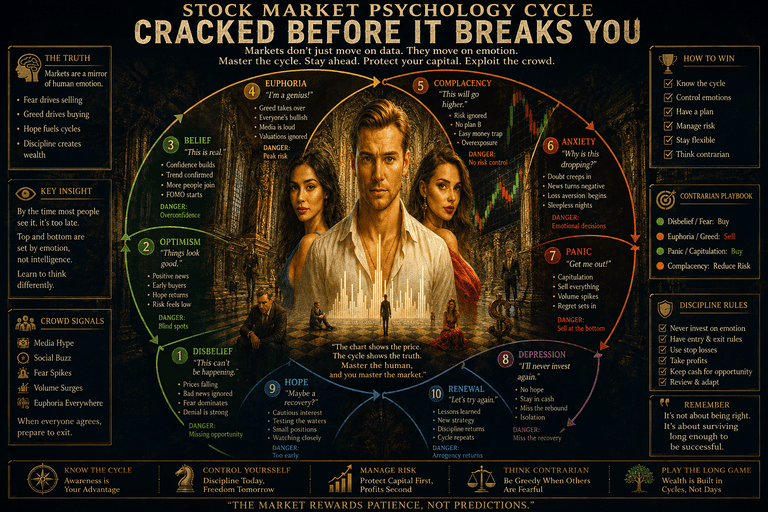
Although every bubble tells a different story, every market follows remarkably similar emotional geometry because human behaviour changes far more slowly than technology or economics. The cycle begins after prolonged disappointment, when expectations have become so depressed that investors stop searching for opportunity altogether, allowing patient capital to accumulate positions while pessimism still dominates the headlines. As selling pressure gradually exhausts itself, hope quietly returns, followed by belief as participation broadens and confidence slowly replaces scepticism.
Success eventually breeds conviction, conviction evolves into consensus and consensus gradually transforms into overexposure as portfolios become increasingly concentrated and nearly everyone who wants to own the asset has already committed capital. At this stage, optimism itself is not the danger. The danger is that there are progressively fewer new buyers capable of validating ever-higher expectations. Fragility therefore enters the market long before prices decline, revealing itself through narrowing leadership, weakening reactions to good news and increasingly muted advances despite continued optimism.
Eventually an ordinary catalyst exposes an extraordinary imbalance. Investors blame interest rates, inflation, disappointing earnings or geopolitical events, yet these developments merely trigger a process that had already begun months earlier. Markets do not collapse because reality suddenly changes; they collapse because expectations had already travelled too far ahead of reality. Confidence rapidly gives way to uncertainty, uncertainty becomes fear, fear accelerates into panic and capitulation eventually pushes expectations below reality once again, creating the conditions for the next cycle to begin.
The sequence rarely changes.
Hope → Belief → Conviction → Consensus → Overexposure → Fragility → Fear → Panic → Capitulation → Opportunity.
Understanding this cycle changes the way you see markets because it shifts your attention away from predicting headlines and toward measuring the constantly changing relationship between expectation, positioning and reality. Once you recognise that every major boom and bust follows the same psychological architecture, the objective is no longer to predict the next piece of news but to identify where the market currently sits within the cycle, because that invisible chart has explained every great financial mania far more accurately than the visible one ever could.

The Correct Crowd Is Rarely the Largest Crowd
Contrarian investing has become one of the most misunderstood concepts in finance because too many investors believe that simply opposing the majority creates an edge. They see bullish headlines and instinctively turn bearish, or they buy whenever pessimism dominates the news, believing they are thinking independently when they are merely reacting to the crowd in reverse. Real contrarian investing has nothing to do with opposing popular opinion. It begins by identifying the correct crowd and determining whether that crowd still has the ability to move prices.
Every market contains multiple psychological layers. Retail investors, institutions, momentum funds, specialists and long-term believers all influence prices differently. In gold, for example, the critical sentiment signal rarely comes from the general public. It comes from Gold bugs, whose identity has become intertwined with the metal itself. Once that inner circle reaches near-unanimous conviction, the market often approaches psychological saturation regardless of whether the broader public has fully embraced the story. The same principle applies to cryptocurrencies, artificial intelligence and every other major investment theme. Markets become vulnerable not when everyone is optimistic, but when everyone capable of buying has already bought.
Why Fashion Contrarians Fail
Fashion contrarians make the opposite mistake of the crowd while remaining psychologically dependent upon it. They mistake euphoria for an immediate sell signal and despair for an automatic buying opportunity, ignoring the far more important question of whether participation can still expand. Every great bubble survives far longer than expected because fresh capital continues entering the system, while every great bear market eventually ends because selling pressure exhausts itself long before optimism returns.
Markets do not reverse because people become optimistic and they reverse because optimism stops expanding.
The Real Mistake Isn’t Missing the Top
Investors spend far too much energy trying to identify the exact market peak when history shows that perfection is both impossible and unnecessary. The real danger lies in becoming emotionally attached to an investment, allowing conviction to evolve into identity until every warning sign is dismissed as temporary noise. At that stage, investors are no longer protecting capital. They are protecting a belief.
This explains why fortunes are often lost near major peaks. Investors fear missing additional gains far more than they fear surrendering existing profits, convincing themselves that discipline means never selling rather than continually reassessing opportunity. The greatest tactical failure is therefore not selling too early but refusing to recognise when extraordinary opportunities have become ordinary investments burdened by extraordinary expectations.
Today’s Markets, Same Psychology
Today’s market demonstrates the same emotional cycle unfolding through different narratives. Artificial intelligence continues attracting extraordinary optimism because genuine innovation has encouraged investors to extrapolate limitless growth. Cryptocurrencies repeatedly swing between despair and certainty as each recovery attracts fresh believers. Precious metals occupy the opposite end of the spectrum, receiving relatively little attention despite improving long-term structural conditions.
The assets differ but the psychology does not. Opportunity is rarely determined by today’s headline. It is determined by where expectations currently sit within the broader emotional cycle.
The Real Chart Behind Every Crash
Every market crash carries a different explanation, yet beneath the headlines the same psychological architecture appears with remarkable consistency. Expectations expand faster than reality, participation becomes increasingly concentrated, conviction hardens into certainty and fragility quietly replaces resilience. The eventual catalyst may be inflation, interest rates, disappointing earnings or geopolitical conflict, but those events merely expose conditions that have been developing for months or even years. Markets rarely collapse because the news suddenly turns bad. They collapse because expectations had already left no room for disappointment.
This is the real chart behind every crash. It is not drawn with candlesticks, moving averages or oscillators but with the collective expectations of millions of investors who gradually transform possibility into certainty before inevitably confronting reality. Those who learn to read this invisible chart stop chasing headlines and start measuring positioning, expectation and emotional saturation instead.
The lesson extends far beyond any individual asset class because every great cycle follows the same geometry. Technologies change, economies evolve and narratives come and go, but human behaviour remains astonishingly consistent. Hope becomes belief. Belief becomes conviction. Conviction becomes overexposure. Overexposure becomes fragility. Fragility becomes panic. Panic eventually creates opportunity, and the cycle quietly begins again.
The greatest investors understand that markets are driven less by information than by how people collectively interpret that information. They know that prices ultimately reflect expectations rather than reality and that the widest gap between those two forces is where both the greatest dangers and the greatest opportunities emerge. Learning to recognise that gap is far more valuable than predicting the next headline because headlines change every day, while the psychology driving markets has remained largely unchanged for centuries.
Articles Worth Checking Out