


Silver Price Forecast: Ignore Panic, Follow Structure
March 09, 2026
The first rule of the metals market
History in the metals market works less like a reference and more like a navigation chart. Gold and silver repeat the same behavioural patterns because the same emotions return every cycle. Fear of currency failure, distrust of governments, and the promise of monetary refuge pull investors into the sector at predictable moments.
The sector also attracts strong ideological camps. One side sees manipulation behind every move. The other treats gold as the only real money. Both miss the same driver. Markets move through liquidity, positioning, and crowd psychology. Investors who ignore those forces usually end up providing liquidity to those who study them.
The metals market teaches this lesson every cycle. Those who refuse to study the past usually end up financing those who do.
Gold forecasts versus reality
For years, some commentators argued that selling gold near the 2011 peak was a historic mistake. Forecasts ranged from $2,000 by 2009 to $5,000 by 2013, with some pushing extreme numbers such as $50,000 per ounce. Predictions like these gain traction because they tap into fear and ideological conviction.
The chart told a different story. Gold peaked near $1,920 in 2011 and then spent years correcting while those forecasts circulated widely. The problem was not just magnitude. The forecasts ignored how markets actually move.
Even the current environment reflects that reality. By early March 2026, gold trades in the mid $2,000 range after breaking above $2,400 during 2024. The metal eventually exceeded the 2011 peak, but only after a long consolidation rather than the sudden collapse-driven surge many predicted.
Extreme targets like $50,000 imply systemic breakdown. In such conditions, portfolio prices would hardly matter. The appeal of those projections says more about investor psychology than about market mechanics.
Gold is not a universal hedge against every economic outcome. It is simply another asset moving through liquidity cycles.
The psychology of the hard money crowd
Debate around gold often turns ideological. Hard money advocates argue that fiat currencies inevitably fail and that a return to gold-backed money offers the only stable system. Conviction easily turns into tunnel vision.
Their criticism carries some truth. Governments have repeatedly abused monetary systems. Yet the conclusion that gold alone solves the problem ignores the structure of modern economies. Monetary systems operate through networks of credit, productivity, and liquidity. They cannot be reduced to a single metal.
Trouble begins when ideology replaces analysis. Some investors treat gold less as an asset and more as a belief system. Every policy move becomes proof that metals must rise regardless of timing or liquidity conditions.
Markets rarely cooperate with belief systems. They move through cycles.
The reality of the Federal Reserve’s influence
Over the past fifteen years, the Federal Reserve revealed a difficult reality for many gold advocates. Policymakers expanded liquidity aggressively while the U.S. dollar remained strong for long stretches. Capital flowed into equities, technology, and innovation instead of rushing automatically into gold.
Central banks cannot control markets completely, but they exert powerful influence over liquidity and credit conditions. That influence often determines when capital rotates toward defensive assets such as gold and when it chases growth.
Gold tends to perform best during financial stress, negative real yields, or rising systemic uncertainty. When risk appetite dominates, capital usually moves elsewhere.
Understanding that relationship offers far more value than assuming a single policy outcome must produce a single asset response.
Why silver behaves differently
Silver tends to exaggerate gold’s movements because it straddles two identities. Part of its demand comes from investment flows similar to gold, while another portion comes from industrial use in electronics, solar technology, and manufacturing. When metals rally, silver often accelerates faster. When they decline, it can fall harder.
This dual character creates powerful opportunities but also punishes emotional investors who chase momentum without understanding the cycle.
Silver rarely begins a major bull run on its own. It usually explodes after gold establishes a clear upward trend and investor confidence returns to the sector.
Where gold stands as of March 2026
The precious metals sector thrives on emotion. Predictions of monetary collapse attract attention, while quiet consolidation phases receive little interest. Yet the opportunities usually emerge during those quieter periods when pessimism dominates and positioning resets.
The lesson remains simple. Panic rarely produces rational decisions, and ideological certainty rarely produces accurate timing.
Precious metals reward the investor who studies structure and understands crowd behaviour. The real edge comes from using the masses’ emotions against them—buying when panic dominates and reducing exposure when enthusiasm becomes excessive. Gold confirmed the long-term breakout once it closed above the $2,400 level on a weekly basis. That move validated the pathway toward the $5,000 zone, a target we had outlined to subscribers well before the breakout unfolded. With that milestone reached, the market now needs time to release pressure.
This phase frustrates most investors because it replaces action with patience. Markets do not move in straight lines. After a powerful advance, consolidation becomes necessary before the next leg can develop. We took partial profits during the surge but maintained core positions, as the broader commodities bull market still appears to have significant room ahead.
Corrections will occur along the way—some sharp, others mild. They are not anomalies; they are the mechanism through which trends reset and continue. While the metals market cools, attention shifts to opportunities elsewhere. Markets always provide them for those willing to wait rather than chase.

A Short Step Back: What Past Market Opportunities Still Teach Us
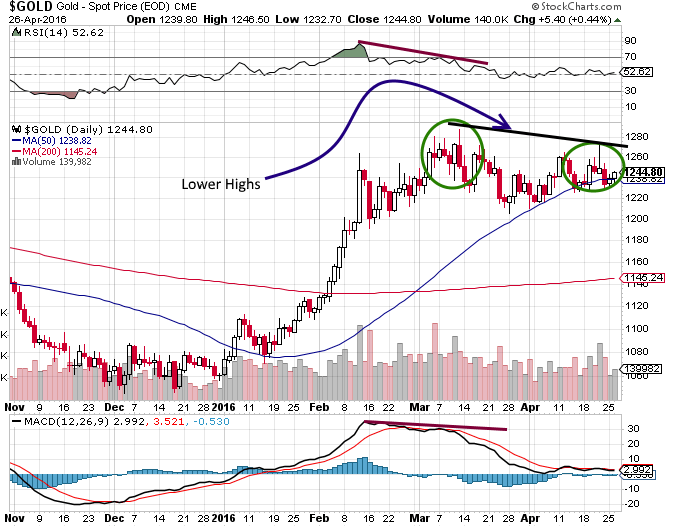
Observe the historical setup. The 2016 gold chart shows a series of lower highs accompanied by repeated negative divergence signals. In technical terms, that pattern reflects fading momentum. The market was still advancing in price, but the underlying strength was already weakening.
Precious Metals Investing: Opportunity Begins Where Panic Starts
When navigating the precious metals sector, history functions less like background information and more like a navigation chart. Gold and silver move through cycles driven by liquidity and crowd psychology, not ideology. Fear of currency collapse, distrust of institutions, and promises of monetary salvation appear in every generation and usually intensify at the worst possible moments.
The metals arena attracts strong beliefs. Some investors insist that manipulation explains every price move. Others treat gold as the only legitimate form of money. Both views overlook the central driver of markets: capital flows and positioning. Precious metals rise and fall within the same liquidity cycles that shape equities, bonds, and currencies.
Investors who refuse to study these cycles usually become liquidity for those who do.
The psychology of the hard-money crowd
Gold often attracts investors who approach the metal with ideological certainty rather than analytical discipline. The hard-money community frequently frames gold as the cure for every monetary problem and views fiat currency as permanently doomed.
There is truth in their criticism of monetary excess. Governments have always abused currency systems. Yet believing gold must rise continuously ignores how markets actually function. Liquidity cycles, interest rates, and risk appetite all influence capital flows.
When investors treat gold as a belief system instead of an asset class, they lose timing discipline. Markets do not reward ideology. They reward patience and positioning.
Silver price forecast and the strategic approach
We stated that silver’s first objective was to take out the 2011 high near $50 on a monthly basis, with an ideal extension toward $60. Once that barrier was cleared, the next targets were $99–$105, followed by $120. Both levels were reached.
Now the market needs a cooling phase before the next advance. Investors rarely welcome this stage, yet it is necessary. Patience creates opportunity. Impatience manufactures losses.
Silver first needs to release excess momentum. The technical indicators must drift back toward the oversold zone while price consolidates. No market can rise indefinitely. Continuous vertical advances eventually produce a euphoric top, and those tops collapse once the crowd starts believing the next galaxy is within reach.
That cleansing process appears to be underway. As speculative excess fades and weaker hands exit, the market begins preparing the next structural setup.
The next major trigger occurs if silver closes at or above $120 on a monthly basis. A confirmed breakout at that level opens the door to $199, $210, and $240, with an extreme extension toward $300.
Beyond that, speculation becomes unnecessary. The next meaningful discussion begins only after $210 is decisively taken out. No need to project further until the market earns it.
In conclusion:
Precious metals reward patience more than conviction. Panic and ideological certainty both produce poor decisions because they disconnect investors from market structure.
Markets rarely reward those who chase narratives. They reward those who study cycles and act when the crowd becomes emotional.











I like the proverb how true. I’m not greedy & would take an ounce of brains.
As to Gold-what a difference 2 days make. Looks like Gold resynced[cc]. But when it looks good it should be sold sometimes. How’s that for an analysis. Where now brown cow?
The proverb is excellent and if put into practice the results are almost always positive. Gold did move higher, but from the noise in the Gold camp, you would think it was trading north of $1400. Oil is what has moved nicely, Gold well not yet. It should have put in a series of new 6 month highs, but instead only recently managed to breakout. Depending on your time frame and discipline Gold could be construed as a good investment now. However, we would rather wait for confirmation from several fronts before jumping in. The dollar could trade down to 90 without affecting the bullish pattern. If it were to break below that level decisively on a monthly basis it would alter the outlook.
It is also a matter of time before the US embraces negative rates, and that is an unknown area for Gold.
However, if the long term trend turned positive in Gold we would embrace Gold ASAP and that has not happened yet.
As for your analysis there is some truth to it. It is close to the saying “if it’s too good to be, then it usually is”
Having said, that we are not bearish on Gold and the majority who read this article assumed we are bearish on the metal. They let the headline dictate the way they interpreted the data