

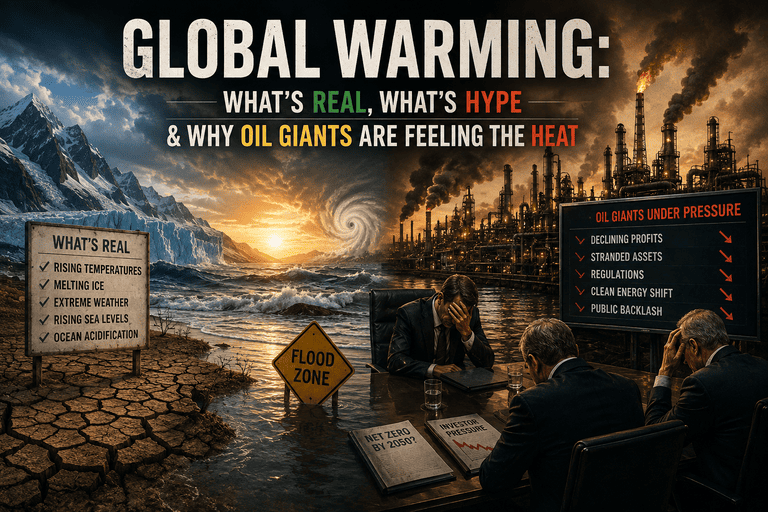
The Global Warming Debate: Climate Reality, Political Hype & Oil’s Next Battle
Aug 19, 2026
The climate debate has become so politically charged that questioning the policy response is often treated as questioning the underlying science, while accepting the evidence for human-driven warming is sometimes portrayed as accepting every prediction, model and government programme built around it. Both positions are intellectually lazy because they collapse several separate questions into one argument, allowing people to defend an entire political framework simply by defending one part of it.
The basic science is considerably less controversial than the political debate suggests. Earth has warmed substantially since the pre-industrial period, atmospheric greenhouse-gas concentrations have increased sharply, and the IPCC and NASA conclude that human activity, particularly greenhouse-gas emissions, is the dominant cause of the warming observed since the mid-20th century. (NASA Science)
That does not, however, settle the much larger questions surrounding climate policy, economic forecasting or the reliability of every dramatic prediction attached to the issue. The existence of warming does not automatically prove that every proposed solution will work, every forecast will be accurate, or every dollar spent on mitigation represents intelligent capital allocation.
The Problem With Turning Science Into Ideology
Climate science describes a physical system, while climate policy attempts to alter economic behaviour within that system, and those are radically different problems. The first can be investigated through temperature records, atmospheric measurements, ocean data, ice cores and physical models, while the second involves politics, technology, incentives, energy security, taxation, industrial capacity and human behaviour.
That distinction matters because a scientific conclusion can be broadly correct while a political response remains inefficient or badly designed. If carbon emissions contribute to warming, that tells us something important about the physical system, but it does not tell us whether a particular carbon tax is optimal, whether banning a particular technology makes economic sense, whether subsidies create unintended consequences or whether governments are capable of allocating enormous amounts of capital efficiently.
This is where the climate debate repeatedly loses perspective. Science can establish a mechanism without establishing the wisdom of every policy built around that mechanism.
The Evidence Has Changed
The original article was written from a period when climate scepticism could reasonably focus heavily on whether warming was occurring and whether humans were responsible, but the evidence has become considerably stronger since then. NASA’s current assessment states that the planet’s average surface temperature has risen by roughly 1°C since the late 19th century, while the IPCC concludes that human influence has unequivocally warmed the atmosphere, ocean and land. (NASA Science)
NASA’s latest temperature data also show that 2024 remains the hottest year in the instrumental record, with 2025 effectively tied with 2023 within the margin of error, reinforcing the longer-term warming trend rather than eliminating it. (NASA)
None of this means the climate changes in a perfectly straight line, because natural variability remains important and phenomena such as El Niño, volcanic activity and solar variability can produce substantial short-term fluctuations. The mistake is using those fluctuations to argue that the longer-term trend does not exist, just as it would be a mistake to use a single hot year as proof that every extreme climate prediction must therefore be correct.
The trend and the noise are different things.
Where Climate Scepticism Still Has a Legitimate Target
The strongest criticism of climate orthodoxy should therefore move away from denying the warming itself and towards examining the enormous assumptions that sit between climate science and economic policy. Climate models are useful tools for exploring scenarios, but a scenario is not a prophecy, and the further we project into the future, the more assumptions accumulate around technology, demographics, economic growth, energy consumption, adaptation and political behaviour.
This distinction is crucial for investors because markets operate through expectations, and expectations can become detached from reality in both directions. A company can benefit enormously from investment in renewable energy, batteries, nuclear power, grid infrastructure or data centres without the underlying climate narrative being perfectly accurate, while another company can be destroyed by regulation even if the physical climate impact ultimately proves smaller than projected.
The investment question is therefore not simply “Is global warming real?” but “Which assumptions have already been priced into capital markets, and which remain misunderstood?” That is a much more useful question.
The Media Has Its Own Incentives
Mass media introduces another layer of distortion because dramatic predictions attract attention far more effectively than carefully qualified statements about probability distributions and uncertainty. A headline suggesting that civilisation has ten years left is psychologically powerful, while a scientist explaining that outcomes depend on emissions pathways, feedback mechanisms and probability ranges is unlikely to generate the same level of engagement.
This does not prove that the underlying science is false, just as sensational journalism about a recession does not prove that economic statistics are fraudulent. It demonstrates something more interesting: information changes when it passes through systems designed to capture attention.
Investors already understand this mechanism because financial media repeatedly turns uncertain forecasts into confident narratives, then replaces those narratives when reality disagrees. Climate reporting can experience the same pressure, particularly when scientific uncertainty is converted into political certainty for audiences that already know which conclusion they are expected to reach.
The correct response is neither blind belief nor automatic rejection. It is to examine the underlying data.
The Forgotten Variable: Adaptation
One weakness in many climate discussions is the tendency to focus almost entirely on mitigation while giving insufficient attention to adaptation, technological substitution and human ingenuity. Humanity does not simply sit passively while environmental conditions change, because rising prices encourage substitution, technological constraints encourage innovation and economic incentives continually alter behaviour.
This matters enormously when assessing long-term economic damage because the world of 2050 will not simply be today’s world with a different temperature. Energy systems will change, infrastructure will change, agricultural techniques will change, cities will change and technologies that barely exist today may become economically dominant.
That does not eliminate climate risk, but it complicates simplistic projections of inevitable catastrophe. The future is not merely climate plus time; it is climate interacting with adaptation, technology and human agency.
The Investment Angle Is More Interesting Than the Political Argument
For investors, climate change should therefore be treated as a massive allocation problem rather than a political identity test. Capital will flow towards whatever technologies solve expensive problems most efficiently, whether those technologies are solar, nuclear, natural gas, carbon capture, batteries, grid infrastructure, geothermal power or technologies that have not yet reached commercial scale.
This creates opportunities on both sides of the conventional climate trade. Investors who blindly assume that every green technology will succeed can overpay for companies with poor economics, while investors who dismiss the entire transition as political theatre can miss enormous capital flows into infrastructure, electricity generation, transmission and computing.
Mass psychology makes the situation even more interesting because markets frequently price narratives before they price economics. Once an industry becomes politically fashionable, capital floods towards it, valuations rise and investors begin confusing capital availability with commercial viability.
That is where the contrarian question becomes powerful: Which part of the climate transition is genuinely transformative, and which part is simply a crowded trade wearing a moral narrative?
The Real Hoax May Be Certainty
Those claiming that Global Warming Is a Hoax, make a dramatic claims that the evidence cannot support, but the underlying instinct to question consensus remains valuable if it is redirected towards something more defensible. The real intellectual problem is not that scientists have discovered nothing, nor that warming is imaginary; it is that political systems routinely transform legitimate scientific findings into absolute narratives and then use those narratives to justify policies whose costs, benefits and unintended consequences remain uncertain.
The climate system is complex, the economy is complex and human behaviour is complex, which means anyone presenting a perfectly certain twenty-, thirty- or fifty-year outcome deserves scrutiny regardless of which political side they occupy. A sceptic should therefore be sceptical of exaggerated climate claims, but should apply exactly the same scepticism to claims that human activity has no meaningful influence on climate.
Scepticism loses its value when it becomes another form of certainty.
Follow the Evidence, Not the Tribe
The Tactical Investor approach has always been more useful when it separates observation from narrative, and climate change deserves exactly the same treatment. The evidence supports significant warming and a dominant human contribution, but that evidence does not provide a blank cheque for governments, corporations, activists or investors to assume that every proposed response is rational or economically efficient.
The smarter position is uncomfortable because it refuses to join either flock. Accept the physical evidence where it is strong, question the assumptions where uncertainty remains, examine the economic consequences, follow the capital and remain alert to the possibility that the crowd can be simultaneously correct about the problem and completely wrong about the investment opportunity.
That is where the real advantage lies. Global warming does not need to be a hoax for climate hysteria to create bad investments, just as climate change does not need to be catastrophic for adaptation and energy transformation to create enormous opportunities. The market does not reward political loyalty. It rewards understanding the vectors beneath the narrative, and climate change is no exception.

In Case You Missed It












WTF? An informative article trashed by a moronic headline and tags. Is that you Vladimir Basic? If so, you’re a fucking idiot.
Tracking back through the articles you’ve posted over the past couple of months I see that your climate change denialism has no scientific basis. Instead you’ve lazily fallen for Big Oil funded misinformation campaigns such as the 1998 petition by 32k “scientists” (anyone with a degree was entitled to sign it) which you dragged up again on 22 March, despite it having been discredited 10 years ago:
http://www.theguardian.com/environment/2006/sep/19/ethicalliving.g2
Your article ‘Global Warming Hoax destroyed by Nobel Laureate’ was based on the views of Dr Ivar Glaever, whose lack of credibility in the field of climate change was ruthlessly exposed in 2012:
http://www.skepticalscience.com/ivar-giaever-nobel-physicist-climate-pseudoscientist.html
By any standards this is sloppy journalism of the worst kind.
A suggestion to help you avoid further embarrassment, assuming your attention span stretches to a 27 page document: read the IPCC’s 5th assessment report summary for policy makers of the physical science basis for climate change:
http://ipcc.ch/pdf/assessment-report/ar5/wg1/WGIAR5_SPM_brochure_en.pdf
Then, if you can, produce evidence that negates it. Good luck with that.
It would not hurt if you actually stated some facts other than posting an idiotic phrase. Global Warming is a scam. While We don’t favour what big oil companies are doing, the science being Global warming is faulty at best. In the future, please post something of value as opposed to a blanket statement that is meaningless
One word Geo-magnetism. the world has gone through such phases before. And there is a host of science which I am sure such a scholarly person such as yourself has failed to look at, which shows that higher C02 levels are more conducive to health and longevity. I won’t bother providing you the information as you are already lazy. Look at the St Lazarus clinic.
Finally, anyone with a shred of common sense would know that with AL Gore that the frontier something is amiss, but that big fact slipped your mind. Oh the co founder of Green peace is also in our camp
Are you talking to yourself?
“Global warming is a scam” is both an idiotic phrase and a blanket statement that is meaningless.
Just follow my prescription: inform yourself be reading some actual science instead of falling hook, line and sinker for Big Oil funded misinformation.
Evidently you’re content with a career in trotting out bullshit.