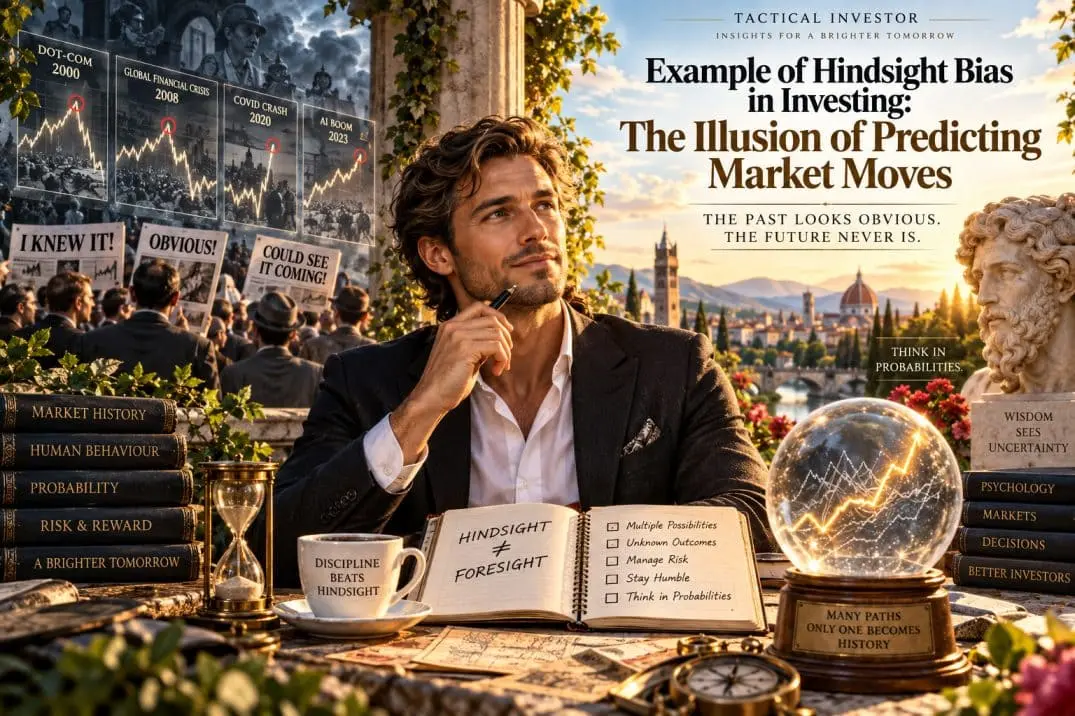
Example of Hindsight Bias: Why the Market Always Looks Obvious After It Happens
September 15, 2026
Financial markets create a peculiar psychological illusion: once something has happened, it suddenly looks as though it was obvious all along. A crash appears inevitable after the market has collapsed, a bubble looks ridiculous after it bursts, and a spectacular rally seems perfectly predictable once prices have already exploded, allowing investors to rewrite the uncertainty that existed beforehand and convince themselves they could have seen everything coming.
This is hindsight bias, and it is far more dangerous than simply remembering the past incorrectly. It can make investors overestimate their predictive ability, underestimate the uncertainty that existed at the time, and become increasingly confident that the next major market move will be obvious before it happens. That confidence is expensive and the market does not reward you for explaining yesterday. It rewards you for making decisions when tomorrow is still uncertain.
Hindsight Bias: The Illusion That You Knew It All Along
Hindsight bias occurs when people look backward after an event and believe they would have predicted it beforehand. In financial markets, the distortion is particularly powerful because markets generate endless explanations for price movements, meaning that almost any major event can be made to appear inevitable once the outcome is known.
Consider the 2008 financial crisis. After the collapse, it was easy to construct a convincing narrative explaining the housing bubble, excessive leverage, deteriorating credit and systemic risk, but knowing those factors existed before the collapse was very different from knowing exactly when they would overwhelm the system, how quickly the breakdown would occur, and how far asset prices would fall.
An investor who says, “I knew the crash was coming,” may actually mean something very different from an investor who had a documented forecast, a defined time horizon, a specific position and a risk-management plan before the event occurred. Hindsight removes the uncertainty, the failed alternatives and the ambiguity that existed at the time, leaving behind a clean story that reality never actually provided.
The Past Gets Cleaner Every Time You Remember It
The human brain does not replay the past like a video recording. Memories are reconstructed, and once we know the outcome, that knowledge can contaminate how we remember what we previously believed.
This creates a particularly dangerous problem for investors because successful predictions become psychologically larger while failed predictions quietly disappear. An investor may remember the one time they warned about a crash while forgetting the five earlier warnings that produced nothing, creating the illusion of extraordinary foresight from a record that was actually far more uncertain.
Several psychological mechanisms reinforce this process:
- Memory reconstruction: Once the outcome is known, our recollection of what we previously believed can shift toward that outcome.
- Narrative construction: Humans naturally search for coherent explanations, so a chaotic market event can be transformed into a story that makes the outcome appear inevitable.
- Confirmation bias: Investors tend to remember evidence supporting their existing beliefs while discounting evidence that contradicted them.
- Selective memory: Correct calls are remembered, while incorrect calls are often rationalized, forgotten or quietly rewritten.
The result is an investor who becomes increasingly confident without necessarily becoming more accurate.
The Market Looks Obvious Only After the Damage Is Done
This is where hindsight bias becomes particularly destructive. Look at a chart after a major crash and the decline appears obvious. You can draw the resistance level, identify the deterioration in momentum, point to the valuation excesses and explain precisely why the market should have fallen. But none of those observations tells you whether the market would have collapsed next week, next year or five years later. That is the trap.
Charts contain information, but hindsight allows us to select the information that mattered after we already know the answer. The investor therefore needs to distinguish between recognizing a pattern and proving that the pattern had predictive power before the event occurred.
Technical analysis can help investors study price behaviour and market structure, but it should not be transformed into a retrospective fortune-telling exercise. Technical Analysis of Stock Trends. The important question is not whether a chart looks obvious today. It is whether the information available at the time justified the decision that was made.
The Biggest Hindsight Trap: Confusing Explanation With Prediction
Markets generate explanations effortlessly. After prices rise, analysts explain why investors became optimistic. After prices fall, they explain why investors became fearful. After a crash, they explain the economic weakness that caused it, and after a recovery, they explain why the recovery was inevitable.
Explanation is not prediction. You can explain an event perfectly and still have been incapable of predicting its timing, magnitude or sequence beforehand. This distinction becomes particularly important when investors evaluate market commentators, analysts and their own historical decisions because a forecast should be judged according to what was actually knowable when the forecast was made.
A useful record therefore contains the original thesis, the assumptions behind it, the expected time frame, the conditions that would invalidate it and the alternative scenarios that were considered. Without that record, hindsight can quietly rewrite the past and make almost any investor appear more accurate than they actually were.
Randomness Makes the Illusion Even Stronger
Short-term markets contain an enormous amount of noise, and that noise creates another problem for hindsight bias because random outcomes can produce remarkably convincing patterns.
Imagine thousands of investors making different forecasts. Some will inevitably make several correct calls in succession simply through probability, while others will experience a sequence of failures. The successful investors may then construct elaborate explanations for their apparent superiority, while the crowd interprets their recent success as evidence of exceptional forecasting ability.
This does not mean skill is irrelevant. It means that a successful outcome is not automatically evidence of a successful process. The only reliable way to separate skill from luck is to examine decisions over time, including the assumptions, probabilities, risk taken, alternatives considered and results across multiple environments. A single spectacular prediction proves very little, particularly when hindsight makes the prediction appear more precise than it actually was.
The Dangerous Confidence That Comes After the Crash
Hindsight bias becomes especially dangerous after a major market event because investors feel they have learned something when they may simply have learned an explanation. The investor watches a crash unfold and concludes that the warning signs were obvious. They then become more confident about identifying the next crash, increase their bearish positioning, and eventually discover that markets can remain irrational, optimistic or simply unpredictable far longer than their retrospective analysis suggested.
The same thing happens after powerful rallies. An investor watches a stock rise 300%, identifies the early signals and concludes that the opportunity was obvious. The next time a similar pattern appears, they assume the outcome will repeat, ignoring the fact that the original result depended on a unique combination of valuation, liquidity, sentiment, fundamentals and timing. Hindsight turns uncertainty into certainty and that is precisely why it must be resisted.
Stop Trying to Predict the Past
The antidote to hindsight bias is not to stop analysing markets. It is to become much more disciplined about what analysis actually means. Before making an investment decision, ask what you know, what you do not know, what assumptions you are making, what could invalidate the thesis, and what alternative outcomes remain plausible. Record those assumptions before the outcome occurs, because doing so prevents the future from being smuggled into your memory of the past.
This is where probability becomes more useful than certainty. Bayes’ Theorem and Investing provides a framework for updating beliefs as new evidence arrives rather than pretending that the eventual outcome was predetermined. The objective is not to eliminate uncertainty and the objective is to make better decisions while uncertainty still exists.
Use Adversarial Thinking Against Yourself
One of the strongest defences against hindsight bias is to attack your own thesis before the market has a chance to do it for you. If you believe a stock is going higher, deliberately search for evidence that could prove you wrong. If you believe a crash is approaching, identify the conditions that would invalidate that conclusion. If you believe a company is undervalued, ask what information the market may know that you have failed to consider.
This is uncomfortable because investors naturally prefer information that confirms their existing beliefs. That discomfort is useful. A strong investment process should make it difficult for you to rewrite reality simply because reality disagrees with you.
The Investor’s Real Edge Is Not Prediction
Markets are complex adaptive systems in which millions of participants respond to one another, to new information, to prices and to their expectations about what everyone else will do next. This means that even sophisticated models cannot remove uncertainty from the system, because the participants themselves are constantly changing their behaviour in response to the system they are attempting to understand.
That is why the goal should not be perfect prediction. The goal should be prepared recognition. You want to recognize when sentiment has become extreme, when price has deviated substantially from reasonable value, when momentum is losing force, when breadth is deteriorating or improving, and when the crowd is becoming either dangerously confident or excessively fearful. You are not trying to know exactly when the market will turn. You are trying to recognize when the conditions surrounding that turn are becoming increasingly visible.
Hindsight Bias Is the Enemy of Intellectual Honesty
The most dangerous consequence of hindsight bias is not that it makes people remember incorrectly. It is that it allows them to become confident for the wrong reasons. An investor who believes every major market event was predictable eventually becomes convinced that the next one will be predictable too. That belief encourages excessive risk, oversized positions and the abandonment of humility, precisely when uncertainty should be commanding greater respect.
The antidote is intellectual honesty. Write down what you believe before the outcome. Assign probabilities rather than pretending to know. Define what would prove you wrong, and then evaluate yourself against the information that was actually available when the decision was made. Do not judge a forecast simply because it eventually came true, instead, judge the process that produced it.
The Future Is Still Unwritten
The market will always tempt you with the illusion that everything can be explained. After a bubble bursts, the warning signs will appear obvious; after a crash, the causes will seem perfectly logical; and after a spectacular rally, the opportunity will look as though it was sitting in plain sight.
But the future did not contain that certainty. The investor’s job is therefore not to construct increasingly impressive explanations for what already happened. It is to remain capable of making rational decisions while the outcome is still unknown, because that is the only moment when an investment decision actually matters.
Hindsight says, “I knew it.” Discipline asks, “What did I know before it happened?” And that question changes everything. The strongest investor is not the person who can explain every market move after the fact. It is the person who can look at uncertainty without inventing certainty, recognize the limits of prediction without becoming passive, and maintain enough discipline to act when emotion creates an opportunity.
Markets will continue producing surprises, human beings will continue pretending they were obvious, and hindsight will continue turning uncertainty into a story that feels like foresight. Do not fall for it.