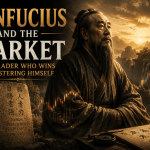
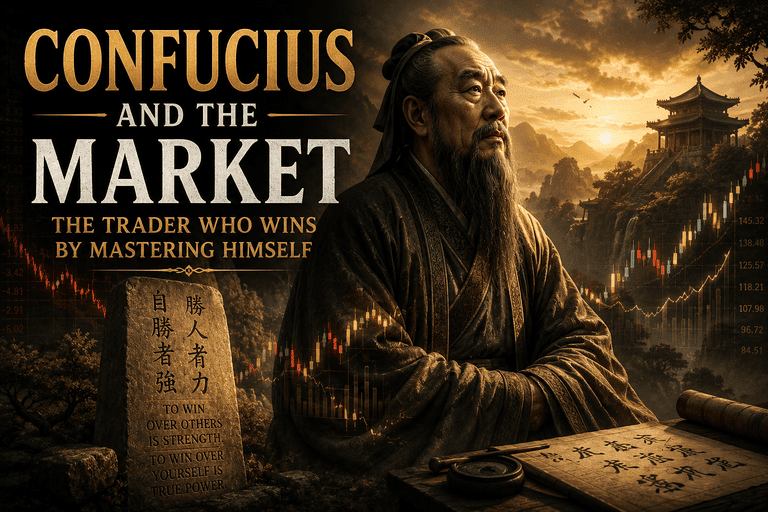
Confucius and the Market: The Trader Who Wins by Mastering Himself
August 19, 2026
Confucius never traded a stock, studied a candlestick or opened a brokerage account, yet his philosophy contains an unusually powerful framework for navigating markets because he spent far more time studying human behaviour, judgement, discipline, learning and the consequences of acting without understanding than most modern trading systems spend studying price. The mistake is to turn Confucius into another collection of motivational quotations; the more interesting approach is to translate his principles into a market framework, then combine them with mass psychology and vector analysis to understand not only what the crowd is doing, but why it is doing it and when its behaviour begins to become strategically unstable.
The central idea is simple: the trader who cannot govern himself will eventually be governed by the crowd, because markets continuously manufacture situations designed to trigger impatience, imitation, fear, greed and overconfidence. Confucius built his philosophy around self-cultivation, disciplined learning and the development of judgement, and that makes his ideas surprisingly compatible with a market framework in which the greatest threat is rarely lack of information but the inability to process information without becoming part of the psychological machinery producing the price. (Stanford Encyclopedia of Philosophy)
The First Trade Is With Yourself
Confucius placed extraordinary importance on self-cultivation, arguing that understanding develops through study, reflection and repeated practice rather than through instinct or superficial knowledge. The Analects repeatedly returns to the idea that learning without reflection is insufficient, while reflection without learning is dangerous, creating a balance that translates almost perfectly into trading: data without interpretation becomes noise, while interpretation without evidence becomes imagination.
This creates the first Confucian trading principle: before attempting to predict the market, learn to observe your own reactions to it, because the investor who becomes euphoric during a rally, terrified during a correction or desperate to prove a thesis has already surrendered part of his decision-making process to the market. Self-discipline is therefore not an ornamental virtue added after the strategy has been built; it is the operating system that determines whether the strategy survives contact with reality.
The market constantly asks the same question in different forms: Can you remain yourself while everyone around you is becoming something else? That question sits directly inside mass psychology, because the crowd becomes most powerful when individuals stop evaluating independently and begin using the behaviour of others as evidence that their own behaviour must be correct.
Study Before You Act
Confucius did not treat knowledge as something acquired once and then permanently possessed, because genuine understanding required continuous study, observation and refinement. He also placed importance on learning from others, including recognising both their strengths and their weaknesses, which creates an unusually practical principle for investors: every market participant becomes a potential source of information if you can separate useful behaviour from the emotional reasons behind it. (Chinese Text Project)
That means the serious trader studies more than charts and financial statements, because the market contains several layers operating simultaneously: fundamentals determine what should matter over time, price reveals where capital is actually moving, sentiment shows how participants interpret information, and positioning reveals how much of that interpretation is already embedded in the market.
This is where your mass-vector framework adds another dimension to Confucian thinking, because instead of merely asking whether investors are optimistic or pessimistic, it asks whether their beliefs are becoming concentrated enough to create a directional force. Ten million investors can be emotional without producing a powerful market vector if their beliefs conflict with one another, but when fear, leverage, media narratives and positioning begin pointing in the same direction, emotion becomes organised energy and price can move far beyond what any individual fundamental variable would suggest.
The Crowd Is a Teacher, Not a Master
Confucius encouraged learning from others, but that does not mean surrendering judgement to them, and this distinction is crucial because the market rewards observation of the crowd while punishing obedience to it. The crowd contains information because collective behaviour reveals what millions of participants currently believe, yet the same crowd can become dangerously distorted when imitation, confirmation bias and fear begin reinforcing one another.
This creates a paradox that the modern investor should exploit: the crowd is often most informative when it becomes least reliable. Extreme bullishness tells you that risk appetite is widespread, extreme pessimism tells you that risk aversion has become dominant, and violent positioning changes tell you that expectations are being repriced, but none of those signals automatically tells you what to buy or sell because the strategist still has to determine whether the underlying system is confirming or contradicting the psychological movement.
That is where Confucian restraint becomes strategically useful, because the correct response to an extreme is not automatically to oppose it but to investigate it. If everyone is bullish and the underlying structure continues improving, fighting the trend simply because it is popular is vanity; if everyone is bullish while breadth, liquidity and earnings expectations begin deteriorating, however, the same enthusiasm becomes a potential warning that the crowd’s confidence is moving faster than reality.
Harmony Does Not Mean Agreement
One of the most misunderstood aspects of Confucian philosophy is the importance placed on harmony, because harmony does not mean that everyone must hold identical opinions or behave identically. Confucian thought connects harmony with appropriate relationships and disciplined conduct, meaning that order emerges when different elements operate within a coherent structure rather than when every element is forced into uniformity.
That distinction is extraordinarily useful in markets because a healthy market does not require everyone to be bullish, nor does it require everyone to be bearish; it requires disagreement, because every transaction requires a buyer who sees value where the seller sees risk and a seller who sees risk where the buyer sees value. The danger appears when disagreement collapses into one-sided conviction, because markets become vulnerable when almost everyone is positioned for the same outcome and therefore has fewer remaining buyers or sellers capable of sustaining the move.
Your vector framework turns this into something measurable: coherence increases force, but excessive coherence increases fragility.
When capital, sentiment, leverage and narrative all point in one direction, the trend can become extraordinarily powerful, yet the same concentration creates a structural weakness because any significant change in the dominant belief forces participants through the same narrow exit. That is why market tops and bottoms often feel irrational while they are forming, because the crowd is not simply changing its mind; it is attempting to escape a previously shared reality at the same time.
Confucius Would Not Chase the Crowd
Confucius’ emphasis on propriety, restraint and self-command provides another useful distinction between participation and imitation. The disciplined investor does not need to reject the crowd, because trends can contain genuine information and powerful momentum, but neither should he surrender his judgement simply because everyone else appears certain.
This is where a modern version of Confucian discipline becomes a trading rule: participate when the vector is strong and coherent, reduce exposure when the vector becomes excessively crowded, and become aggressive only when perception and underlying reality diverge enough to create asymmetry.
That framework is different from conventional contrarianism because it does not assume the crowd is always wrong, and it does not require predicting the exact turning point. Instead, it treats consensus as a variable that changes the risk structure of the trade, allowing the investor to recognise that a rising market can remain attractive while expectations are still expanding rationally, but becomes progressively more fragile when the majority begins treating continued appreciation as inevitable.
Mark Twain’s famous observation that history does not repeat itself but often rhymes fits neatly here, because markets rarely reproduce the same event with identical circumstances, yet human reactions to uncertainty, wealth, loss and social pressure repeatedly generate recognisable patterns. The names change, the technology changes and the narrative changes, but the underlying human vector often remains remarkably familiar.
The Confucian Edge Is Patience With Purpose
Patience is frequently misunderstood as inactivity, but Confucian discipline suggests something more demanding: patience should be the product of preparation rather than indecision. An investor who has studied the business, understood the market structure, measured sentiment and defined the conditions that would invalidate the thesis can wait without becoming psychologically dependent on immediate results, whereas an investor without preparation experiences every passing day as a demand to act.
This distinction becomes critical during market volatility because the crowd creates artificial urgency, making investors feel that every price movement requires a response and every headline represents a new reality. The disciplined trader instead asks whether anything fundamental has changed, whether the dominant vector has shifted and whether the probability distribution has materially changed, because if the answer is no, movement alone is not a reason to abandon the strategy.
The greatest advantage of patience is therefore not that it prevents mistakes; it creates optionality, because capital that has not been committed to mediocre opportunities remains available when a genuine asymmetry appears.
Learning From Mistakes Without Becoming Them
Confucian self-cultivation also provides a useful answer to one of trading’s most destructive psychological problems: ego attachment. A losing trade can either become evidence that the investor is incompetent or become information that improves the next decision, and the difference depends entirely on whether the trader treats the market as a judge of personal identity or as a continuous source of feedback.
This is where mass psychology and Confucian learning intersect most effectively, because every mistake can be examined at several levels: was the fundamental thesis wrong, was the timing wrong, was the crowd’s psychology misunderstood, was the position too large, or did the trader simply refuse to accept information that contradicted the original belief? The purpose of the review is not to create a story that protects the ego but to identify which vector was misunderstood so that the next decision begins from a stronger informational position.
A trader who learns from the market becomes progressively harder to manipulate, while a trader who repeatedly defends his previous decisions becomes increasingly predictable, and predictable participants are exactly what mass psychology feeds upon.
The Superior Trader Does Not Need to Be Certain
Confucian philosophy ultimately points towards cultivated judgement rather than omniscience, and that is perhaps the most useful lesson for modern markets because certainty is usually a psychological luxury that markets cannot afford. The investor does not need to know exactly what will happen; he needs to understand the conditions under which one outcome becomes more probable than another and then structure his exposure so that being wrong does not remove him from the game.
That is where mass-vector psychology completes the framework: Confucius teaches the trader to govern himself, while vector analysis teaches him to read the behaviour of everyone else. One controls the internal variable; the other measures the external environment, and the combination creates a far stronger system than either discipline can provide alone.
The crowd supplies the force, the market supplies the feedback, price reveals the conflict and discipline determines whether you exploit the movement or become part of it. The strategist therefore does not ask, “How do I beat the market?” because that question assumes the market is an opponent that can be defeated; he asks, “What is the market telling me about the people participating in it, where is their collective behaviour becoming excessive, and how can I position myself without surrendering control of my own judgement?”
That is the Confucian market strategy. Learn before acting, observe before judging, discipline yourself before challenging the crowd, and let the vector tell you when patience should become action. The market does not have to be defeated. You simply have to become harder for it to defeat.

Ideas That Challenge Consensus