

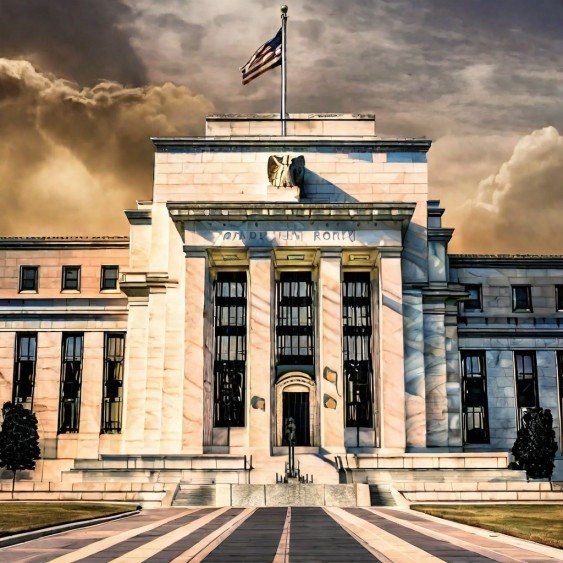
End of Cash: Fed’s Titan Clash
Nov 6, 2025
Cash is dying, and the killers wear suits and spreadsheets. They do not act by accident. They engineer consent, then declare the outcome inevitable. Negative rates, digital currency pilots, and a bloated central balance sheet combine into one single program: shrink the role of physical money, centralise control, and convert private liquidity into institutional leverage.
The Fed’s balance sheet sits north of $6.5 trillion today. That is not neutral bookkeeping; it is firepower parked in reserves while retail faces tighter credit. The Fed can flood markets and then refuse to let money circulate freely. That separation between stockpiles and velocity is the active policy. You see abundance on paper and stagnation in the streets. (Federal Reserve)
Velocity proves the point. M2 velocity collapsed after 2008 and has never returned to its old rhythm. Today, M2 turns roughly 1.39 times per year, not the 2.0-plus circulation of earlier cycles. Money exists, but it no longer moves through commerce the way it once did. That arrested flow makes the stimulus theatrical. You can print liquidity, yet the public still feels poorer. (Macrotrends)
Negative rates are a blunt instrument and a social scalpel. Some advanced economies flirted with subzero policy for years. Negative policy does two things: it taxes hoarders and it makes cash expensive to hold in the formal system. When cash becomes a liability, people accept substitutes that carry surveillance. That is the point. Push interest into negative real territory, and the public hands over anonymity for convenience. (World Population Review)
Corporate America reads this script and borrows the plot. Buybacks exploded as the path of least resistance. Firms borrowed cheap funding to repurchase shares instead of investing. In 2024, S&P 500 buybacks set records near $942 billion for the year, and headline buyback plans hit more than $1 trillion in follow-on announcements. That is balance-sheet engineering dressed as shareholder love. It props valuations while real productive investment atrophies. (News Release Archive)
Ask not whether the Fed can break markets. Ask whom the market breaks for. The modern central bank has two levers: price signals and architecture. They control interest rates and the plumbing of payments. CBDC experiments and tokenisation discussions at the BIS and IMF are not futuristic thought experiments. They are infrastructure blueprints for routing every payment through a programmable core. That level of control makes negative rates permanent, reversible, and targetable. (IMF)
Design choices matter. A well-designed retail CBDC can preserve privacy, but most pilots do the opposite. The IMF and BIS documents make privacy a policy question, not an automatic feature. Once payments become digital by default, authorities gain immediate visibility into who spends what, where, and when. That visibility turns monetary policy into fiscal policy on demand. Want to incentivise consumption in a sector? Program credits into selected wallets. Want to punish dissent? Halt transactions. The tech is neutral; the governance is not. (IMF)
This is not a theory. Watch how liquidity behaves near market stress. The Fed can stop letting bonds roll off, pivot to reinvestment, and reverse supposed tightening within weeks. Recent policy shifts show the Fed ending its balance sheet reduction and pivoting to reinvestment when money markets tightened this autumn. Policy swings are no longer slow motion; they are tactical responses calibrated to prevent any disorder that the system cannot contain. That agility works for creditors and large counterparties, not for hourly wage earners. (Reuters)
The social outcome is predictable. A financial regime that converts cash into tracked, programmable entries concentrates risk and power. Households lose bargaining power. Small firms lose optionality. Banks become conduits for centralised mandates rather than community lenders. The policy math rewards asset holders. The price of that reward is the erosion of transactional anonymity and the amplification of surveillance capitalism.
For you who read markets, the imperative is clarity. First, stop treating cash as quaint. Treat it as a policy variable—second, separate liquidity from fungibility. Central banks can create liquidity without restoring fungibility. Third, a position for policy asymmetry. When central banks backstop markets, they also develop cycles in which asset prices rally on promises and correct on delivery gaps. That is where most retailers lose their shirts.
Tactically, watch these three indicators like a predator: central bank balance sheet trends, M2 velocity changes, and corporate buyback flow. When the balance sheet rises while velocity falls, the system prefers asset inflation over wage growth. When buybacks accelerate into rate cuts, expect equities to climb even as real economic activity lags. When CBDC pilots shift from opt-in to default provisioning, prepare for a policy that can microtarget spending and freeze accounts.
This is a war on cash, not because technocrats hate paper money, but because digital money solves a problem they have: how to manage expectations and enforce policy without overt coercion. Convert cash into code, and you convert dissent into data. For state actors with balance sheets gorged on securities, that power is irresistible.

End of Cash: Survival and Strike Plan
If the state turns money into code, your first duty is to preserve mobility, privacy, and optionality. That means three concurrent objectives: keep liquid buffers outside immediate surveillance, hold durable non-state stores of value, and make yourself operationally hard to read. Do those three things, and you survive policy shocks. Fail, and you become a predictable data point.
Liquidity ladder, not fantasy. Keep a sliding pool of cash equivalents you can access in minutes, days, and months. A small, tactical cache of physical cash covers immediate card rail collapses. A near-term pool in short-dated government bills or ultra-short funds buys breathing room for weeks. Longer cash reserves should sit in diversified jurisdictions or accounts where withdrawal rules protect you from political freezes. Treat liquidity as operational readiness, not yield hunting.
Own metal, but own it quietly and physically. Physical bullion solves a trust problem that digital entries cannot fix. Hold some at home in a safe, more at a reputable private vault under your control, not in a custodial ETF exposed to paper squeezes. Avoid flashy displays of collection. If you proxy metal exposure via funds, accept counterparty risk and size positions accordingly. Metal is a hedge, not a sermon.
Split custody across systems. No single bank, broker, or wallet should hold your entire life. Use at least three separate channels: a domestic bank for payroll and bills, an offshore account for larger savings and jurisdictional optionality, and a self-custodied crypto wallet for programmable, private transfers when rails fail. Each channel needs its own operational plan, login hygiene, and test withdrawals. Test before trouble, not during.
Privacy as discipline, not paranoia. Remove financial gossip from social platforms. Stop documenting trades and big purchases publicly. Use burner phones for critical transactions, segregate finance devices, and implement basic operational security. Use reputable VPNs and two-factor authentication, but never rely on a single point of failure. Make your financial life compartmentalised and redundant.
Crypto is a tool, not a religion. Self-custody matters more than coin choice—hardware wallets and cold storage place you in direct control of keys, removing custodial risk. Stablecoins tied to significant assets can serve as cash proxies in degraded rails, but they introduce counterparty and regulatory risk. Avoid leverage and avoid exotic tokens for baseline survival. Crypto offers utility for cross-border mobility, not a guaranteed exit.
Business posture, not bravado. If you run or own a company, design payment flows that flex between fiat, stable digital instruments, and barter relationships. Build contingency vendor networks that accept alternative payment forms. Keep payroll structures adaptable, with emergency wage channels ready for rapid redeployment. Corporations that can reprice, pivot payments, and shore up supply chains will survive policy shocks while others choke.
Position assets for policy asymmetry. Favour assets that central planners find awkward to confiscate or control, such as dispersed farmland leases, hard commodities stored under private title, and diversified foreign currency holdings. Real estate in stable legal systems remains useful, but beware property that can be frozen under emergency powers. Corporate bonds of systemically significant issuers offer liquidity but tie you to the very institutions that control rails.
Behavioral protocol beats prediction. Quiet accumulation outperforms public prophecy. Don’t advertise cash stashes or bullion buys. Reduce transaction cadence that creates data footprints. When markets swing, act surgically, not theatrically. Use limit orders away from retail windows, stagger execution across time and venues, and rotate counterparties to prevent patterns from emerging.
Legal first, sovereign second. Everything here works inside lawful frameworks. Use trusts, multi-sig structures, and legal vehicles to add operational barriers to arbitrary freezes. Consult counsel in each jurisdiction before opening accounts or shifting assets. Lawful complexity increases friction for coercive action, and that friction buys time and bargaining power.
Psychology matters. Train for patience. The system rewards the noisy actor who moves first and punishes those who panic. Build rules you cannot break when markets scream. One rule: no leverage in crisis. A second rule: never concentrate liquidity in a single custodial account. A third rule: never announce defensive moves. Obey the rules, and you remove emotion from survival.
When policy tightens into coercion, act like a specialist operative, not a civilian. Execute preplanned withdrawals, route funds through tested intermediaries, and convert part of your savings into assets that transfer outside regulated rails, always within the law. Maintain a durable physical kit of records, passkeys, and unencrypted copies stored offline. That kit buys days, sometimes weeks, to react.
Finally, profit from the chaos by selling certainty. The market will overpay for liquidity, and those who control unmonitored cash will collect premiums during distress. Be ready to lend discreetly, to buy forced sellers, and to provide rails for small supply chains. The edge belongs to those who stay liquid and anonymous, while others liquidate in public.
This playbook demands sacrifice. It asks you to trade convenience for control, social status for anonymity, and short returns for long optionality. Do the work, build the systems, and you move from prey to operator. The state can script payments, but it cannot program a resolution.
If you want, I will translate these protocols into an actionable checklist, including vendor types, jurisdictional trade-offs, and specific sequence of actions for the first 72 hours of a sudden account freeze. Say the word, and I will lay it out step by step, surgical and executable.

Provocative Readings for the Curious