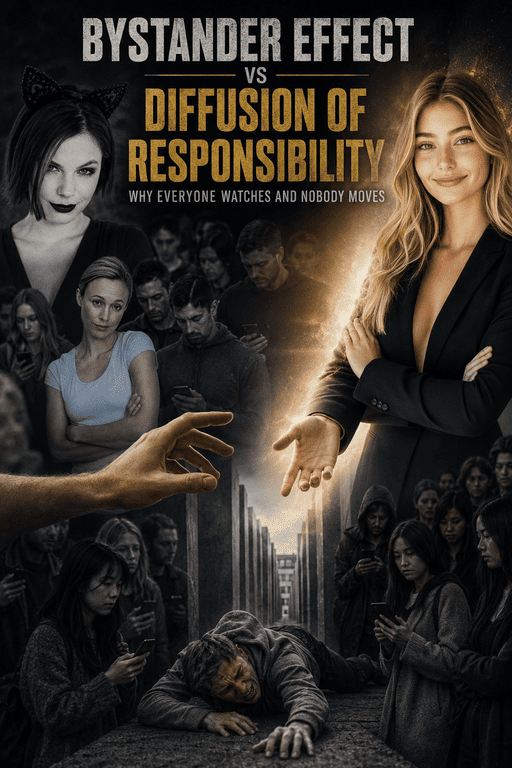
Bystander Effect vs Diffusion of Responsibility: Everyone Saw It Coming. Nobody Moved.
Aug 22, 2026
The most dangerous failures are not always hidden. Sometimes the warning is visible, the evidence accumulates and the risk becomes increasingly difficult to ignore, yet nothing meaningful happens because every person observing the problem assumes that someone else is either responsible for acting or better positioned to understand what is happening. The result is a form of collective paralysis in which awareness increases without producing action, creating the illusion that because everyone can see the danger, someone must already be dealing with it.
The distinction between the bystander effect and diffusion of responsibility helps explain why this occurs. They are closely related but not identical: the bystander effect describes the tendency for individuals to become less likely to intervene when other people are present, while diffusion of responsibility explains part of the mechanism behind that passivity, as the presence of others spreads perceived responsibility so widely that no single person feels fully accountable for acting.
This is not merely a problem associated with emergencies or public crises. The same psychological architecture appears in financial markets, corporations, governments and speculative bubbles, where large numbers of intelligent people can recognise an obvious distortion while remaining trapped inside the collective assumption that somebody else will recognise the danger, act first or possess information that they themselves do not.
The More People Watch, the Less Anyone May Feel Responsible
Individual responsibility is psychologically simple. When one person encounters a problem and nobody else is present, the decision is direct: act, ignore it or accept the consequences of doing nothing. Add more observers and the calculation changes because responsibility is no longer concentrated in one mind, while every additional participant creates another possible explanation for remaining passive.
Perhaps somebody else understands the situation better. Perhaps somebody has already acted. Perhaps the danger is not as serious as it appears because, if it were, surely someone would be doing something.
This is where collective observation becomes dangerous. People do not necessarily fail to act because they are indifferent; they can fail to act because the behaviour of everyone around them becomes evidence that action is unnecessary, producing a feedback loop in which silence validates silence and inaction gradually begins to look like informed judgement.
Markets operate through a similar mechanism. When an asset becomes dangerously overvalued, many investors may privately recognise the problem while remaining invested because the collective behaviour of the market appears to contradict their individual assessment. If everyone else continues buying, perhaps the concern is premature. If major institutions remain exposed, perhaps the risk is already understood and accounted for.
The individual does not abandon judgement completely, but judgement gradually becomes outsourced to the apparent confidence of the crowd.
The Bubble Nobody Wanted to Leave First
Speculative bubbles often contain an extraordinary amount of private doubt. Investors may understand that valuations are stretched, corporate insiders may recognise that expectations have become unrealistic and analysts may privately acknowledge that the prevailing narrative has moved beyond the available evidence, yet recognition alone does not automatically produce action.
Leaving too early can be costly, particularly when the market continues rising and those who remain appear to be rewarded while those who exit are forced to watch from the sidelines as the crowd becomes wealthier. The investor therefore waits, not necessarily because the evidence has become more convincing, but because moving independently carries a cost and somebody else may be willing to take that risk first.
Collective exits rarely begin when everyone agrees that the market has become dangerous. They begin when enough significant participants conclude that the risk of remaining has become greater than the cost of leaving, and once that threshold is crossed, the same crowd that previously created passivity can suddenly produce movement in the opposite direction.
The market therefore moves through two contradictory psychological states. During the advance, the presence of others reduces the urgency to act because everyone appears comfortable and continued participation seems to validate itself. During the decline, the actions of others become evidence that immediate action is required. What looked like stability was often shared hesitation.
Diffusion of Responsibility in Institutions
The problem becomes more complex inside large institutions because responsibility can disappear without anyone explicitly refusing to accept it. A warning may move through analysts, managers, committees, executives and regulators, with each group assuming that another possesses the authority, information or obligation to respond.
By the time the danger becomes undeniable, responsibility can be found everywhere and nowhere. This does not require incompetence. Highly educated and experienced people can become trapped inside structures that fragment accountability, particularly when acting independently creates professional risk while remaining passive appears defensible. A person who raises an alarm too early may be considered alarmist, while the person who waits can later argue that the information was incomplete.
The incentives therefore favour delay, and risk can become most dangerous when it is widely recognised but insufficiently owned. Everyone may know that leverage is excessive, valuations are stretched and the system has become vulnerable, yet the apparent transparency of the problem can create false comfort because the assumption becomes that somebody with greater power will act before the situation becomes critical. Sometimes nobody does.
The Market’s Version of Standing in a Crowd
Investors often imagine that financial decisions are intensely personal because every trade is ultimately executed by an individual or institution, yet markets are deeply social systems and the presence of other participants changes how risk is interpreted.
A falling market can create the assumption that others possess information the individual lacks. Institutional selling, negative headlines and collapsing prices begin to function as evidence in themselves, so even without new fundamental information the crowd’s movement changes the perceived meaning of the situation.
The same process operates during rallies. Rising prices appear to confirm the judgement of those participating, while the absence of visible concern makes caution increasingly difficult to justify, gradually shifting responsibility for evaluating risk away from the individual because the market itself appears to be performing that function.
This is an illusion. The market can aggregate information, but it can also aggregate fear, momentum and imitation, and a rising price does not guarantee that the crowd is correct any more than a falling price proves that the underlying asset has lost its value.
The investor who allows the crowd to perform all independent judgement eventually becomes dependent on the crowd remaining emotionally stable.
Why Nobody Wants to Be First
The first person to act carries the greatest psychological burden because independent action means accepting responsibility for being wrong. Selling too early means watching the price continue higher, while buying too early during a panic means accepting the possibility that the decline will continue, which is why waiting for confirmation feels safer even when the evidence is already visible.
The difficulty is that confirmation often arrives after the asymmetry has disappeared. Once a market bottom becomes obvious, prices may already have recovered substantially, and once the danger of a speculative bubble becomes universally accepted, the opportunity to exit at favourable prices may have passed.
This creates one of the central contradictions of contrarian investing: the conditions that create the best opportunities are often those in which independent action feels least comfortable because the crowd has not yet provided the emotional permission to move.
That does not mean the investor should automatically oppose consensus. Blind contrarianism is merely conformity in reverse. The real question is whether the crowd’s behaviour reflects new information or whether the investor is waiting for the crowd to make a decision that should have been made through independent analysis.
The Contrarian Advantage Begins With Ownership
The practical response is not to become permanently suspicious of groups or to assume that every consensus must be wrong. It is to reclaim responsibility for the decision before the crowd becomes the default source of judgement.
That requires separating three questions that are often collapsed into one:
- What is actually happening to the underlying asset or system?
- What does the crowd currently believe about it?
- What evidence would justify acting even if the crowd continues moving in the opposite direction?
The first concerns reality, the second perception and the third agency. Separating them makes it easier to determine whether market behaviour is communicating useful information or merely amplifying collective emotion. A broad decline in a fundamentally impaired business may represent rational repricing, while the same decline in a financially sound business may create opportunity if the crowd is responding indiscriminately.
The distinction cannot be made by sentiment alone. It requires analysis, patience and a willingness to accept that the crowd may remain wrong longer than expected.
Conclusion: Responsibility Is a Market Variable
The bystander effect and diffusion of responsibility reveal what happens when awareness becomes detached from ownership. One person sees the danger and assumes another will act; the second makes the same calculation, and eventually collective awareness becomes a substitute for collective action.
Financial markets produce their own version of this phenomenon. Investors wait for institutions to recognise danger, institutions wait for policymakers, policymakers wait for clearer evidence, and everyone becomes increasingly dependent on somebody else moving first. During speculative manias, participants wait for others to sell. During panics, they wait for others to buy.
The crowd appears powerful because it contains millions of decisions, yet its weakness may be that no single participant feels responsible for the direction those decisions collectively create.
That is where the individual investor has an advantage, not by assuming the crowd is foolish or opposing it merely for the sake of appearing independent, but by refusing to surrender responsibility for judgement simply because other people are standing nearby. Everyone may see the same danger. The question is whether anyone still believes the decision belongs to them.

Thought-Provoking Reads