

Historical Speculative Bubbles: The Assets Changed. Human Nature Didn’t.
Aug 22, 2026
Historical speculative bubbles are usually explained through the language of prices, valuations and economic excess, yet the numbers are merely the visible residue of something that began much earlier and much deeper, because before a market becomes irrational, a sufficient number of people must first become psychologically aligned around the same possibility, gradually replacing independent judgement with social confirmation until participation itself begins to feel like evidence that the underlying opportunity must be genuine. The crowd rarely announces the moment at which analysis becomes imitation, and therein lies the danger, for the transition is subtle enough to feel perfectly rational while it is occurring, particularly when rising prices reward those who joined early and punish those who hesitated, creating a powerful feedback loop in which wealth appears to validate the narrative, the narrative attracts new participants and the arrival of new participants drives prices still higher.
The assets involved in these episodes have changed repeatedly, moving from tulip contracts and colonial ventures to railway shares, technology companies, property, cryptocurrencies and whatever financial vehicle the next generation discovers, but the underlying machinery has remained remarkably consistent because human nature has not evolved at anything resembling the speed of financial innovation. Every era develops its own explanation for why previous rules no longer apply, and every era eventually discovers that innovation can transform industries without abolishing the psychological forces that govern crowds, which is why historical speculative bubbles should be studied less as museum pieces from the financial past and more as recurring experiments in imitation, expectation, fear and collective belief.
The Crowd Creates Its Own Evidence
A speculative bubble begins with something that contains at least a fragment of legitimacy, whether a new technology, an expanding trade route, an unusual monetary environment or a genuine change in economic conditions, because pure fantasy rarely attracts enough capital on its own to sustain a prolonged advance. The initial participants may even be correct, yet rising prices gradually alter the composition of the crowd as attention shifts away from the underlying development and towards the wealth apparently being created by those who arrived before everyone else, at which point the opportunity ceases to be evaluated primarily on what it produces and begins to be evaluated according to how rapidly its price has risen.
This is where mass psychology begins exerting greater influence than conventional analysis, because people do not merely observe prices as neutral pieces of information; they interpret them through social and emotional filters, particularly when friends, colleagues, neighbours and increasingly the media appear to be benefiting from an opportunity that the observer has failed to seize. The fear of financial loss is powerful, but the fear of exclusion can be equally potent, especially when the crowd begins treating hesitation not as prudence but as evidence that the sceptic simply fails to understand the future.
The result is a self-reinforcing vector in which perception attracts participation, participation strengthens the trend, the trend appears to validate perception and the entire structure acquires an authority that no individual participant consciously created, even though every participant contributes to maintaining it. By the time the bubble becomes obvious to everyone, the crowd is no longer merely following the market; it has become one of the mechanisms through which the market continues to move.
From Tulips to Technology
Tulip Mania remains one of the most recognisable examples of speculative excess, although the popular version of the story is often simplified beyond recognition, particularly the claim that an entire Dutch society abandoned reason and exchanged houses for individual flowers. The historical record is more complicated, yet the episode remains valuable because it illustrates how rapidly a desirable and scarce asset can become embedded within a speculative network once expectations of future price appreciation begin to dominate its practical or aesthetic value.
The South Sea Bubble followed a different path, involving corporate promises, government debt and political influence, but the psychological structure was familiar enough that the details almost become secondary, because rising prices created social proof and social proof attracted further capital until the distance between expectation and underlying economic reality became increasingly difficult to ignore. Once confidence weakened, the same crowd that had interpreted every advance as confirmation discovered that belief could reverse direction, and the financial mechanism that had amplified optimism became equally efficient at transmitting fear.
The dot-com bubble repeated the pattern with a vocabulary appropriate to the technological revolution of its age, and the mistake was not that the internet lacked transformative potential, because history eventually proved precisely the opposite. The deeper mistake was the assumption that recognising a genuine transformation automatically justified every valuation attached to companies associated with that transformation, a distinction crowds often lose when a compelling narrative and rapidly rising prices begin reinforcing one another.
When Euphoria Becomes a Substitute for Analysis
The most dangerous stage of a speculative bubble is not necessarily the point at which the public becomes enthusiastic, but the point at which enthusiasm becomes self-protecting and contrary evidence is absorbed, ignored or reinterpreted so that it no longer threatens the dominant narrative. Markets can remain expensive for extended periods, which is why simple declarations that something is overvalued rarely provide a complete investment strategy, yet there is a difference between recognising an expensive market and recognising one in which participants have begun constructing increasingly elaborate explanations for why the concept of valuation itself should no longer matter.
At this stage, the crowd becomes remarkably efficient at disciplining dissent, not through formal coordination but through a distributed social process in which those who question the prevailing optimism appear increasingly detached from reality as prices continue rising. A sceptic can be wrong for months or years in market terms while still being correct about the underlying imbalance, and this creates one of the most psychologically difficult aspects of contrarian thinking, because independence of thought is easy to celebrate in retrospect but far less comfortable when the crowd appears to be becoming wealthier without you.
The mass psychology of a bubble therefore cannot be understood simply as greed, because greed is too narrow a description for the collection of forces involved, which may include status, imitation, fear of exclusion, overconfidence, narrative reinforcement and the deeply human tendency to assume that a movement which has persisted for a considerable period must possess some permanent quality. The crowd does not need every participant to believe the same story with equal conviction; it merely requires enough participants to continue acting in ways that sustain the collective direction.
The Collapse Begins Before the Panic
Every bubble eventually encounters a point at which the supply of willing buyers begins to weaken, although the first signs of this shift are often subtle because prices may continue rising even as the psychological foundation beneath the advance begins to deteriorate. Momentum slows, reactions to good news become less impressive, previously ignored risks begin attracting attention and the market enters a period during which participants are still attempting to preserve the old narrative even as evidence accumulates that the underlying vector has changed.
This is where the reversal becomes particularly dangerous for late participants, because many remain anchored to the prices that existed only weeks or months earlier and interpret the initial decline as an opportunity to buy more of an asset whose previous ascent has convinced them that recovery is inevitable. The first decline is therefore often absorbed by confidence, but as confidence fails to restore the trend, doubt begins spreading through the same networks that previously transmitted optimism, and the psychological architecture of the bubble starts operating in reverse.
Panic is not simply fear intensified; it is the collapse of a shared expectation, and once enough participants realise that the crowd may no longer provide the liquidity or confirmation they previously relied upon, individual decisions become increasingly defensive. Selling creates lower prices, lower prices alter perception, altered perception encourages further selling and the self-reinforcing mechanism that once produced euphoria now accelerates the retreat.
The Contrarian Does Not Fight the Crowd
The conventional image of the contrarian is often misleading because successful contrarian investing is not built around permanently opposing popular opinion or reflexively buying whatever everyone else dislikes, as a crowd can be wrong for extended periods but it can also identify genuine trends long before the majority understands them. The more useful distinction lies between observing a trend and becoming psychologically absorbed by it, because the investor who can separate price movement from personal identity is better positioned to recognise when mass participation has pushed the risk-reward structure into a different phase.
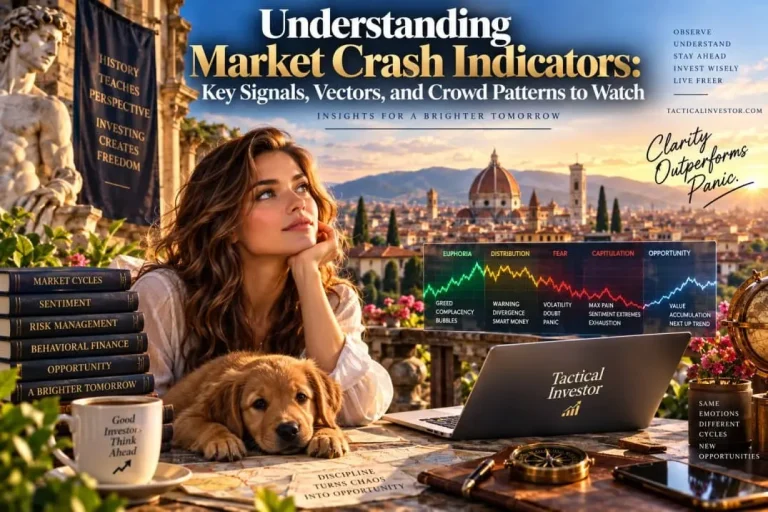
Historical speculative bubbles become valuable precisely because they train the observer to recognise recurring behavioural vectors, beginning with the emergence of a compelling narrative, followed by expanding participation, increasing confidence, widespread imitation, the dismissal of contrary evidence and eventually the point at which the marginal buyer becomes increasingly dependent upon the arrival of another, still more enthusiastic participant. None of these signals alone guarantees a collapse, yet together they create a framework for understanding whether a market is being driven primarily by improving fundamentals or by the expanding psychological need to justify prices already achieved.
The same framework becomes equally useful after a collapse, because the crowd that was once convinced that prices could rise indefinitely may become equally convinced that recovery is impossible, even when the underlying businesses or assets remain capable of surviving the crisis. This reversal creates the environment in which mass psychology can compress prices below reasonable estimates of value, although genuine contrarian analysis still requires distinguishing temporary fear from structural deterioration, since not every collapsing asset represents an opportunity and some businesses or industries deserve to remain permanently impaired.
The Pattern Survives Every Generation
The enduring lesson from historical speculative bubbles is not that markets are irrational all the time, nor that every major advance must end in catastrophe, but that periods of extreme collective confidence and extreme collective fear can alter behaviour so profoundly that price temporarily becomes detached from the slower-moving realities beneath it. Human beings remain highly social decision-makers, and in environments characterised by uncertainty, complexity and rapidly changing information, the behaviour of others becomes an increasingly powerful shortcut for determining what appears safe, dangerous, intelligent or foolish.
That mechanism explains why bubbles can develop around genuinely revolutionary technologies and why crashes can destroy the prices of perfectly viable businesses alongside those that were built upon fantasy, because the crowd does not reverse with surgical precision. It moves through broad emotional vectors, first rewarding participation with increasing confidence and later punishing it with increasing urgency, while individuals caught within the movement often struggle to recognise how much of their own judgement has been shaped by the behaviour they believe they are merely observing.
The assets will continue changing, and each new speculative cycle will arrive wrapped in circumstances sufficiently different to persuade many participants that historical comparisons no longer apply, yet the deeper pattern will remain available to anyone willing to look beneath the surface. Tulips, South Sea shares, railways, technology stocks, property and cryptocurrencies belong to different centuries and different economic systems, but the crowd that carried them beyond reason was responding to a far older set of impulses, and the investor who understands those impulses is not granted the power to predict every top or every bottom, but gains something more useful: the ability to recognise when perception, participation and price have begun moving together so completely that the crowd can no longer see the structure it has built around itself.