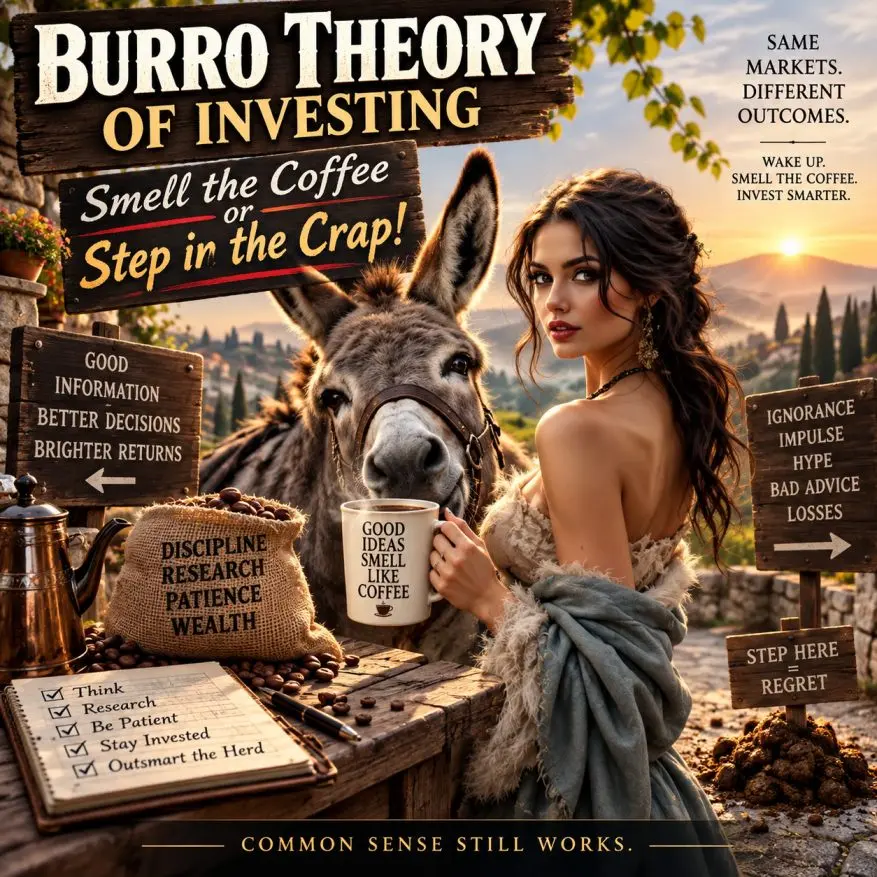
Burro Theory of Investing: Smell the Coffee or Step in the Crap!
Sept 10, 2026
The financial system has always had a problem that investors routinely underestimate: the burden keeps getting heavier, yet the system must keep moving. Debt accumulates, economic pressures change, markets periodically seize up, and governments and central banks respond with policies designed to prevent instability from becoming systemic collapse. This is the basic intuition behind the Burro Theory, a metaphor associated with Luke Gromen that describes a financial system carrying an increasingly heavy load while policymakers continually attempt to keep it moving.
The Tactical Investor interpretation takes the metaphor beyond monetary mechanics. The real opportunity emerges when we combine policy responses with mass psychology, herd behaviour, sentiment, and market vectors, because policy does not move markets in isolation. Investors interpret policy, react emotionally, reposition capital, and frequently overshoot in either direction, creating the very extremes that contrarian investors seek to exploit.
The question is therefore not simply whether the burro is carrying too much weight. It is whether the crowd understands what the burden means, how policymakers are responding, and how investor behaviour is changing as a result.
The Burro and the Financial System
The Burro Theory presents the global financial system as an overburdened animal that cannot simply stop moving without risking serious consequences. Governments and central banks therefore attempt to keep the system functioning through monetary policy, fiscal intervention, liquidity provision, interest-rate adjustments, and other measures designed to prevent financial stress from becoming uncontrollable.
The metaphor is useful because it highlights an uncomfortable reality: policymakers often operate under constraints rather than from positions of unlimited freedom. Excessive debt can restrict policy choices, while aggressive tightening can create financial stress and excessive stimulus can create inflationary or asset-price pressures.
The burro therefore keeps moving, but the path is rarely smooth. This is where investors make their first mistake. They assume that every policy action should be interpreted literally rather than asking how the market will psychologically respond to that action.
Mass Psychology Is the Missing Variable
The Tactical Investor expands the Burro Theory by placing mass psychology at the centre of the analysis. Markets are not machines that mechanically translate interest rates, money supply, inflation, and government spending into asset prices, because human beings interpret those developments and then act on their interpretations.
A rate hike can be interpreted as evidence that inflation is finally being controlled, or as a threat to economic growth. A liquidity injection can be interpreted as a rescue operation, or as evidence that the financial system is weaker than policymakers admit.
The policy is the event. The crowd’s interpretation is the market reaction. This is why sentiment matters so much. Market Sentiment When investors become excessively optimistic, positive developments can already be fully reflected in prices. When fear becomes extreme, negative expectations can become so deeply embedded that even modestly positive developments can trigger a violent reversal. The investor who studies only the policy misses the psychological transmission mechanism.
The Herd Turns Policy Into a Market Event
Herd behaviour magnifies these reactions. Investors observe what other investors are doing, interpret collective behaviour as information, and then modify their own positions, creating feedback loops that can push prices far beyond what the original policy change might justify.
Consider a period of aggressive rate increases. Investors may abandon growth stocks, commodities, or other risk assets because they fear tighter financial conditions, but if that selling becomes indiscriminate, the market can eventually move far beyond what the underlying economic deterioration warrants.
That is where the Tactical Investor approach becomes contrarian. The objective is not to assume that every policy action is bullish or bearish. It is to determine whether the crowd’s reaction has become excessive. If fear has pushed prices below reasonable value, the policy itself may matter less than the psychological distortion created by the policy.
Vector Psychology: Follow the Force
This framework becomes even more useful when viewed through vector psychology. A market vector represents the direction, intensity, breadth, and persistence of the forces moving capital. Policy can initiate or accelerate a vector, but investor behaviour determines whether that force expands, stabilizes, saturates, or reverses.
Suppose markets fall sharply after a central bank announces tighter policy. If selling continues to broaden, momentum deteriorates, and fear intensifies, the bearish vector remains powerful. Fighting that force simply because an asset appears cheap can be premature.
But suppose prices continue declining while selling intensity weakens, breadth improves, and increasingly negative news produces smaller declines. The market may be approaching a transition even though the headlines remain frightening.
The important question becomes: Is the burro still being pushed in the same direction, or is the force moving the market beginning to weaken? That is a more useful question than simply asking whether policymakers are bullish or bearish.
Applying the Burro Theory Across Markets
The Burro Theory can be applied across asset classes because policy changes affect different parts of the financial system differently.
Hard assets: Gold, silver, copper, and other commodities can become increasingly important when investors become concerned about currency purchasing power, supply constraints, fiscal deterioration, or monetary instability. But even here, the investor must distinguish between a genuine structural trend and a crowded trade driven by recent performance.
Growth and momentum stocks: Tightening liquidity can initially damage speculative assets, but excessive pessimism can eventually create attractive entry points when the underlying businesses remain intact. The opportunity comes from identifying when the crowd has priced in an extreme outcome rather than simply buying because prices have fallen.
Cash and liquidity: Liquidity itself becomes an asset during periods of extreme uncertainty because it provides optionality. Investors with available capital are not forced to sell when the crowd panics and can instead evaluate opportunities created by forced liquidation.
Options: Volatility often increases when uncertainty and fear become dominant. For investors who understand the risks, selling cash-secured puts on stocks they genuinely want to own can transform patience into an income-generating strategy, allowing them to get paid while waiting for the market to reach a desired entry level. The common thread is not a particular asset. It is the relationship between policy, psychology, valuation, and the market vector.
Why the Burro Keeps Moving
The strongest part of the Burro Theory is not the claim that policymakers can prevent every crisis. They cannot. Financial systems can experience severe recessions, crashes, liquidity events, defaults, and structural failures despite intervention.
The more useful observation is that policymakers generally have strong incentives to prevent temporary financial stress from becoming a complete systemic breakdown. When markets deteriorate rapidly, authorities often respond because the consequences of allowing a destabilizing feedback loop to continue can become economically and politically unacceptable. This creates an important distinction.
The system can break without the financial system disappearing. A crash can destroy wealth for individual investors while simultaneously creating the conditions for a new cycle. Weak companies can fail, excessive leverage can be liquidated, valuations can reset, and capital can eventually migrate toward stronger businesses and productive assets. The burro may stumble. It may even throw some of its load into the ditch, but the broader economic system continues adapting.
2020: When Fear Met Policy
The COVID-19 crash provides a powerful example of the interaction between mass psychology and policy intervention. In early 2020, fear spread rapidly as investors confronted an unprecedented economic shutdown, and markets experienced one of the fastest declines in modern financial history. The 2020 Market Crash
Then policy changed the psychological environment. Central banks cut rates and introduced extraordinary liquidity measures, while governments deployed enormous fiscal support. The significance was not simply the amount of money involved, but the way those actions changed expectations about the probability of systemic financial failure.
Investors who had sold because they expected economic catastrophe suddenly faced a market responding to unprecedented policy support. This is the Burro Theory in practical form: the burden becomes enormous, the animal begins to stumble, and policymakers attempt to keep it moving. The investor’s job is to understand what happens next.
Inflation, Commodities, and the Psychological Rotation
The inflation cycle produced another version of the same process. As inflation surged, investors became increasingly concerned about aggressive monetary tightening and the economic consequences that could follow.
Commodity markets responded to a combination of supply constraints, geopolitical developments, energy pressures, and changing expectations. Gold, silver, copper, and other hard assets attracted attention, but the crucial investment question was never simply whether inflation was high.
It was whether the market had correctly priced the future path of inflation, policy, supply, and demand. That distinction prevents the Burro Theory from becoming another simplistic macroeconomic slogan. A good framework should explain why markets can initially react one way and subsequently reverse as expectations change.
The Burro Is Not the Investment
This is perhaps the most important lesson. Do not become obsessed with predicting whether the financial system will collapse, whether central banks will print money, or whether debt will eventually become unsustainable. Those questions can be intellectually interesting while providing very little tactical value if they do not tell you what investors are actually doing.
Watch the crowd. Study sentiment. Examine valuation. Monitor liquidity and technical behaviour, and identify whether the dominant market vector is strengthening, weakening, broadening, or narrowing. When fear becomes extreme, determine whether the underlying economic damage justifies the price destruction. When optimism becomes euphoric, determine whether expectations have become so elevated that even good news may no longer be sufficient to push prices higher.
The Burro Theory provides the macroeconomic backdrop. Mass psychology provides the behavioural transmission mechanism. Vector psychology provides the directional framework. Valuation determines whether the resulting dislocation matters.
Conclusion: Smell the Coffee Before You Step in the Crap
The Burro Theory is valuable because it reminds investors that financial systems carry enormous burdens and that policymakers will frequently intervene when those burdens threaten to destabilize the system. But the real investment advantage comes from understanding what happens after intervention, because policy changes expectations, expectations change behaviour, and collective behaviour changes markets.
This is where the Tactical Investor interpretation becomes more powerful than a simple macroeconomic metaphor. The investor is not merely watching governments and central banks; the investor is watching how millions of participants interpret what governments and central banks are doing.
That distinction can expose opportunities that conventional analysis misses. A market can fall because the economy is deteriorating, or it can fall far more than the deterioration warrants because fear has become the dominant force. A market can rise because fundamentals are improving, or it can rise far beyond reasonable valuation because liquidity, greed, and herd behaviour have created a self-reinforcing feedback loop.
The tactical investor studies the difference. The burro will continue carrying its burden. The financial system will continue experiencing stress, intervention, adaptation, excess, and correction. The objective is not to pretend that the system is perfectly controlled, but to recognize that instability itself creates psychological extremes, and those extremes can create opportunities when price becomes disconnected from value.
Smell the coffee and understand the system, understand the crowd, understand the vector, and most importantly, understand what the market is pricing before you decide what the market should be doing.