

Compound Interest and the Tyranny of Time: Why Wealth Favors Those Who Can Wait
Aug 12, 2026
Most people understand compound interest mathematically, yet remarkably few understand it psychologically, because the formula is simple while the behaviour required to exploit it is almost unnatural: you must allow something small and seemingly insignificant to continue working long after your attention has moved elsewhere. A hundred becomes a hundred and ten, then a hundred and twenty, and eventually the numbers begin behaving in ways that seem disproportionate to the original capital, not because anything magical happened, but because each gain quietly became part of the machinery producing the next gain. Time does not merely pass while capital compounds; time becomes the mechanism that transforms modest advantages into disproportionate outcomes.
This is why compounding is less a mathematical trick than a test of temperament, because the early stages are almost insulting in their lack of drama while the later stages can appear almost impossible to explain to someone who entered the process halfway through. The person watching from the outside sees wealth accelerating and assumes intelligence, luck or some hidden advantage must be responsible, while the person who began years earlier knows that the real advantage was simply remaining exposed to a productive process while everyone else kept interrupting theirs. The greatest threat to compounding is therefore not a bad formula but human impatience.
The Strange Relationship Between Time and Wealth
Time has always been difficult for human beings to conceptualise because we experience it linearly while many important processes develop exponentially, which creates a psychological mismatch between what we expect to see and what eventually appears. A seed does not resemble a tree, and a small investment does not resemble a fortune, yet both contain the same underlying principle: the visible result can remain unimpressive for an unusually long period before accumulated effects suddenly become impossible to ignore.
The market amplifies this phenomenon because capital does not compound in isolation from human behaviour, and investors constantly interrupt the process through fear, boredom, overconfidence and the irresistible temptation to do something simply because doing nothing feels unproductive. The paradox is that the investor who spends the most time trying to improve every short-term outcome can easily destroy the very time advantage that creates the largest long-term outcome. Compounding rewards continuity, while human psychology keeps trying to break it.
That is why time should be viewed as a form of capital rather than merely a measurement, because every year an asset remains productive gives the underlying earnings, dividends, reinvestment and appreciation another opportunity to interact with what came before. Lose money and you lose capital; waste time and you lose something even harder to recover, because yesterday cannot be reinvested.
The Crowd Has a Different Clock
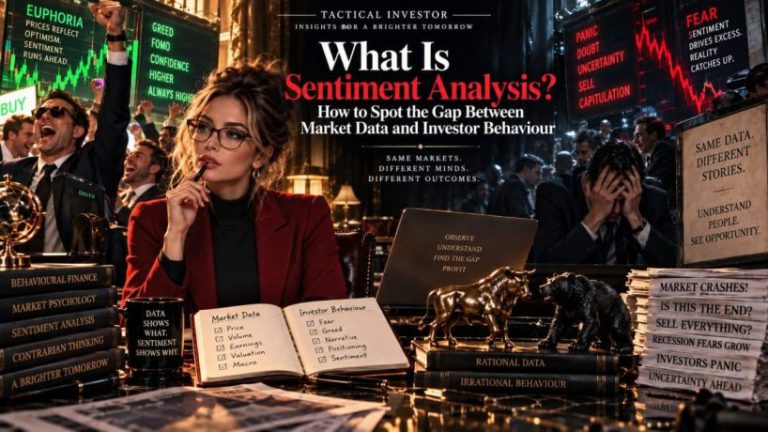
Markets rarely move according to the patient clock of compounders because mass psychology operates on a much shorter horizon, with crowds constantly shifting between urgency and complacency as prices move. When prices fall sharply, investors suddenly believe they have no time to think, while when prices rise rapidly, they become convinced they have no time to wait, creating the strange spectacle of people demanding certainty precisely when uncertainty is greatest.
This is where mass psychology intersects with compounding, because extreme fear can temporarily disconnect price from the long-term productive capacity of an asset, while extreme optimism can push price far ahead of what that productive capacity can reasonably justify. The disciplined investor therefore does not merely ask whether an asset is rising or falling, but whether the crowd’s emotional reaction is creating a temporary distortion that can be exploited by someone willing to operate on a longer clock.
The opportunity often appears when the crowd’s time horizon collapses. Panic compresses years of thinking into minutes, while euphoria compresses decades of expected growth into today’s price, and both distortions create opportunities for the investor capable of maintaining a longer perspective.
Time Becomes More Valuable During Panic
Market crashes are often described as periods when wealth disappears, but that description hides an important distinction between declining prices and declining productive capacity. A company whose shares fall forty per cent does not automatically lose forty per cent of its factories, customers, intellectual property, cash-generating ability or competitive position, which means the distance between market price and underlying economic reality can sometimes become enormous.
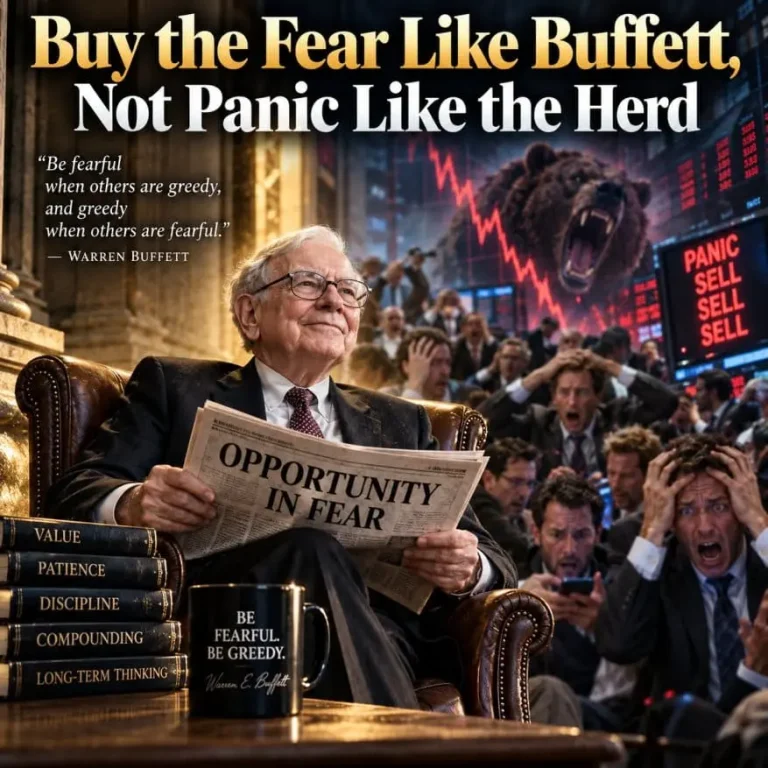
This is where mass psychology becomes a weapon rather than merely something to observe, because extreme fear can force investors to sell assets precisely when their future earning power remains intact. The disciplined investor is not buying panic itself; he is buying the possibility that the emotional distortion will eventually disappear while the underlying productive system continues functioning.
Benjamin Graham understood this distinction through his insistence on separating price from value, while Warren Buffett repeatedly demonstrated the power of allowing time to work on productive assets rather than constantly attempting to predict the next market movement. Their deeper lesson is not simply “buy good companies”, but build positions that can survive long enough for time to reveal what the crowd temporarily cannot see.
The Most Dangerous Mistake Is Interrupting the Process
Compounding is fragile because every interruption has a cost that is larger than the transaction itself, particularly when investors sell productive assets during periods of fear and later attempt to re-enter after confidence has returned. The problem is not merely paying commissions or taxes; it is potentially removing capital from the compounding engine during the very period when valuations are most attractive and then buying it back after the emotional pressure has reversed.
This is why volatility can become an unexpected ally for long-term investors, provided the underlying asset remains sound and the investor has sufficient liquidity and discipline to withstand the disturbance. The crowd sees volatility as something that must be escaped, whereas the compounder sees certain periods of volatility as changes in the price of access to future cash flows.
The distinction is subtle but powerful: you do not need to predict every market decline if your strategy is designed to survive them. Once survival is separated from prediction, the investor gains something more valuable than a perfect forecast, because the ability to remain invested allows time to continue performing the work that prediction constantly tries to replace.
Mass Psychology Creates the Entry Points
This does not mean every falling market is automatically a buying opportunity, because sometimes prices fall for legitimate reasons and sometimes an apparently cheap company is simply becoming less valuable. The useful signal appears when several vectors begin pointing in the same direction: sentiment becomes extreme, forced selling increases, valuations compress, technical conditions become exhausted and the underlying business remains capable of producing future value.
That combination creates something more interesting than a conventional dip, because the market may be temporarily pricing an asset according to the emotional state of its owners rather than according to its long-term economic potential. When that happens, the investor is effectively purchasing something more valuable than a low price: additional time at a favourable starting valuation.
Technical analysis can help identify these moments without pretending to predict the future, because indicators such as oversold momentum, abnormal volume, moving-average deviations and positive divergences can reveal when selling pressure is becoming exhausted. Mass psychology explains why the crowd is behaving that way, while technical analysis helps identify when the behaviour may be changing, and compounding determines what happens if the position is then allowed enough time to develop.
The Hidden Power of Options and Time
Time becomes even more interesting when options enter the equation because options markets place an explicit price on time, uncertainty and volatility, allowing sophisticated investors to structure positions around these variables rather than simply buying shares and waiting. Selling puts on assets you genuinely want to own can potentially generate premium while establishing a lower effective entry price, although the obligation to purchase the shares and the possibility of substantial losses must always be understood before using the strategy.
Long-dated options introduce the opposite idea because they purchase time rather than merely purchasing immediate exposure, allowing an investor to express a longer-term thesis without relying on a precise short-term prediction. Strategies involving LEAPS, put selling or combinations of long and short options can therefore interact with the same principle as compound interest: time becomes an asset that can be priced, sold, bought or patiently accumulated.
This does not make options a shortcut to compounding, and anyone treating leverage as a substitute for patience is likely to discover that time can destroy capital just as efficiently as it can create it. The important lesson is that sophisticated investors do not merely ask where price will go; they ask how much time the thesis requires, what the market is charging for that time and whether the structure of the position allows the thesis to survive long enough to become true.
The Real Compounding Advantage
The greatest advantage in investing may therefore be neither superior intelligence nor superior information, but the ability to maintain a coherent process longer than most participants can maintain their emotional discipline. Markets continually tempt investors to reset the clock, abandon a thesis, chase a new narrative or convert temporary price movements into permanent conclusions, while the patient investor quietly allows earnings, reinvestment and time to accumulate beneath the noise.
This creates one of the great asymmetries in markets: the crowd experiences time as pressure, while the disciplined investor can experience it as leverage. Every additional year that a productive asset compounds increases the distance between the original capital and the eventual outcome, provided the underlying thesis remains intact and the investor avoids destroying the process through unnecessary intervention.
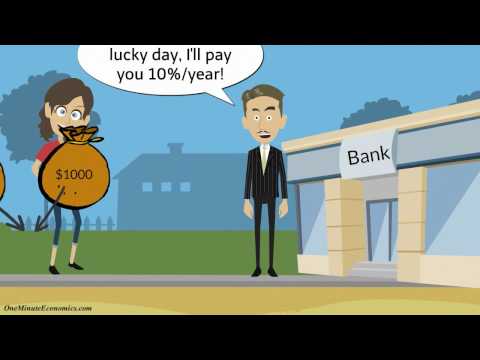
That is why the question “How does time play an important role in the power of compound interest?” has a deeper answer than any financial calculator can provide. Time does not simply multiply returns; it gives a sound process the opportunity to become something much larger than it initially appears, while mass psychology repeatedly gives patient investors the chance to acquire that process more cheaply when everyone else has temporarily lost faith in it.
The market will always offer reasons to interrupt the journey, whether through panic, euphoria, political uncertainty, economic forecasts or the latest supposedly transformative narrative. The investor who understands compounding learns to ask a different question: has the underlying engine changed, or has the crowd merely changed its mood?
If the engine remains intact, time becomes your ally; if the engine is broken, patience becomes an excuse. The real skill is knowing the difference, because once you can distinguish temporary psychological noise from permanent deterioration, you stop treating every market movement as an instruction and begin treating time itself as part of your strategy.
And that may be the quiet secret behind the largest compounding outcomes: the fortune is rarely created in the moment of purchase; it is created afterwards, while almost everyone else is becoming impatient.
Articles Worth Your Time