
Diesel Refining Stocks: Profit From Tight Fuel Markets and Refining Margins
Sept 18, 2026
The energy market is often discussed as though crude oil were the only variable that mattered. Oil rises, therefore energy stocks rise; oil falls, therefore the sector weakens. That framework misses a critical part of the industry: crude must be converted into gasoline, diesel, jet fuel and other products, and the companies controlling that conversion capacity operate under a different set of economic forces.
When refining capacity tightens while demand for middle distillates remains resilient, refiners can experience an earnings environment very different from that of oil producers. The critical variable is not simply the price of crude, but the spread between what refiners pay for feedstock and what they receive for finished products.
A refiner can face rising crude prices without benefiting if product prices fail to keep pace. Conversely, stable or falling crude prices can support strong profitability when diesel and other refined products remain scarce and crack spreads expand. Smart Investors who focus exclusively on crude prices risk overlooking where the actual earnings leverage resides.
The Diesel Equation Is Really a Refining Equation
One clarification matters from the beginning: “sour diesel” is not technically the correct investment thesis. The relevant issue is the ability of sophisticated refineries to process heavier, sulfur-rich crude and convert it into valuable products, including diesel and other middle distillates.
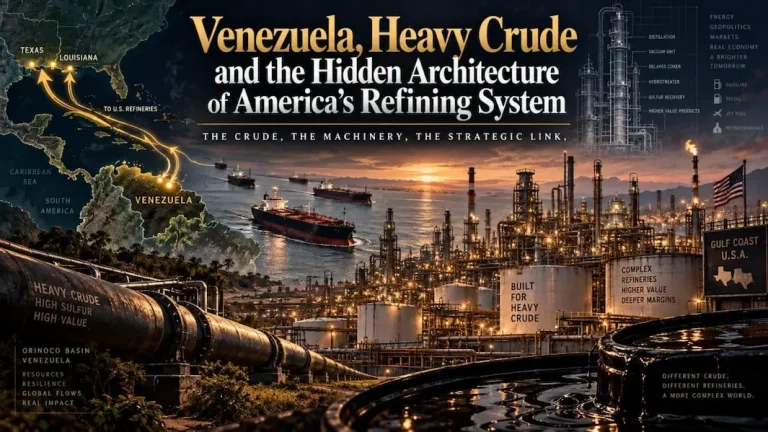
Heavy and sour crude can trade at discounts because processing it requires more sophisticated equipment. Refineries with complex conversion systems and desulfurization capabilities may therefore gain an advantage when discounted feedstock is available and refined-product prices remain elevated.
The potential economic chain is straightforward: Discounted heavy or sour crude → complex refining capacity → valuable middle distillates → stronger crack spreads → higher refinery earnings.
The advantage is not automatic. Refinery configuration, crude differentials, operating costs, utilization and product prices determine whether the spread actually translates into stronger margins.
Refining is also an industrial bottleneck. New capacity takes years to permit and construct, while environmental restrictions, capital costs and uncertain long-term fuel demand can discourage investment. When capacity closes, the remaining system may become more sensitive to disruptions because replacing lost throughput is neither quick nor simple.
Shrinking Capacity Can Create a Scarcity Premium
Markets frequently underestimate infrastructure until it becomes scarce. A refinery closure may appear to be a narrow corporate event, yet lost capacity can reduce a regional market’s ability to respond when demand rises or supply disruptions emerge elsewhere.
The remaining refiners do not automatically benefit from every closure. Their advantage depends on whether they can access crude, operate reliably and sell products into markets where supply has tightened. But when demand remains firm and replacement capacity is limited, existing facilities can acquire greater economic importance.
This creates an asymmetry. During periods of abundant fuel, refining assets may appear cyclical and unattractive; during shortages, the market can suddenly recognize the value of infrastructure that cannot be replicated quickly. The transition from indifference to urgency can produce earnings leverage, but investors must distinguish a temporary disruption from a sustained structural shortage.
Valero: Direct Exposure to Refining Economics
Valero Energy remains a direct way to examine large-scale refining economics. Its investment relevance lies in its extensive refining system and exposure to refined-product markets, where changes in crack spreads can materially affect profitability.
The key question is not whether every barrel of crude becomes more valuable. It is whether Valero can acquire feedstock at attractive prices and sell finished products at margins that support stronger earnings. For a diesel-tightness thesis, Valero offers substantial refining exposure without requiring the investor to rely exclusively on rising upstream oil prices.
Why VLO Matters
- Large-scale refining operations.
- Significant middle-distillate production.
- Gulf Coast infrastructure.
- Access to domestic and international refined-product markets.
- Potential leverage to expanding crack spreads.
The risk is cyclicality. Exceptional margins can attract investor attention and elevated expectations, leaving the stock vulnerable if profitability normalizes. Refining opportunities are therefore often more attractive before the market fully prices in scarcity than after peak earnings become the dominant narrative.
Marathon Petroleum: Scale and Infrastructure
Marathon Petroleum represents another major U.S. refining exposure. Scale matters in an industry where crude sourcing, logistics, distribution and operational efficiency can materially influence profitability. Its extensive refining system provides exposure across multiple markets, potentially allowing the company to benefit from regional differences in supply, demand and feedstock economics. If refined products remain tight while the industry struggles to add capacity, that infrastructure can become a source of strategic flexibility.
The investment question is whether Marathon’s scale translates into durable operating advantages and attractive margins under the market conditions being evaluated. Size alone does not guarantee superior returns, particularly when refining margins contract or valuations already reflect strong earnings.
Phillips 66: Refining Plus Energy Infrastructure
Phillips 66 offers a broader energy exposure, combining refining with infrastructure, chemicals, marketing and other operations. That diversification makes it less of a pure refining-margin investment, but it also means its financial performance cannot be assessed through crack spreads alone.
Energy supply chains extend beyond the refinery gate. Crude must be transported, products must be stored and distributed, and fuels must reach end markets, creating additional economic exposures throughout the system.
Phillips 66 is therefore relevant for investors examining refining alongside broader energy infrastructure. Those seeking a concentrated bet on a sudden expansion in refining margins need to account for the contribution of its other businesses and the way those operations affect overall earnings.
PBF Energy: Greater Sensitivity, Greater Risk
PBF Energy belongs in a different risk category. A more concentrated refining business can experience pronounced earnings swings as margins change, creating potential upside during favourable conditions but substantial downside when the cycle turns.
This is where investors must separate business quality from opportunity quality. A company with greater operational risk can still become a tactical opportunity if the market environment shifts sharply in its favour, while a strong business can become an unattractive investment when its valuation assumes unusually favourable conditions will persist.
PBF therefore represents a more aggressive expression of the refining thesis. If crack spreads expand, concentrated exposure may amplify the earnings response; if margins deteriorate, that same exposure can magnify losses. The question is not simply whether volatility is high. It is whether the investor understands the source of that volatility, the company’s financial resilience and the conditions required for the thesis to work.
HF Sinclair: Regional Refining Economics
HF Sinclair offers a regional angle through its refining footprint. Fuel markets are not perfectly unified, and profitability can vary with transportation infrastructure, local supply, pipeline constraints and regional demand.
A global diesel shortage does not automatically translate into stronger margins for every refiner. The company must be positioned to access the affected market and capture the difference between its feedstock costs and local product prices. Regional refiners deserve attention when supply disruptions create localized distortions. The key is to identify where scarcity is occurring and whether a particular company’s assets can benefit from it.
China Changes the Equation
The Chinese refining story is more complicated because enormous refining capacity does not automatically create a bullish diesel thesis. Sinopec is a major refining company, while PetroChina combines refining with substantial upstream and natural-gas operations. Their exposure must be evaluated against domestic demand, government influence and the changing structure of China’s energy consumption.
Important factors include:
- Rising electric-vehicle penetration.
- Changes in transportation demand.
- Government influence over energy markets.
- Potential refining overcapacity.
- Shifting demand across petroleum products.
A company can possess enormous refining capacity while operating in a market where traditional fuel demand is changing. That does not automatically make Chinese refiners unattractive, but it means that global product scarcity and domestic refining profitability cannot be treated as the same thesis.
The Heavy and Sour Crude Advantage
The more sophisticated version of the refining thesis concerns the relationship between crude quality and refinery complexity. Not every refinery can process every crude grade with equal efficiency, and facilities equipped to handle heavier, sulfur-rich feedstocks may benefit when those barrels trade at discounts.
The attractive combination is straightforward: a refinery acquires discounted crude and sells refined products into a tight market. The spread between those two sides of the operation, adjusted for processing costs and other expenses, determines whether the opportunity translates into meaningful profitability.
Investors should therefore monitor more than Brent or WTI. Relevant variables include:
- Heavy-versus-light crude differentials.
- Sour-versus-sweet crude spreads.
- Diesel crack spreads.
- Refinery utilization rates.
- Product inventories.
- Refinery outages and closures.
- Regional supply disruptions.
No single indicator establishes the investment case. The opportunity emerges from the interaction between crude costs, product values, operating capacity and demand.
Vector Psychology and the Refining Trade
The market’s psychological response can amplify the underlying energy cycle. Vector psychology examines sentiment as a moving force, focusing not only on its direction but also on its intensity, breadth and persistence.
A tightening diesel market may initially attract little attention because declining inventories or refinery disruptions appear technical and disconnected from broader investment narratives. As margins improve and earnings reports reveal stronger profitability, analysts may revise forecasts and investors begin seeking exposure.
At that point, the narrative can accelerate. The market shifts from questioning whether conditions have improved to competing for the companies perceived to benefit, and the same assets that were ignored during weak conditions can become crowded trades.
That is where risk increases. Investors often become most comfortable with a thesis after the evidence is widely visible, even though valuations may already reflect much of the improvement. The contrarian objective is not to buy weakness or sell strength automatically. It is to determine whether market perception has moved ahead of the underlying economics, and whether the trend still has room to strengthen.
A Watchlist, Not a Ranking
These companies represent different ways to investigate a diesel-tightness and refining-margin thesis. They should be classified by exposure and risk rather than reduced to a simplistic ranking.
| Company | Ticker | Primary exposure |
|---|---|---|
| Valero | VLO | Large-scale, direct refining exposure |
| Marathon Petroleum | MPC | Scale and broad U.S. refining operations |
| Phillips 66 | PSX | Refining combined with broader infrastructure |
| PBF Energy | PBF | More concentrated, higher-sensitivity refining exposure |
| HF Sinclair | DINO | Regional refining economics |
| Sinopec | 0386 / 600028 | Major Chinese refining exposure |
| PetroChina | Multiple listings | Integrated energy and refining exposure |
Valero, Marathon Petroleum and PBF Energy offer different ways to investigate refining-margin sensitivity, but their operating structures and risks differ materially. Valero provides substantial direct refining exposure, Marathon brings scale and infrastructure, while PBF represents a more concentrated exposure to changes in refining profitability.
The appropriate comparison depends on the investor’s objectives, valuation assumptions, financial-risk tolerance and view of the refining cycle. No company benefits simply because diesel prices rise; the relevant question is whether its own margins and earnings improve.
The Real Opportunity May Not Be Oil
The central mistake is treating the energy market as a single trade. Producers, pipelines, refiners and chemical companies respond to different economic forces, so rising crude prices do not automatically translate into rising profits across the sector.
When diesel becomes scarce, crude producers may benefit from higher prices, but refiners depend on the relationship between feedstock costs and product values. The more precise question is who owns the industrial machinery capable of converting available crude into products the market needs, and whether that conversion can be done profitably.
Geopolitical instability, transportation risks and infrastructure constraints can intensify supply pressures, but the investment case still depends on actual market conditions. A compelling narrative cannot substitute for evidence of improving margins, attractive valuation and financial resilience.
Conclusion: Follow the Margins, Not the Mania
Refining stocks deserve attention when the physical energy system becomes constrained because scarcity can increase the value of existing conversion capacity. But the thesis should never be reduced to the assumption that rising oil prices automatically produce stronger refinery profits.
The critical variables are crude differentials, refinery complexity, diesel demand, product inventories, capacity constraints and the evolution of refining margins. Investors should also consider whether the market has already priced in unusually strong conditions, because exceptional earnings can become a liability when expectations outrun what the industry can sustain.
The opportunity lies in identifying a meaningful change in refining economics before it becomes a crowded narrative. Diesel shortages, shrinking capacity and sophisticated crude-processing capabilities can combine to create attractive conditions, but the evidence must come from the margins and the companies’ ability to capture them. The crowd may focus on the price of oil. The refining investor must follow the spread between crude and the products the world needs.

In Case You Missed It