Karpman’s Drama Triangle: Who Are You Without the Role?
August 19, 2026
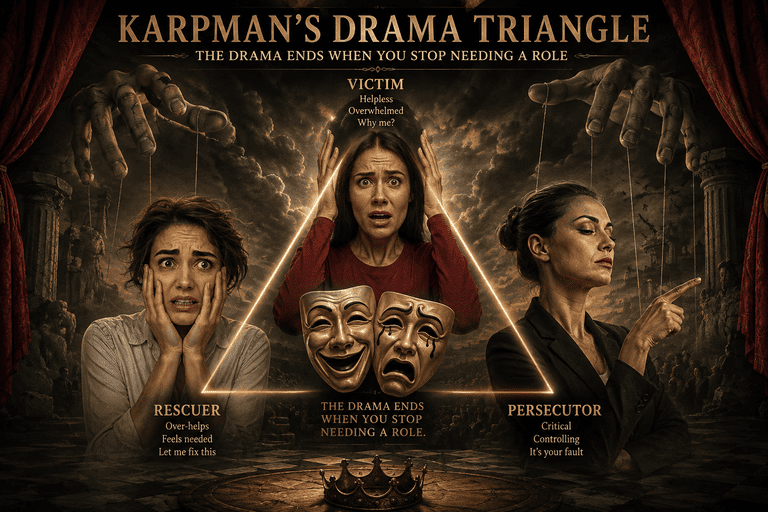
Human beings spend enormous amounts of energy trying to control outcomes they do not control: choosing the wrong partner, staying in the wrong relationship, buying the wrong house, entering a market at the wrong moment or defending the wrong investment, then constructing explanations that locate responsibility in circumstances, other people or bad luck. The surface circumstances differ, but the underlying geometry is remarkably consistent: we enter a role, the role shapes perception, perception shapes behaviour, and behaviour reinforces the circumstances we claim to be trying to escape. Karpman’s Drama Triangle exposes this mechanism by showing how destructive interactions organise themselves around three shifting positions: Victim, Rescuer and Persecutor.
Stephen Karpman’s original 1968 model is often misunderstood as a classification of personalities, but the critical feature is precisely that the roles are not fixed identities. A person can move from Victim to Persecutor when frustration replaces helplessness, or from Rescuer to Victim when their attempts to solve another person’s problems are rejected, while everyone involved remains convinced that they are merely responding to someone else’s behaviour. The deeper problem therefore is not which role you occupy, but why the interaction requires a role at all.
The empowerment interpretation reverses the triangle by replacing drama with agency, accountability and constructive action: the Victim becomes the Creator, the Persecutor becomes the Challenger and the Rescuer becomes the Coach. The objective is not to become better at occupying these positions but to stop deriving identity, certainty or psychological reward from them. Once that happens, the question changes from “Who is responsible for this happening to me?” to “What can I actually observe, influence and choose?”
The Role Becomes the Trap
The Victim says circumstances control me, the Rescuer says others need me, and the Persecutor says others are the problem, yet all three positions provide the same hidden benefit: responsibility is displaced outside the self. Each role therefore appears to provide power while quietly surrendering it, because maintaining the role requires the continued existence of the situation that justifies it. The person becomes psychologically dependent upon the very problem they claim to want removed.
Consider a relationship in which one person chooses a troubled partner because they believe they can rescue them, becomes frustrated when the partner refuses to change, and eventually becomes the Persecutor who lists everything they have sacrificed. The partner then withdraws, resists or retaliates, becoming the Victim and creating another cycle in which each person interprets their behaviour as a reaction rather than recognising that both are maintaining the same system. The same geometry appears at work: an employee feels ignored and becomes the Victim, management becomes the Persecutor, another colleague enters as Rescuer, and when the conflict inevitably returns, everyone discovers that they have changed positions without changing the underlying structure.
The roles move; the system remains. That distinction matters because solving the emotional position without changing the mechanism simply allows the same pattern to regenerate under different circumstances. The drama survives precisely because everyone is reacting to the visible behaviour rather than observing the feedback loop producing it.
Heraclitus Would Recognise the Problem
Heraclitus understood change as fundamental to existence, and that insight exposes one of the mechanisms through which interpersonal drama becomes self-sustaining: human beings convert changing behaviour into fixed identities. We call someone difficult, lazy, controlling, ungrateful or “the problem”, and once the label becomes established, we stop observing what is happening now and begin interpreting present behaviour through everything we believe happened before. The identity becomes more stable than the evidence.
The result is a closed feedback loop in which expectation shapes perception, perception shapes reaction, reaction produces predictable behaviour, and that behaviour is then treated as proof that the original expectation was correct. The person is no longer responding to today’s event but to the accumulated meaning they have assigned to the other person, which makes the relationship increasingly resistant to new information. What looks like a problem between two people is therefore often a problem of perception, feedback and decision-making.
The same mechanism operates far beyond relationships. We do it with houses, businesses, stocks and entire markets, constructing a narrative around what something will become and then defending that narrative as reality changes because abandoning it would require admitting that the identity of the person who “saw the opportunity” was built on incomplete information. The investor can therefore move from Rescuer to Victim without recognising that the underlying mechanism has remained unchanged.
Ouspensky: The Machine That Thinks It Is Choosing
Peter Ouspensky’s emphasis on self-observation provides another layer because it treats much ordinary behaviour as mechanical: people react according to established patterns and only afterwards construct a story explaining why their reaction was rational. The practical implication is that changing behaviour without observing the mechanism generating it can simply produce another form of automatic behaviour. Before attempting to change the output, you have to see the machinery producing it.
That distinction aligns closely with the deeper lesson of Karpman’s model. Someone who says, “I always attract the wrong people,” may correctly identify a recurring pattern while completely missing the selection process that creates it, which could involve familiarity, unresolved needs, overconfidence in the ability to change others or an unconscious attraction to situations in which their preferred role remains available. The useful question is therefore not merely why other people repeatedly behave badly, but what repeatedly places the same kind of person or situation inside your decision environment.
Markets expose the same mechanism with unusual clarity. Investors say they always buy the top, sell too early or discover the right stock after it has already moved, yet each failure is often treated as an isolated event rather than evidence of a recurring behavioural vector. Self-observation turns repetition into data, because once the mechanism becomes visible, what appeared to be bad luck can become a decision process that can be examined and potentially changed.
Tesla and the Difference Between Vision and Drama
Nikola Tesla provides a useful counterpoint because his reported method of mentally constructing and testing inventions illustrates the difference between using imagination to model a system and using imagination to validate an identity. He described building mechanisms mentally, refining them and examining potential faults before committing resources to physical construction, which represents a fundamentally different relationship with uncertainty than reacting emotionally and then constructing a justification after the fact. The relevant lesson is not Tesla’s inventions themselves but the discipline of modelling before committing.
Applied to investing, this means constructing the thesis before committing capital, identifying what would invalidate it, considering competing explanations and testing the scenario against available evidence rather than demanding that reality confirm the original narrative. This is not prediction in the absolute sense, because markets contain variables no model can fully anticipate; it is scenario construction, in which the investor defines the conditions under which the thesis remains valid and the conditions under which it must be abandoned. The strategist therefore observes, models and chooses instead of reacting, rescuing or blaming.
That distinction is the empowerment shift. The Victim interprets events as forces acting upon them, the Rescuer attempts to control outcomes that belong to someone else, and the Persecutor converts uncertainty into blame, whereas the strategist treats changing conditions as information and preserves the ability to respond. Agency begins when the need for the role ends.
The Wrong House, the Wrong Stock, the Wrong Moment
A house purchased during a period of euphoria illustrates the mechanism clearly: prices have risen for years, everyone insists that waiting means missing the opportunity, rates subsequently increase, and the property becomes a burden. At that point the owner can either reassess the new environment or become the Victim, assigning responsibility to the government, bank, estate agent, economy or anyone else associated with the outcome, even though the original decision was made under a particular set of assumptions. The problem is not that circumstances changed; circumstances always change, but the owner has confused a changing environment with a betrayal of their original narrative.
Investors repeat the same error when they buy into euphoria and then defend the position after the trend reverses because selling would force them to admit that momentum was mistaken for value. They begin rescuing the position by averaging down without a revised thesis, persecuting anyone who questions the investment and eventually becoming the Victim when the market refuses to cooperate. The market did not put them inside the triangle; their interpretation of the market did.
This is where mass psychology becomes important because markets reveal collective behaviour through price, volume, sentiment, positioning and the direction of the psychological vector. Crowds can enter collective versions of the same roles: helplessness during panic, desperate attempts to rescue collapsing narratives during euphoria and persecution of dissenters when contrary evidence threatens the group’s emotional certainty. The individual investor therefore faces not only the psychology of the market but the additional danger of synchronising with its psychological roles.
The Market Has No Role for You
The market does not care whether you are the hero, victim, genius, contrarian or person who warned everyone first, because those identities exist inside your interpretation while the market processes orders, expectations, liquidity and changing information. Its indifference is therefore liberating: a falling market does not require victimhood, a losing position does not require rescue, disagreement does not require persecution, and collective panic does not create an obligation to become the person who saves everyone else. The market provides information; it does not assign you a psychological role.
Observation can appear passive because it contains no dramatic reaction, but it is actually a form of power because it creates a gap between stimulus and response. That gap is where agency exists: instead of automatically defending the position, blaming the market or attempting to force the outcome, you can observe what changed, determine what remains true and choose whether the original allocation still makes sense. The objective is not emotional detachment for its own sake but greater freedom between information and action.
From Drama to Empowerment
The empowerment interpretation of Karpman’s model therefore changes the objective from escaping other people to reclaiming your own decision-making. The Victim becomes the Creator, asking what can actually be influenced; the Persecutor becomes the Challenger, turning pressure into information rather than blame; and the Rescuer becomes the Coach, helping without taking responsibility away from another person. In relationships, this means choosing people capable of standing beside you rather than people who provide an opportunity to rescue them, observing whether behaviour aligns with words rather than trying to manufacture change, and deciding what behaviour you will accept rather than demanding that another person become someone else.
In investing, the same structure becomes even cleaner. You are the Creator when you control allocation, the Challenger when you actively attack your own thesis and the Coach when you allow evidence to teach you instead of demanding that price validate you. Risk cannot be eliminated, but unnecessary psychological risk can be reduced by refusing to turn every position into an extension of identity.
The Investor Who Stops Needing to Be Right
The greatest shift occurs when the investor no longer needs the market to confirm anything about them. They can buy when fear becomes excessive without pretending to know the exact bottom, remain in cash during extreme euphoria without experiencing inaction as failure, and abandon a thesis when the evidence changes without interpreting the decision as an assault on their intelligence. The investment becomes a decision rather than a referendum on the self.
This is where mass psychology and Karpman’s framework converge. Crowds become powerful because individuals surrender agency to collective roles, and markets become dangerous when those roles synchronise across millions of participants: panic creates Victims, collapsing narratives create Rescuers who keep trying to justify them, and dissenters become Persecutors because challenging consensus threatens the emotional structure holding the group together. The empowered investor steps outside that structure by observing the vector, understanding the crowd, preserving optionality and acting only when the asymmetry becomes favourable.
The drama therefore does not end when you choose a better role; it ends when you no longer need one. Once identity stops demanding that you be right, save others, defeat opponents or explain every outcome, the market becomes what it actually is: a changing system that supplies information rather than validation. Agency begins when the role ends.

Insights Worth Your Time