Mass Psychology Investing: When Reality, Narrative and Power Collide
Aug 18, 2026
There is a strange temptation to dismiss astrology as either profound truth or complete nonsense, leaving no room for anything more interesting in between. The planetary configurations described in the source material are real astronomical events, including the Saturn-Neptune conjunction at 0°45′ Aries on February 20, 2026, while astrologers have also drawn attention to the historical Saturn-Neptune conjunction of 1989 and its coincidence with the fall of the Berlin Wall and the collapse of the Soviet order.
But correlation is not causation, and there is no established scientific evidence that planetary positions cause wars, market crashes, political revolutions or changes in human behaviour. The more interesting question is whether astrology can function as a symbolic language for identifying conditions that mass psychology and systems analysis can actually test. Viewed this way, the planets do not cause the event; they become a framework for asking what happens when institutions, narratives, technology, power and human behaviour begin moving in different directions.
Astrology Without the Horoscope
Take the traditional symbolism attributed to the major players in the current cycle. Saturn represents structure, limits, authority, rules and institutional constraint; Neptune represents ideals, ambiguity, narratives, illusion and the dissolution of boundaries; Uranus represents disruption and discontinuity; Pluto represents concentrated power and deep transformation. Gemini is associated within astrological symbolism with communication and information, while Aquarius is linked with networks and collective systems.
Strip away the planets and what remains is a remarkably useful systems vocabulary. Constraint. Narrative. Disruption. Power. Information. Networks. Agency. Those are not supernatural concepts. They are variables in the behaviour of complex systems.
This is where mass psychology investing becomes more interesting than conventional astrology. Instead of saying that Saturn and Neptune will cause institutional change, we can ask what happens when institutional constraints collide with a population’s changing beliefs about reality. Instead of claiming Uranus causes technological disruption, we can examine what happens when information technology accelerates faster than institutions can adapt.
The planets become the symbolic layer and Mass psychology becomes the behavioural layer. Vector analysis becomes the analytical layer and that gives us something worth testing.
Saturn Meets Neptune: When Reality Collides With the Story
The Saturn-Neptune conjunction is particularly interesting because its symbolism creates a direct tension between structure and narrative. Saturn represents the institution saying, “This is reality.” Neptune represents the collective imagination asking, “Is it?”
That conflict exists everywhere. Governments depend on legitimacy. Financial systems depend on confidence. Corporations depend on narratives about future earnings. Currencies depend partly on trust. Markets depend heavily on expectations. When the distance between institutional claims and collective belief becomes too large, the structure can remain physically intact while its psychological foundation begins to disappear. That is the important distinction.
Institutions often lose legitimacy before they lose power. The Berlin Wall provides a useful illustration, although it should not be presented as proof of astrology. The 1989 Saturn-Neptune conjunction coincided with the fall of the Wall and the eventual dissolution of the Soviet Union, but that conjunction also occurred alongside Uranus, making any attempt to attribute those events to Saturn and Neptune alone overly simplistic. (The Astrology Podcast)
What matters from a systems perspective is what the Wall represented. It was not merely concrete.It was a physical expression of a political system, an ideological boundary and a mechanism of control. When enough people stopped behaving as though that structure possessed unquestionable legitimacy, the physical barrier became surprisingly fragile. The structure had not necessarily weakened overnight; the behaviour supporting the structure had changed and that is mass psychology.
The Legitimacy Vector
This gives us a useful vector that can be applied far beyond astrology. Imagine two forces operating simultaneously: Power Vector: the ability of an institution to enforce decisions. Legitimacy Vector: the willingness of people to accept those decisions.
These vectors normally move together. When they diverge, instability increases. An institution can retain enormous formal power while losing public trust. A government can still control the machinery of the state while increasingly struggling to persuade people that its decisions are legitimate. A central bank can still set interest rates while markets increasingly question whether its forecasts deserve credibility.
Eventually, the gap matters and the sequence becomes:
Institutional claim → perception gap → declining trust → behavioural divergence → reduced compliance → structural pressure.
This is much more useful than predicting that a planetary conjunction will cause political change, because every step can be observed.
The same framework applies to markets. When investors stop believing that a company’s narrative matches its numbers, the valuation structure begins to weaken. When they stop believing that central banks can control inflation, policy credibility becomes part of the market’s risk premium. When investors stop believing that a particular economic regime will continue, capital begins moving before the official data confirms the transition. The event is not caused by the narrative and the narrative is part of the system producing the event.
Uranus, Information and the Speed of Belief
The Uranus-Gemini symbolism described in the source material becomes particularly interesting when translated into modern information systems. Rather than asking whether Uranus causes technological disruption, ask what happens when communication becomes radically faster, cheaper and more decentralised.
That process is already visible. AI can generate enormous quantities of text, images, video and persuasion at a speed humans cannot match. Social networks distribute those narratives instantly, while algorithms determine which material receives attention. The result is not simply information abundance.
It is information abundance combined with uncertainty about what deserves belief. That distinction may become one of the defining psychological problems of the next decade.
For most of human history, information was scarce and distribution was slow. Now information is abundant, but verification remains limited by human attention. The resulting imbalance creates a dangerous vector:
Information velocity > verification velocity.
Once that happens, the problem changes from finding information to determining which information is credible. That creates fertile ground for mass psychology because people facing overwhelming uncertainty tend to simplify. They choose tribes, narratives and trusted sources, then filter subsequent information through those choices. Confirmation bias does the rest. AI therefore does not need to make people irrational. It can simply make the feedback loop between information and belief faster.
Pluto, Networks and the Battle for Reality
The Pluto-Aquarius symbolism can also be translated into a question about power and networks. Who controls the infrastructure through which information moves? Who controls the algorithms that determine visibility? Who controls the models that generate information? Who owns the platforms through which millions of people construct their understanding of events?
This is not abstract. Information infrastructure is becoming a form of power infrastructure. The old model of influence relied heavily on centralised institutions such as governments, newspapers, television networks and major financial organisations. The emerging model is more complicated because influence now moves through decentralised networks, algorithms, communities and increasingly autonomous systems.
That creates a new struggle between centralised authority and distributed agency. The interesting variable is not simply who has more power. It is whether formal authority and information authority remain aligned.
If they diverge, the system becomes unstable. A government may possess formal authority while losing narrative control. A corporation may dominate an industry while losing control over how consumers perceive it. A financial institution may remain solvent while markets begin treating it as fragile. Again, psychology becomes the bridge between structure and outcome.
The AI Feedback Loop
The most important vector may be the interaction between technology and collective belief.
- AI produces narrative.
- Narrative changes perception.
- Perception changes behaviour.
- Behaviour produces data.
- Data improves the next generation of AI systems.
- The system then produces more powerful narrative.
That is a feedback loop. If the loop is positive, small changes can become amplified. A narrative does not need to be true to become influential; it needs enough distribution, emotional resonance and reinforcement to change behaviour. Once behaviour changes, the consequences can make the original narrative appear correct, even when the original claim was weak.
Markets already operate this way. An optimistic AI narrative attracts capital. Capital pushes AI-related assets higher. Higher prices attract more attention. More attention creates more optimism. Investors then interpret rising prices as evidence that the original narrative was correct.
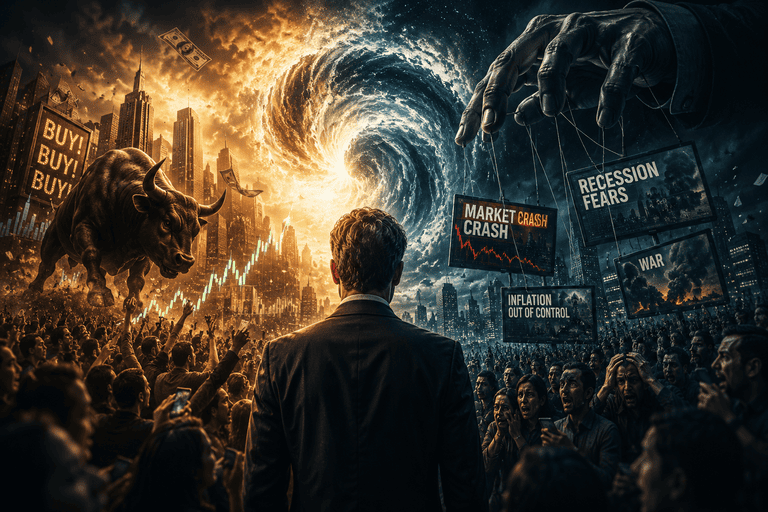
The same mechanism works during collapse. Fear produces selling. Selling produces lower prices. Lower prices confirm the fear. Confirmation produces more selling. The technology changes the speed and the psychology remains ancient.
From Planetary Symbolism to Observable Vectors
This is where astrology can be made considerably more useful without pretending that it has established predictive power.
Instead of:
Saturn + Neptune = institutional collapse
use:
Constraint + narrative conflict = legitimacy stress.
Instead of:
Uranus in Gemini = technological revolution
use:
Information velocity + technological disruption = faster belief transmission.
Instead of:
Pluto in Aquarius = transformation of collective power
use:
Network concentration + distributed agency = conflict over information and institutional control.
Now the framework generates hypotheses rather than predictions. You can measure institutional trust, market breadth, capital flows, volatility, media narratives, search behaviour, social sentiment, AI adoption, concentration of corporate power and changes in political behaviour. If the proposed vectors are real, they should leave fingerprints. That is the important upgrade. Do not use astrology to predict the event. Use the symbolism to identify the question, then use data to test the vector.
The Market Connection
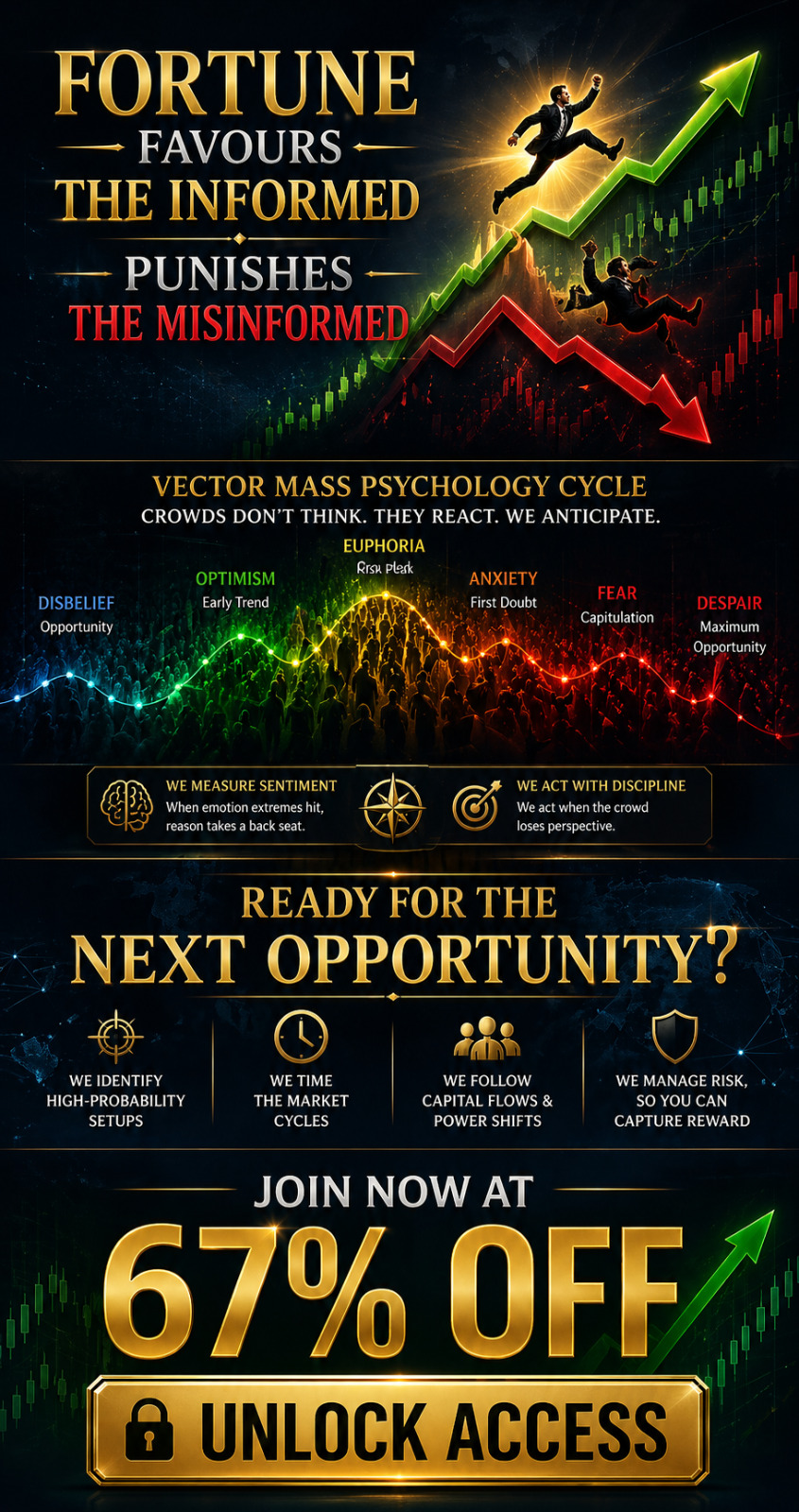
For investors, this becomes particularly useful because markets are expectation machines. Price does not wait for reality to become obvious; it moves when enough participants change their expectations about reality.
That means the most important variable is often the gap between narrative and behaviour. If investors remain bullish while capital flows weaken, breadth deteriorates and volatility begins rising, the narrative may be losing structural support. If investors remain terrified while prices stop responding to negative information, the bearish vector may be exhausting itself.
The same framework applies to sectors and technologies. A revolutionary narrative can be correct while its valuation is wrong. A genuine technological breakthrough can create an investment bubble because investors extrapolate its benefits too aggressively. Conversely, a powerful technology can remain undervalued because the crowd has not yet recognised its implications.
The investor therefore has to separate truth from price: Something can be real and overpriced and something can be misunderstood and cheap. Mass psychology determines much of the distance between those two conditions.
The Real Question for 2026–27
The useful question is not whether Saturn, Neptune, Uranus or Pluto will cause some predetermined event. There is no established scientific basis for making that claim, and even historical astrological correlations cannot establish causation. The more interesting question is whether the symbolic framework points us towards genuine structural tensions already developing in society, markets and technology.
Right now, several powerful vectors are interacting: institutional trust is under pressure in many societies, information is becoming dramatically cheaper to produce, AI is accelerating the creation and distribution of narratives, networks are becoming more powerful, and individuals have access to information systems that were previously controlled by large institutions.
That creates an unusual environment.
Authority is becoming more distributed while information is becoming more concentrated inside powerful technological systems.
That contradiction deserves attention. The old world depended on controlling information to control behaviour. The emerging world may depend on controlling the systems that generate, filter and distribute information. That is a subtler form of power, and its consequences for markets could be enormous because markets ultimately price expectations, not facts.
This is where the astrology becomes interesting without needing to be true. It provides a language for thinking about constraint versus dissolution, authority versus agency, centralisation versus networks, and reality versus narrative. Mass psychology provides the mechanism, while vector analysis tells us what to watch.
The planets do not need to cause the change. They only need to give us an interesting way to ask where the change is already trying to go, and that is the real opportunity for mass psychology investing: not predicting the future from the sky, but recognising when human beings begin changing their behaviour on the ground.

Editor’s Picks