

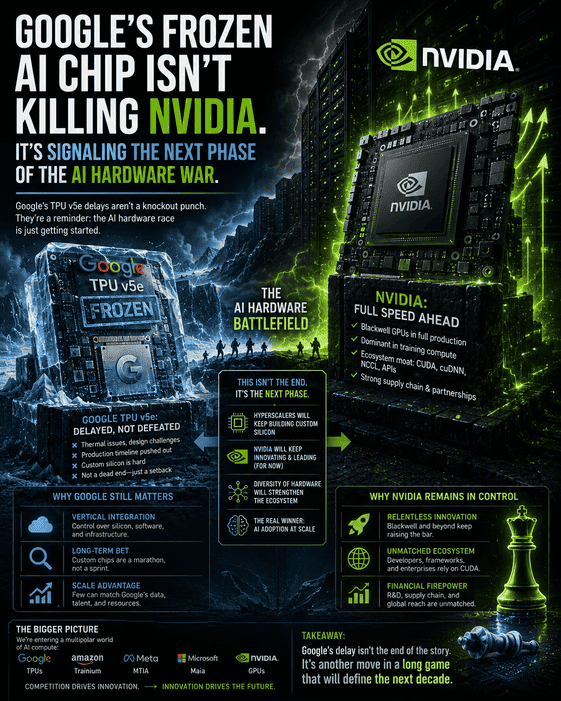
Google’s Frozen AI Chip Isn’t Killing NVIDIA. It’s Redefining the AI Hardware War.
Aug 6, 2026
Many experts are pushing clickbait. The underlying developments are real, but “NVIDIA is DEAD” is lazy analysis. It generates clicks while missing the larger shift.
The semiconductor industry is moving beyond a fifty-year focus on transistor scaling. Competitive advantage now comes from advanced packaging, chiplets, 3D integration, photonics, memory, software ecosystems, manufacturing, energy efficiency, and supply chain execution. No single breakthrough has to kill NVIDIA. Multiple advances across different fields can gradually erode its edge.
China’s progress in multi-beam lithography, soft X-ray research, domestic lithography, photonics, advanced packaging, chiplets, 3D integration, and CXMT’s DDR6 ambitions reflects that broader transition. Innovation is becoming distributed, not concentrated.
Ironically, NVIDIA’s bigger near-term risk may be perception, not technology. If investors conclude the company increasingly has to help finance or stimulate demand rather than simply meet it, the narrative changes. Markets can tolerate slower growth. They rarely tolerate the belief that demand is being manufactured.
Technology leadership fades gradually. Market valuations can collapse overnight. Confusing those two is why so many clickbait headlines miss the real story.
Frozen v2 Is Real. The Headline Isn’t.
Google is reportedly developing a specialised AI inference chip known internally as Frozen v2, and that part is entirely legitimate. According to Reuters and other industry reports, the objective is to hardwire significant portions of Gemini’s inference architecture directly into silicon, eliminating much of the overhead associated with running large language models on fully programmable hardware. Internal engineering projections suggest the design could eventually deliver somewhere between six and ten times more tokens per watt than Google’s existing TPU infrastructure, although those figures remain internal targets rather than independently verified benchmarks, with deployment expected no earlier than 2028 if development remains on schedule. (Reuters)
That immediately raises the obvious question. If Google can achieve those gains, does NVIDIA suddenly become obsolete? The answer is no, but it also isn’t as simple as saying NVIDIA has nothing to worry about. Frozen v2 solves one specific problem exceptionally well, and history suggests specialised hardware often outperforms general-purpose hardware once workloads become predictable. The important distinction is that solving one problem better does not automatically mean owning the entire market.
The Industry Is Moving Beyond Moore’s Law
For decades, semiconductor progress followed Moore’s Law. Shrink transistors, increase density, improve performance and repeat the process every few years. That formula transformed computing, but physics has become increasingly uncooperative as transistors approach atomic dimensions, forcing the industry to search for performance improvements elsewhere.
That search is now accelerating. Huawei recently introduced what it calls the Tau Scaling Law, arguing that future performance gains should come less from shrinking transistors and more from reducing signal latency across increasingly sophisticated three-dimensional architectures through its LogicFolding approach. Whether Huawei’s branding proves revolutionary or merely evolutionary remains an open question, but the broader direction is undeniable. Future performance is increasingly being driven by architecture, packaging and communication rather than transistor scaling alone.
This matters because it changes the nature of competition. The next decade may not belong exclusively to whoever builds the smallest transistor. It may belong to whoever integrates logic, memory, networking, packaging and software into the most efficient computing system.
The Battlefield Is Becoming Three-Dimensional
The industry’s centre of gravity is quietly shifting from lithography toward integration. Advanced packaging, chiplets, hybrid bonding, stacked memory, three-dimensional logic and heterogeneous computing are becoming increasingly important because moving information across a chip is rapidly becoming as expensive as performing the computation itself.
That explains why technologies such as TSMC’s advanced packaging, Huawei’s LogicFolding and Google’s Frozen architecture all appear to be moving in similar directions despite pursuing different objectives. They are attempting to reduce latency, shorten communication paths, improve energy efficiency and optimise complete computing systems rather than individual processors. Even Jensen Huang has acknowledged that many of these packaging concepts have been evolving for years, although Huawei claims to extend them in new directions.
If that trend continues, investors may need to stop thinking in terms of faster chips and begin thinking in terms of better systems.
China May Be Changing the Rules Faster Than Expected
The larger wildcard isn’t Frozen. It’s China.
For years, conventional wisdom assumed restricting access to ASML’s most advanced EUV lithography machines would permanently slow Chinese semiconductor development. Instead, those restrictions appear to have accelerated domestic innovation. China is investing simultaneously in lithography, advanced packaging, design software, memory, networking and alternative chip architectures, effectively attacking the problem from multiple directions rather than waiting for access to Western technology. (Investing.com)
Reports of domestic lithography development, renewed investment in indigenous manufacturing equipment and aggressive research into alternatives to conventional transistor scaling suggest China is pursuing an entirely different strategy. Rather than winning yesterday’s race, it is attempting to redefine tomorrow’s. Whether every claim ultimately proves successful remains uncertain, but dismissing these developments simply because they originate from China would be a serious analytical mistake. The semiconductor industry has repeatedly demonstrated that constraints often become powerful catalysts for innovation.
Memory and Photonics Could Become the Next Battleground
Another area receiving far less attention than it deserves is memory.
Artificial intelligence increasingly depends not only on computational power but also on the speed at which enormous quantities of data move between processors. Companies developing next-generation memory technologies, including faster DDR6-class architectures and increasingly sophisticated high-bandwidth memory solutions, may become just as strategically important as GPU manufacturers because data movement is rapidly emerging as one of AI’s principal bottlenecks. Likewise, silicon photonics is attracting growing attention because photons transport information far more efficiently than electrons over longer distances, potentially reducing one of the largest power constraints facing future AI data centres as energy efficiency becomes the industry’s dominant design priority. (Reddit)
Investors obsessed solely with GPU performance may therefore be watching only one part of a much larger technological transformation.
NVIDIA’s Greatest Strength May Also Become Its Greatest Challenge
None of this means NVIDIA suddenly becomes irrelevant.
The company still possesses one of the strongest competitive positions in technology through CUDA, NVLink, Mellanox networking, mature software libraries, enterprise support and perhaps the deepest AI developer ecosystem ever assembled. Those assets cannot be replicated overnight, and replacing an ecosystem is vastly more difficult than replacing a processor.
The greater question is whether that ecosystem remains sufficient if the industry itself fragments into specialised architectures. Every hyperscaler now wants to own more of its infrastructure. Google has TPUs and Frozen. Amazon continues investing in Trainium and Inferentia. Microsoft has Maia. Meta is developing MTIA. Apple continues expanding custom silicon throughout its ecosystem, while OpenAI has reportedly explored its own hardware initiatives through partners. None of these companies necessarily wants to eliminate NVIDIA, but all of them want greater control over long-term infrastructure costs.
The Future Will Probably Belong to Specialists
The biggest mistake investors can make is assuming the future belongs entirely to NVIDIA or entirely to custom silicon. Technology rarely evolves that way.
Large-scale AI training still rewards maximum flexibility because research changes constantly, while production inference increasingly rewards maximum efficiency because the workload becomes stable. Those are different optimisation problems requiring different engineering solutions, making it entirely plausible that tomorrow’s AI infrastructure will consist of programmable GPUs handling frontier research while specialised ASICs, photonic interconnects, advanced memory systems and increasingly sophisticated three-dimensional architectures dominate production deployment.
So let’s separate fact from fiction.
Fact: Google is developing an extremely interesting specialised inference chip that could materially reduce Gemini’s operating costs if current engineering targets are achieved.
Fact: The semiconductor industry is rapidly expanding beyond transistor scaling into advanced packaging, three-dimensional integration, memory innovation, photonics and specialised architectures, with China emerging as a far more formidable competitor than many expected. (Reuters)
Fiction: NVIDIA is dead.
NVIDIA may continue leading AI for years, or it may eventually find itself challenged by technologies that barely exist today. That is the nature of exponential industries. Investors should avoid becoming permanent bulls or permanent bears because neither camp survives technological revolutions particularly well. The winners are usually those who recognise when the primitive itself has changed, and today’s primitive is no longer raw computing power. It is the ability to build the fastest, most efficient and most adaptable AI systems, regardless of whose logo appears on the chip.

Beyond the Headlines