

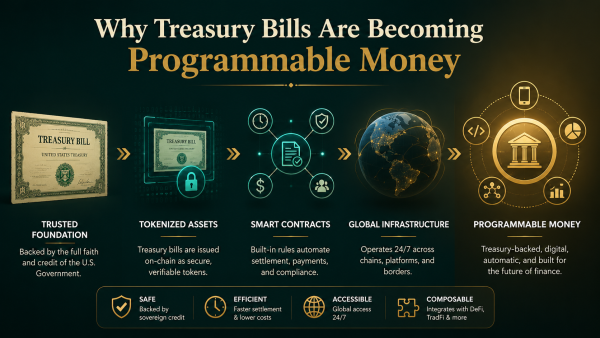
Why Treasury Bills Are Becoming Programmable Money: The Quiet Revolution Most Investors Haven’t Noticed
July 30, 2026
For well over two centuries U.S. Treasury securities have held a remarkably stable place at the centre of the global financial system, serving all at once as reserve assets for central banks, collateral for financial institutions, safe havens whenever uncertainty flared, and the benchmark against which almost every other asset on earth is measured, and yet for all that importance they have remained largely invisible to the average investor because they traditionally lived out of sight inside banks, pension funds, insurance companies, money market funds, and sovereign portfolios. That quiet role, however, may finally be starting to change.
Much of the noise around digital assets still swirls around Bitcoin, Ethereum, and the more speculative corners of crypto, and those conversations dominate the headlines for the simple reason that prices lurch dramatically and public attention naturally chases volatility, yet a far more consequential shift may be taking shape beneath that visible layer, because Treasury securities themselves are beginning to evolve from passive financial instruments into programmable components of an increasingly digital monetary system, a distinction that may ultimately matter far more than the rise or fall of any single cryptocurrency.
From Static Asset to Something Entirely New
For generations Treasury bills essentially functioned as static assets, since institutions bought them, collected their interest, and occasionally posted them as collateral inside wholesale markets, so that although they embodied safety, liquidity, and stability they rarely stepped beyond the traditional architecture of banking, where settlement stayed slow by any modern technological standard, transactions leaned on a chain of intermediaries, and access remained concentrated within institutional finance. Stablecoins have quietly begun to alter that relationship, because every fully reserved dollar-backed stablecoin requires high-quality liquid assets standing behind its value, and in practice those reserves increasingly take the form of short-duration Treasury bills and cash equivalents, so that each time a new digital dollar enters circulation another slice of government debt effectively gets embedded inside an always-on payment network capable of running twenty-four hours a day across international markets.
The Treasury itself has not changed at all, but its function very much has, because instead of sitting passively inside institutional portfolios these securities increasingly become the foundation supporting programmable digital money, remaining government obligations while now participating in an entirely different settlement architecture, a transformation that feels rather like moving from paper documents to cloud computing, where the underlying information stays exactly the same and yet its usefulness expands dramatically simply because the infrastructure surrounding it has changed.
The Real Innovation Is Programmable Collateral
That observation quietly drags the discussion away from cryptocurrency and toward something considerably larger, because the real innovation here may not be digital money at all but rather programmable collateral, and collateral has always been one of finance’s most important yet least appreciated building blocks, given that lending, derivatives, repo markets, clearing systems, and countless other activities all depend on assets that both sides of a transaction can trust. Treasury securities sit at the very top of that hierarchy because they pair deep liquidity with exceptionally low default risk, so that by wiring those same assets into blockchain-based settlement systems, stablecoins effectively turn one of the world’s oldest financial instruments into internet-native collateral capable of moving anywhere on the planet within seconds.
The implications stretch well past payments, because programmable Treasury-backed assets can potentially settle transactions continuously rather than only during banking hours, and they can plug directly into tokenised financial markets, decentralised settlement systems, and automated contractual arrangements without leaning on many of today’s intermediaries, so that whether or not every proposed application ultimately succeeds is almost beside the point, since the architecture itself has already widened what Treasury securities are able to do inside modern finance. This also goes a long way toward explaining why stablecoin issuers have quietly become some of the largest buyers of short-term Treasury debt, and their purchases are not speculative but structural, because unlike traditional investors trying to forecast where interest rates are heading, stablecoin issuers acquire Treasury bills for the plain reason that every additional dollar issued demands corresponding reserve assets, so that as adoption grows Treasury demand grows almost automatically alongside it, embedding the relationship within the design of the system rather than leaving it hostage to shifting market sentiment.
A New Category of Structural Buyer
That represents a subtle but genuinely important shift, because Treasury demand has historically flowed from foreign central banks, commercial banks, pension funds, insurance companies, and money market funds, and stablecoin issuers now join that roster as an entirely new category of structural buyer, so that over time, if digital dollars keep expanding, this source of demand could grow increasingly significant, reducing dependence on some of the traditional buyers while handing private digital intermediaries a larger role inside government debt markets. Notice how far this drifts from the usual crypto debate, because most investors keep asking whether Bitcoin will rise while the more important question may well be who ends up owning tomorrow’s Treasury market, since whenever the financial plumbing changes the capital flows eventually follow.
The Geopolitical Dimension
This evolution also carries meaningful geopolitical weight, because for decades the United States benefited not only from the dollar’s role as the world’s dominant reserve currency but from Treasury markets standing as the deepest and most liquid pool of high-quality collateral available anywhere, and stablecoins could reinforce that advantage by extending Treasury-backed settlement into digital environments where speed, programmability, and global accessibility keep growing in value. None of that guarantees permanent American monetary dominance, though, because technology itself remains neutral and payment rails carry no national loyalties, so that just as the internet eventually supported businesses across every continent, blockchain settlement can ultimately underpin multiple currencies running on very similar infrastructure, and while dollar-backed stablecoins currently dominate simply because dollar liquidity remains unmatched, the underlying technology could eventually accommodate euro-backed, yuan-backed, commodity-backed, or entirely new forms of reserve assets should economic conditions ever tilt in their favour.
The long-term competition therefore shifts in a fundamental way, because it is no longer merely a contest between currencies but increasingly a contest between liquidity ecosystems, and that distinction matters because investors so frequently conflate the two, since stablecoins are not replacing Treasury securities but rather multiplying the ways those securities can function inside the global economy, and by the same token they are not automatically strengthening cryptocurrency at the expense of traditional finance so much as pulling traditional government debt deeper into digital financial architecture.
Why This Matters for Investors
The consequences for investors are profound, because those who keep viewing stablecoins purely as cryptocurrency products risk missing the larger structural transition already unfolding beneath the surface, given that payment systems evolve, settlement evolves, collateral evolves, and eventually capital allocation evolves right alongside them, and history repeatedly shows that the greatest fortunes tend to emerge not from spotting the most visible products but from identifying the infrastructure quietly transforming everything built on top of it. Perhaps that is the most important lesson of all, because for more than two hundred years Treasury bills have represented one of the safest assets in the entire financial system, and over the coming decades they may also become one of its most programmable, so that if that shift genuinely takes hold the digital asset revolution will not simply have minted a new form of money but will have handed one of history’s oldest financial instruments an entirely new role in the architecture of global finance.