
MCAS Stock Deep Forensics: The Holding Company the Market Missed
July 29, 2026
Investors often believe they are valuing a business when, in reality, they are valuing only the portion of the business that is easiest to understand. That distinction becomes increasingly important when analysing PT M Cash Integrasi Tbk (IDX: MCAS) because the company has evolved into something far more complex than a conventional operating business. Beneath the consolidated financial statements sits an expanding collection of listed and private subsidiaries spanning payments, merchant software, logistics, digital advertising, APIs, cloud services, clean energy and financial technology. Yet the market continues to focus primarily on consolidated revenue and earnings, treating the entire group as though it were a single enterprise.
That approach may be convenient, but it risks overlooking the very source of long-term value. The central question is therefore no longer whether MCAS is cheap on traditional valuation metrics. The more important question is whether investors are valuing the operating company while largely ignoring the portfolio of businesses it controls.
Observable Reality: MCAS Increasingly Resembles a Capital Allocator
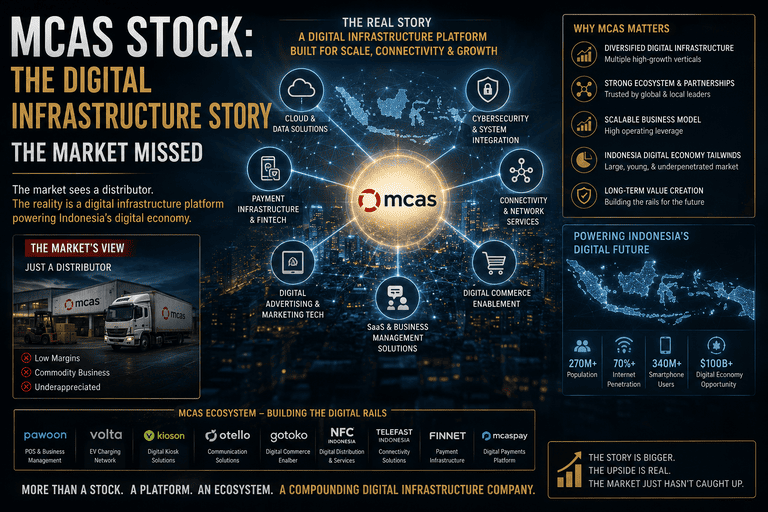
The first clue lies in the group’s corporate architecture. MCAS controls significant interests in both listed and unlisted businesses, including majority ownership of NFC Indonesia (NFCX) alongside control or strategic influence over companies such as Telefast Indonesia (TFAS) and numerous private subsidiaries. Those businesses, in turn, own or participate in additional operating companies across merchant technology, digital media, payment infrastructure, logistics, cloud advertising, software services, APIs and emerging technology platforms.
This creates a layered ownership structure rather than a simple operating business. Cash flows, strategic decisions and future growth opportunities increasingly originate from multiple operating entities rather than from a single income statement. That distinction matters because holding companies should not be analysed solely through consolidated earnings. Their value depends on the quality of the assets they own, the way those assets reinforce one another and management’s ability to allocate capital across the portfolio more effectively than shareholders could do independently.
The Market Is Valuing Earnings. It May Need to Value Ownership Instead.
Most investors instinctively begin with earnings because earnings are easy to measure. They compare price-to-earnings ratios, estimate future cash flows and apply valuation multiples based on recent profitability. That process works reasonably well for businesses with a single operating model, but it becomes increasingly unreliable when applied to companies whose underlying assets differ substantially in maturity, growth prospects and economic characteristics.
A digital distributor, a logistics platform, a software business and an API provider should not trade on identical valuation multiples because they generate value in fundamentally different ways. Consolidating them into a single income statement inevitably obscures those differences. Stronger businesses subsidise weaker ones during investment phases, rapidly growing subsidiaries may contribute little current earnings despite possessing considerable long-term value and early-stage businesses often depress reported profitability while increasing the future earning power of the group. Investors focusing exclusively on consolidated financial results therefore risk mistaking temporary accounting outcomes for permanent economic reality.
The more appropriate question is not simply how much MCAS earned this year. It is how much each underlying business could reasonably be worth as a standalone enterprise and what proportion of that value ultimately belongs to MCAS shareholders.
The Ecosystem Is More Valuable Than the Sum of Its Products
Looking at the portfolio individually is useful, but it still understates the strategic picture because the subsidiaries do not operate in isolation. Merchant software strengthens payment adoption. Payment infrastructure creates richer transaction data. Data improves advertising and customer engagement. Logistics deepens merchant relationships. APIs integrate third-party applications into the ecosystem, increasing switching costs and creating opportunities for future financial services.
These relationships matter because ecosystems generate value differently from collections of unrelated businesses. Conglomerates often deserve valuation discounts because their subsidiaries have little strategic connection beyond common ownership. Integrated ecosystems deserve closer scrutiny because every additional business can increase the value of those already inside the network. In that sense, MCAS increasingly resembles an operating platform allocating capital across complementary infrastructure rather than a traditional conglomerate assembling unrelated assets.
That distinction also changes how management should be judged. Capital allocation is no longer measured simply by earnings growth. It should also be assessed by whether successive investments deepen the competitive position of the overall ecosystem. Viewed through that lens, the group’s acquisitions and strategic investments appear less like diversification and more like deliberate expansion along adjacent layers of digital commerce.
The Hidden Variable Is Not Earnings but Net Asset Value
This brings us to the most significant unanswered question. If MCAS owns meaningful stakes in listed businesses alongside private subsidiaries that possess independent economic value, then consolidated earnings alone cannot determine intrinsic value. Investors must instead estimate what each asset would be worth if valued independently before adjusting for debt, minority interests and the parent company’s ownership percentage.
This is precisely how institutional investors analyse many of the world’s largest holding companies. Berkshire Hathaway is not valued solely according to consolidated earnings because much of its worth resides in separately identifiable businesses and investment holdings. Prosus cannot be understood without valuing its ownership stakes independently. SoftBank’s reported earnings frequently fluctuate dramatically because accounting treatment obscures the underlying value of its portfolio. In each case, investors eventually gravitate towards a sum-of-the-parts framework because conventional multiples fail to capture the economic reality of the business.
MCAS may deserve similar treatment. Whether it ultimately trades at a premium or a discount depends not on headline earnings but on the aggregate value of the businesses it controls.
What a Genuine Institutional Investigation Would Require
At this point, speculation must give way to evidence. It is tempting to declare that the market has overlooked hidden assets, but doing so without rigorous valuation would merely replace one incomplete narrative with another. A defensible conclusion requires substantially more work than publicly available summaries can provide.
An institutional-grade forensic model would begin by reconstructing the ownership structure of every material subsidiary before gathering three years of financial statements for each operating business. Listed subsidiaries could then be marked to market, while private businesses would require valuation using comparable companies, discounted cash-flow analysis or transaction multiples where appropriate. Those values would need to be adjusted for intercompany ownership, debt obligations, minority interests and any cross-holdings to avoid double counting. Only after calculating the look-through net asset value could investors determine whether MCAS trades at a meaningful holding-company discount or whether the current valuation already reflects the underlying portfolio.
That exercise would also reveal which subsidiaries generate sustainable cash flow, which remain in investment mode, which produce the highest returns on invested capital and which possess the greatest strategic optionality. Without those answers, any claim regarding hidden value remains an informed hypothesis rather than a verified conclusion.
The Next Stage of the Investigation
The logical next step is therefore not another earnings forecast but a full TICAF Level III Forensic Model. Rather than treating MCAS as a single operating company, the model would evaluate the entire ecosystem as an institutional investor would evaluate a private-equity portfolio. Every material subsidiary would receive its own financial history, intrinsic value estimate, return on invested capital assessment, capital-allocation review and long-term strategic rating before being recombined into a consolidated estimate of net asset value.
Only then could investors answer the questions that actually matter. How much of MCAS’s market capitalisation is supported by independently valuable businesses? How large is the holding-company discount, if one exists? Which subsidiaries justify continued investment, and which primarily provide strategic optionality? Most importantly, is the market discounting complexity itself rather than the economic value hidden within that complexity?
Tactical Investor Forensic Verdict
The first article asked whether the market has misclassified MCAS as a distributor when it increasingly resembles a digital infrastructure platform. This investigation asks a different question: even if the market eventually recognises that transformation, is it still valuing only the operating company while overlooking the portfolio beneath it?
At present, the evidence points towards possibility rather than certainty. MCAS exhibits many of the characteristics associated with integrated holding companies whose underlying assets are more valuable than consolidated financial statements suggest. It controls strategically connected businesses, allocates capital across complementary platforms and appears to be building an ecosystem whose economic value may exceed what headline earnings imply.
That is not, however, the same as proving the shares are undervalued.
Until every significant subsidiary is valued independently, every ownership interest is adjusted for economic reality and the group’s look-through net asset value is reconstructed from first principles, the hidden-value thesis remains exactly that: a thesis.
The greatest opportunity may therefore lie not in predicting the answer, but in performing the work that allows the answer to be known. A genuine TICAF Level III Forensic Report would transform the discussion from opinion into evidence, replacing narrative with measurement and revealing whether MCAS is simply a complex company or a digital holding platform whose intrinsic value remains largely invisible to the market.