
Perception Shapes Reality
July 11, 2026
Perception Rules Everything
Perception rules everything. If a person believes the world is dark, hostile, and falling apart, then that is the world they will experience because every piece of information they encounter is filtered through the mental framework they already possess. You can present data, statistics, evidence, and carefully reasoned counterarguments, yet most of that information will be interpreted through existing beliefs rather than evaluated on its own merits. The facts may remain unchanged, but the conclusions often do not because perception acts as the gatekeeper between reality and understanding.
The same principle applies to markets. When prices collapse, one investor sees disaster unfolding in real time while another sees quality assets becoming available at discounted prices. The event is identical, but the interpretation differs because investors rarely respond directly to reality. Instead, they respond to their interpretation of reality, and that interpretation is shaped by memory, experience, emotion, expectations, fears, desires, and the stories they tell themselves about what the future holds. What most people call reality is often a psychological translation of reality rather than reality itself.
That distinction matters far more than most people appreciate because perception influences behaviour long before objective evidence has a chance to intervene. A fearful person can walk into a room and sense hostility where none exists, not because their senses have failed but because fear has quietly become the translator. Their eyes function normally, their hearing remains intact, yet the meaning assigned to every glance, gesture, and conversation changes. The distortion does not occur during observation. It occurs during interpretation, and that subtle shift transforms the message completely. Markets behave in precisely the same way.
How Crowd Perception Moves Markets
During powerful bull markets, investors develop an extraordinary ability to reinterpret risk as confirmation of success. Weak earnings become temporary setbacks, excessive valuations become proof of strength, speculative excess becomes innovation, and every new piece of information passes through an increasingly optimistic filter that reinforces the prevailing narrative. When confidence dominates perception, almost every development appears to support the conclusion that prices will continue rising.
When the cycle eventually turns, the psychological machinery remains the same even though the conclusions reverse completely. Positive developments are dismissed, negative developments are magnified, opportunity begins to resemble danger, and genuine value is increasingly viewed as a trap. The underlying facts often change far less than the stories investors construct around them, yet those stories drive behaviour because markets respond to collective interpretation as much as objective reality.
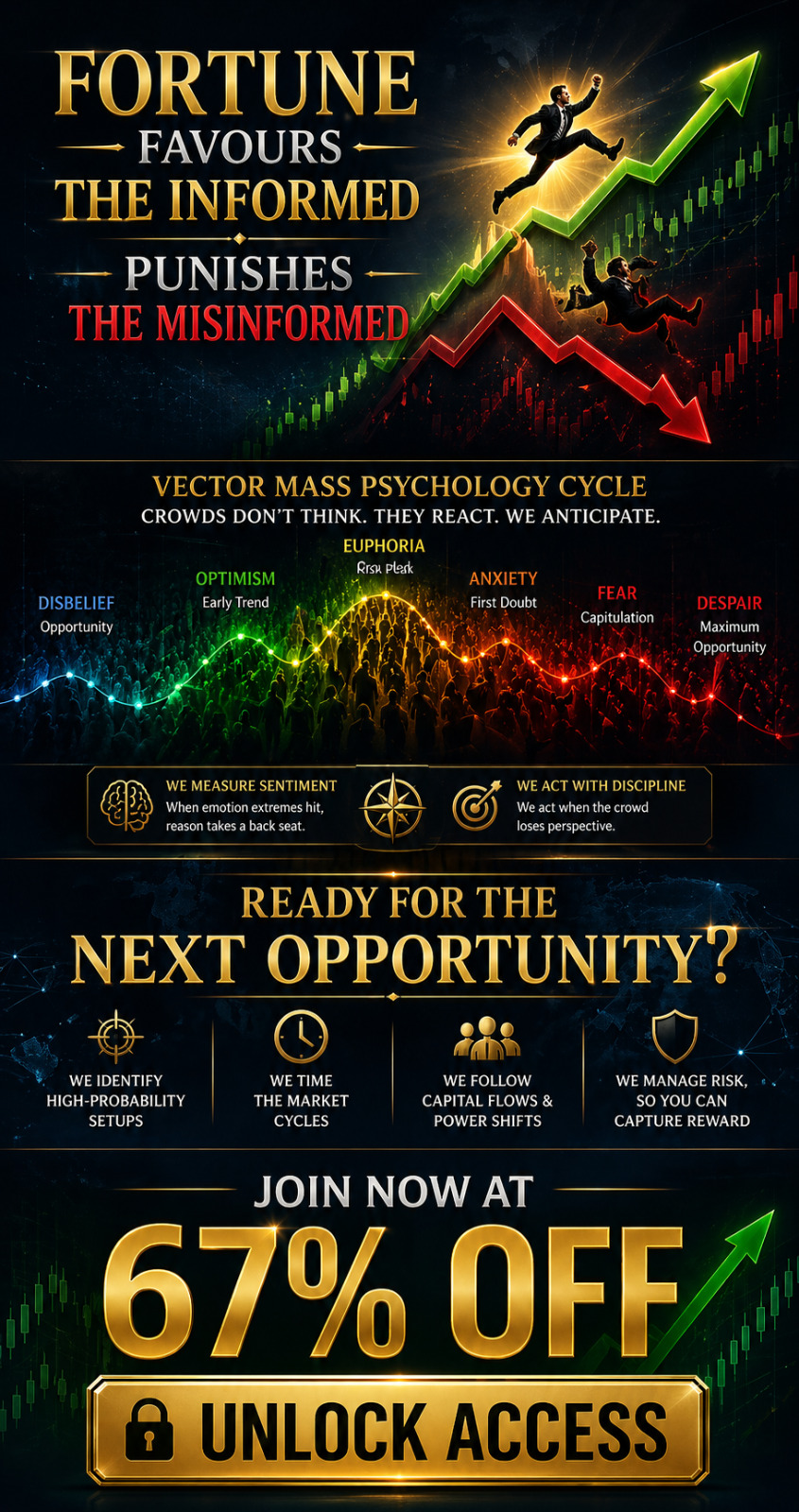
This is why mass psychology occupies such a central role in market behaviour. Markets are not driven solely by earnings, interest rates, or economic data. They are driven by what millions of people believe those variables mean, and when enough participants share the same interpretation, their collective actions begin to reshape the very reality they believe they are observing. Confidence encourages spending, spending supports economic growth, and stronger growth reinforces confidence. Fear follows the same feedback loop in reverse as spending slows, growth weakens, pessimism spreads, and declining confidence validates the original fears. What begins as perception gradually produces consequences that become undeniably real.
Truth, Consensus, and Investor Psychology
This raises a more uncomfortable question. When society labels someone irrational, does that necessarily mean they are wrong, or does it simply mean they disagree with the prevailing consensus? History provides countless examples in which overwhelming majorities embraced ideas that later proved spectacularly false. Consensus creates comfort because agreement reduces uncertainty, but comfort is not evidence, popularity is not proof, and the number of people who believe something tells us far more about prevailing sentiment than objective truth.
That observation should not be confused with the equally flawed belief that the crowd is always wrong. Most people who stand apart from consensus are not misunderstood visionaries. Many are simply mistaken in isolation rather than mistaken collectively. The lesson is not that disagreement is inherently valuable but that truth and popularity are separate variables whose relationship changes over time. Investors who fail to recognize this spend their careers following emotional currents created by other people, while those who understand it begin asking different questions whenever the crowd appears most certain.
When optimism reaches an extreme, they ask what risks are being ignored, and when fear becomes overwhelming, they ask the same question from the opposite direction. They look for doubt when everyone sees certainty, search for opportunity when everyone sees disaster, and recognize that the greatest opportunities often emerge when perception has drifted furthest from underlying reality.
Why Trend Followers Read Behaviour Differently
The objective is not to become a permanent contrarian because blind opposition to the crowd is simply another form of crowd behaviour. The real objective is to understand how emotion shapes perception, how perception influences decisions, and how those decisions eventually appear in market behaviour. Once that relationship becomes clear, price movements begin to reveal far more than changes in valuation alone.
This helps explain why disciplined trend followers often outperform emotionally driven investors over long periods. Their primary concern is not establishing who is intellectually correct but understanding where capital is actually flowing because they recognize that perception moves markets long before fundamentals fully adjust. While the crowd becomes absorbed in narratives, trend followers observe behaviour. While others argue over opinions, they study the movement of capital. While much of the market searches for certainty, they build decisions around probability, recognizing that this seemingly modest shift in perspective produces dramatically different outcomes over time.
The Real Edge in Markets
Most great fortunes have not been built because someone possessed secret information unavailable to everyone else. They were built because someone interpreted widely available information differently from the crowd and acted while collective perception remained distorted. When fear reached an extreme, they recognized opportunity. When optimism reached an unsustainable level, they recognized danger. The events were identical for everyone. Only the interpretation differed.
That may be the closest thing markets offer to a durable edge. It does not require predicting the future, uncovering hidden information, or discovering a flawless indicator. It requires recognizing that perception is not reality and that crowds routinely confuse one for the other. Once an investor fully understands that distinction, they become more resistant to manipulation, less vulnerable to fear, less susceptible to euphoria, and far more capable of making decisions independent of the emotional cycles surrounding them. In a world where enormous industries compete to shape public perception, that independence may be one of the rarest and most valuable advantages an investor can possess.

The Insightful Journey to Profound Understanding