The Paradox of Patience: Unlocking Value in a World of Haste
July 27, 2026
“The stock market is a device for transferring money from the impatient to the patient.”
Warren Buffett
The Most Misunderstood Edge in Investing
Markets reward patience far more consistently than brilliance, yet patience remains one of the least appreciated investment disciplines because its rewards arrive slowly while the rewards of action appear immediate. Investors are conditioned to believe that success comes from constantly doing something, chasing the next trend, reacting to the latest headline, or anticipating the next market move, when history repeatedly demonstrates that excessive activity usually transfers wealth to those willing to wait.
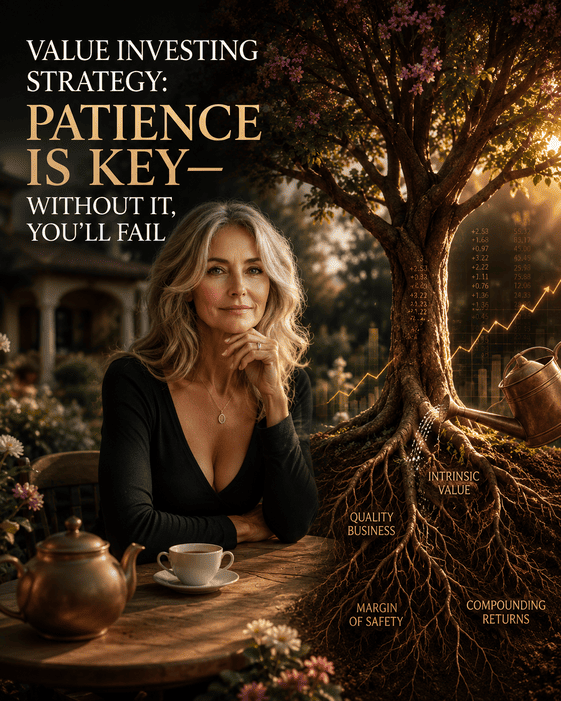
Patience is therefore not passive waiting. It is disciplined inaction grounded in conviction. It is the ability to separate temporary emotion from lasting value, allowing time, rather than constant intervention, to become your greatest ally. The market continually tempts investors to exchange long-term compounding for short-term excitement, yet the greatest fortunes have rarely been built by those who traded the most. They have been built by those who understood when doing nothing represented the highest-probability decision.
Patience Is Psychological Before It Is Financial
The greatest obstacle to patient investing is not the market but human nature. Behavioural finance has repeatedly demonstrated that investors are governed less by rational analysis than by deeply rooted psychological biases such as herd behaviour, loss aversion, confirmation bias, and overconfidence. These instincts evolved to improve survival but often produce disastrous investment decisions because they encourage buying after confidence has become widespread and selling once fear has already reached exhaustion.
Daniel Kahneman’s work on loss aversion illustrates this perfectly. Losses generate far greater emotional pain than equivalent gains create pleasure, encouraging investors to abandon sound positions simply to escape temporary discomfort. Markets exploit this weakness relentlessly. Panic selling rarely occurs because fundamentals have permanently deteriorated; it occurs because emotional pressure becomes unbearable.
Patience reverses that relationship. Instead of reacting to volatility, disciplined investors recognise that falling prices often reflect changing psychology far more than changing value. They understand that the market’s greatest opportunities frequently emerge when fear has compressed expectations well below underlying reality.
The Investors Who Understood Time
Warren Buffett did not become one of history’s greatest investors by predicting every market movement. He became extraordinary because he understood that exceptional businesses compounded value whether the market recognised them immediately or not. His investment in The Washington Post during the 1970s remains a classic example. While others focused on temporary uncertainty, Buffett focused on intrinsic value, allowing patience rather than prediction to generate exceptional returns.
The same principle appears throughout investment history. Walter Schloss ignored the excitement of the dot-com bubble, preferring companies selling below intrinsic value. John Neff consistently avoided fashionable sectors, waiting patiently for pessimism to create opportunity before committing capital. Christopher Browne built wealth through the same philosophy, purchasing outstanding businesses when market sentiment temporarily obscured their long-term value.
- Different investors, different decades, identical discipline.
- None attempted to outguess the market every week.
- They simply allowed time to close the gap between perception and reality.
Patience Needs Structure
Patience should never be confused with inactivity or blind optimism. It works only when supported by disciplined analysis. Technical analysis can help refine timing without replacing fundamental conviction. Long-term moving averages, trend structure, breadth, and momentum provide valuable confirmation that market psychology is beginning to shift. Used correctly, they do not predict turning points; they identify moments when probability begins favouring action rather than continued observation.
The objective is not to buy the exact bottom or sell the exact top. It is to combine strong businesses, attractive valuations, and improving market psychology into one coherent investment process. Technical analysis becomes a timing tool rather than a forecasting system, helping investors remain patient until conditions align.
Turning Volatility into Opportunity
Patient investors understand that volatility is not simply risk but optionality. Selling put options on high-quality businesses during periods of elevated fear illustrates this principle well. Rather than chasing rising prices, investors collect premium while positioning themselves to purchase outstanding companies at lower valuations should markets continue falling. If prices recover, the premium becomes income. If prices decline, the investor acquires a desirable asset at a predetermined discount.
More importantly, maintaining liquidity transforms market corrections from threats into opportunities. Investors forced to sell during crises become prisoners of circumstance. Investors holding cash become buyers precisely when emotional selling creates the widest gap between price and value.
Patience therefore extends beyond holding investments. It also means preserving the flexibility to act when the crowd cannot.
The Crowd Always Pays for Impatience
Every speculative episode reinforces the same lesson. During the dot-com bubble, investors abandoned valuation in pursuit of momentum until reality eventually reasserted itself. The strongest businesses survived, while many fashionable companies disappeared entirely.
Amazon provides an important distinction. Its share price collapsed after the bubble burst, yet the underlying business continued strengthening. Investors focused solely on market psychology abandoned it. Investors focused on long-term value remained invested and were eventually rewarded as fundamentals caught up with expectations.
The same psychological pattern appeared during the financial crisis, the pandemic panic, and countless smaller corrections. The assets changed. Human behaviour remained remarkably consistent. The crowd consistently buys confidence after opportunity has diminished and sells uncertainty after opportunity has improved. Patient investors reverse the sequence.
Patience Is Active, Not Passive
Patience is often mistaken for waiting. In reality, it is one of the most demanding disciplines in investing because it requires resisting the constant pressure to act. Doing nothing while markets become increasingly emotional is psychologically exhausting. Watching others appear to profit tests conviction. Holding through temporary declines challenges confidence. Remaining invested while headlines encourage panic requires emotional discipline that cannot be outsourced to algorithms or forecasts.
Yet this discomfort is precisely where the edge originates. Markets repeatedly transfer wealth from those seeking immediate certainty to those willing to endure temporary uncertainty. The patient investor understands that time is not simply passing; it is allowing emotional extremes to correct themselves while intrinsic value continues compounding beneath the surface.
Conclusion: Time Is the Ultimate Contrarian
Patience is not a virtue because it feels comfortable. It is a virtue because it repeatedly places investors on the opposite side of emotional consensus. Jonathan Swift advised keeping your money in your head rather than your heart, and few observations better describe successful investing. Markets constantly encourage emotional reactions, but enduring wealth belongs to those capable of separating temporary sentiment from permanent value.
The paradox is simple. Investors spend enormous effort searching for sophisticated strategies while overlooking the most reliable edge available to them. Time compounds businesses, expectations eventually converge towards reality, and emotional extremes inevitably reverse.
Patience therefore becomes far more than waiting.
- It becomes a strategy.
- It becomes a filter against the crowd.
Most importantly, it becomes the mechanism through which compounding transforms disciplined judgement into lasting wealth, proving once again that markets do not consistently reward those who move first, but those who know when not to move at all.

Exploring New Ideas