
Why Three Unrelated Events May Be Reshaping the Global Order
July 10, 2026
Most events, when viewed in isolation, carry very little significance. Markets have a habit of overreacting to individual headlines before quietly moving on to the next crisis, scandal or political drama. We generally ignore these episodes because they rarely alter the long-term trajectory of either the economy or the markets. What interests us far more is the accumulation of seemingly unrelated events that begin pointing in the same psychological direction. History suggests that great powers rarely lose influence because of one catastrophic mistake. Confidence usually erodes gradually through a succession of developments that, taken individually, appear unremarkable but collectively begin altering how nations, investors and institutions assess risk.
That is why this latest episode caught our attention.
Not because a football match matters to financial markets, and certainly not because one political intervention changes the course of history, but because it appears to reinforce a broader pattern that has been quietly developing for several years. Viewed through the lens of Vector Mass Psychology, the event is interesting only because it adds another data point to an emerging narrative. Whether that narrative ultimately proves correct is almost secondary. Markets and geopolitics have always responded to perception long before reality fully catches up.
The incident itself accomplished very little. President Trump inserted himself into a sporting event where many observers, including a significant number of American supporters, believed political leaders had no place intervening. The reaction was overwhelmingly negative across much of the international media, and the intervention ultimately changed nothing. Belgium went on to thoroughly outplay and defeat the United States, making the episode appear even more unnecessary in retrospect. The result of the match will soon be forgotten. The perception created by the incident may not.
On its own, that would hardly deserve further discussion. The importance lies elsewhere.
Over the past several years, three developments have quietly reinforced a remarkably similar psychological conclusion among governments around the world.
The first was the freezing and partial seizure of Russian sovereign reserves following the invasion of Ukraine. Whether Russia was justified or entirely at fault is not the point being examined here. International law, morality and geopolitics can all be debated separately. The lasting psychological consequence was much simpler. Many governments concluded that sovereign reserves held abroad were no longer beyond political reach. For decades, central bank reserves were widely viewed as untouchable. That assumption no longer appears universally accepted.
The second development involved growing restrictions surrounding access to leading large language models and advanced semiconductor technology. Once again, the issue is not whether those restrictions were justified. Every nation has legitimate security concerns and every government reserves the right to protect technologies it considers strategically important. The broader consequence, however, is that many countries increasingly view critical technologies as geopolitical instruments rather than purely commercial products. Whether discussing artificial intelligence, advanced chips or cloud infrastructure, dependence on another nation’s technological ecosystem now carries a different set of perceived risks than it did only a few years ago.
The third development is considerably smaller, yet psychologically it reinforces the same direction. The perception that political influence has begun extending into institutions traditionally viewed as independent, including international sporting bodies, further strengthens the belief that influence increasingly follows power rather than established convention. Whether every criticism proves entirely justified is almost beside the point. Mass psychology has never required perfect accuracy. It requires only enough consistency for a narrative to begin organising itself.
History repeatedly demonstrates that perception compounds.
The British Empire did not lose influence because of a single military defeat. Confidence gradually weakened through decades of economic competition, geopolitical challenges and changing global realities. Likewise, the Soviet Union did not suddenly collapse because of one speech or one failed policy. Long before the political system formally disintegrated, perceptions regarding its economic strength, technological competitiveness and institutional resilience had already begun changing both inside and outside its borders. Markets often behave in precisely the same way. Investors rarely react permanently to one headline. They react when enough headlines begin reinforcing the same underlying story.
Viewed together, these developments encourage a broader conclusion. Around the world, many governments increasingly appear to be asking the same question.
What happens if the systems we depend upon can ultimately be turned against us?
Whether discussing reserve currencies, payment systems, artificial intelligence, semiconductors or strategic technologies, dependence itself is increasingly being viewed as a geopolitical vulnerability. That perception alone encourages diversification.
This does not necessarily reflect the intentions of the United States, nor should it be interpreted as a judgment of the American people. Nations frequently pursue policies they believe serve legitimate national interests. The point is considerably narrower. Markets, institutions and governments respond primarily to perceived incentives rather than carefully balanced academic arguments. Once enough decision-makers conclude that concentration creates strategic risk, behaviour begins changing regardless of whether those perceptions are fully justified.
From a Vector Mass Psychology perspective, this increases the probability that the world continues drifting toward greater self-reliance. For more than three decades, globalisation rewarded efficiency above almost everything else. Production migrated to wherever costs were lowest, supply chains stretched across continents and economic interdependence became the dominant organising principle of the global economy.
Increasingly, however, efficiency appears to be giving way to resilience.
Those are not identical objectives.
Efficiency concentrates production where costs are lowest. Resilience deliberately introduces redundancy, diversification and domestic capacity even when doing so increases costs. Reshoring, friend-shoring, strategic stockpiles, domestic semiconductor production, energy security and defence manufacturing all reflect this broader transition. Individually they may appear unrelated. Collectively they suggest that nations are quietly paying a premium for independence.
That transition carries important implications for investors.
We are not suggesting that financial markets stand on the verge of collapse. In fact, quite the opposite. Periods of elevated uncertainty have often proven surprisingly constructive for long-term investors because they prevent excessive complacency from taking hold. Bull markets rarely die because uncertainty exists. They usually end when uncertainty disappears and confidence becomes nearly universal.
Until bullish sentiment climbs well beyond historically elevated levels, our broader strategy remains unchanged. Sharp corrections should be viewed as opportunities rather than reasons for panic.
The changing geopolitical landscape also strengthens the long-term case for several sectors that benefit from strategic investment rather than consumer optimism. Commodities, industrial metals, energy infrastructure, defence, domestic manufacturing, automation and selected technology suppliers all deserve close attention if governments continue prioritising resilience over maximum efficiency. These trends will almost certainly experience setbacks along the way, but the underlying direction appears increasingly durable.
One final observation.
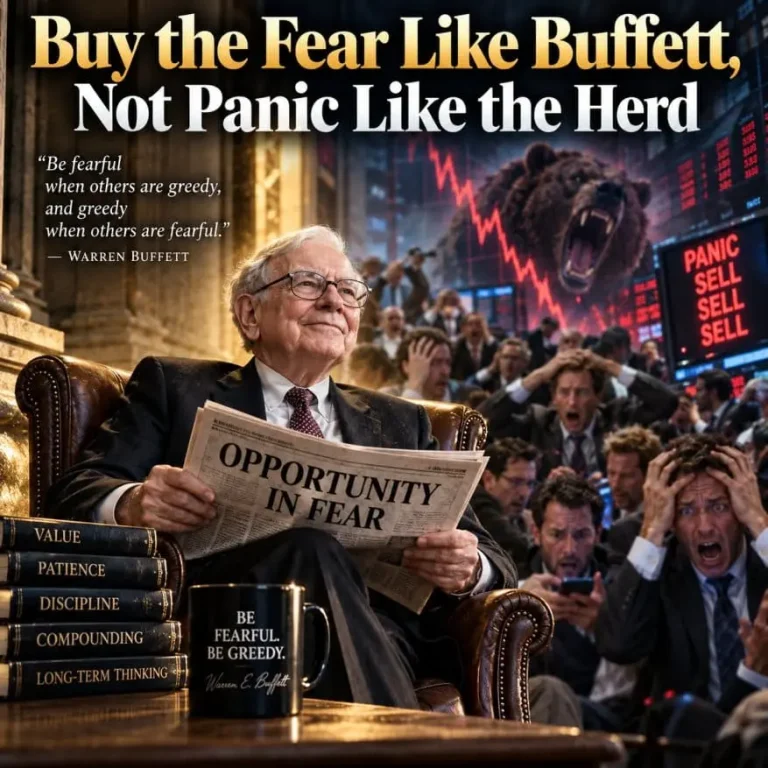
During periods like these, it becomes remarkably easy to allow professional pessimists and financial fearmongers to dominate the conversation. Every headline becomes evidence that civilisation stands at the edge of collapse, every correction becomes the beginning of another Great Depression and every geopolitical disagreement becomes the spark that supposedly changes everything forever.
History tells a very different story.
Markets do not reward certainty. They reward those willing to act before certainty arrives. The crowd mistakes uncertainty for danger, while disciplined investors recognise that prolonged uncertainty often suppresses expectations far more than reality. The greatest opportunities rarely emerge when confidence is abundant. They appear when fear still dominates but its momentum has begun to fade.
Humanity has endured world wars, financial crises, pandemics, sovereign defaults, technological revolutions and political upheaval, yet disciplined investors willing to separate emotion from probability have repeatedly found opportunity precisely when uncertainty appeared greatest.
Perspective matters.
According to the latest estimates from the World Bank, roughly 800 million people still survive on less than three dollars a day, while well over a billion live on less than \$4.20. Most of us spend our time worrying about temporary market volatility while enjoying opportunities that much of the world’s population can scarcely imagine. Perspective will not eliminate uncertainty, but it can prevent temporary setbacks from becoming permanent mistakes.
Markets will always fluctuate, and narratives will always change.