

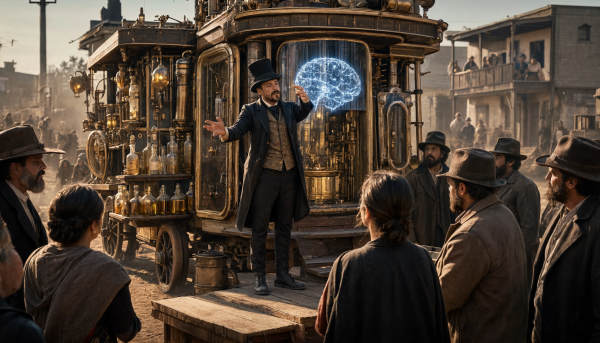
The Snake Oil Phase of Artificial Intelligence
July 10, 2026
Every technological revolution passes through a period where reality and marketing drift so far apart that investors begin confusing promises with products. Railroads had it. The dot-com boom perfected it. Cryptocurrency experienced it. Artificial intelligence has now entered its own version, where almost every company claims to possess something revolutionary while remarkably few are willing to admit how dependent these systems still are on the quality of the knowledge they receive.
Ford’s recent decision to rehire 350 veteran engineers is one of the clearest examples yet that the gap between AI marketing and engineering reality is beginning to close. The company openly acknowledged that relying too heavily on artificial intelligence and automated quality systems failed to deliver the level of product quality it expected. Charles Poon, Ford’s Vice President of Vehicle Hardware Engineering, admitted that management had mistakenly believed feeding design requirements into AI would naturally produce high-quality engineering decisions. It did not. Instead of abandoning AI altogether, Ford reversed course by bringing back experienced “gray beard” engineers whose primary job is not simply designing better vehicles, but training younger engineers and teaching the AI systems where their reasoning continues to fail.
That distinction matters enormously because it exposes one of the biggest misconceptions surrounding artificial intelligence. The technology itself did not fail. Management misunderstood what they had actually built.
Much of today’s AI is marketed as though it possesses something resembling expert judgment. In reality, what most people interact with today are extraordinarily sophisticated neural networks trained on unimaginably large quantities of public information. That achievement is remarkable in its own right, but it should not be confused with expertise. Knowledge and expertise have never been the same thing.
The internet contains humanity’s accumulated knowledge. It also contains humanity’s accumulated confusion, repetition, misinformation, advertising, ideological bias, outdated information and outright nonsense. Hidden among those mountains of data are extraordinary insights produced by brilliant scientists, engineers, physicians, mathematicians and economists, but they exist alongside billions of pages that contribute very little to genuine understanding. When a model learns from all of it simultaneously, the surprising outcome is not that it occasionally produces convincing nonsense. The surprising outcome is that it performs as well as it does.
This is where much of Silicon Valley lost sight of the difference between information and judgment. Human expertise has never developed through passive accumulation alone. A mechanical engineer does not become world-class simply by reading every engineering textbook ever written. A surgeon does not master complex procedures by memorising medical journals. An experienced aircraft designer does not rely exclusively on documentation.
They learn through apprenticeship, repeated failure, constant criticism, observation, mentorship and decades spent absorbing patterns that rarely appear inside formal specifications. Over time, thousands of isolated facts become compressed into intuition. That intuition is extraordinarily difficult to document because much of it exists as tacit knowledge rather than explicit instruction.
Corporate America spent decades building precisely that kind of intellectual capital before convincing itself it had become an unnecessary expense. During the initial AI boom, companies rushed to reduce labour costs, automate decision-making and reassure investors that artificial intelligence would eliminate expensive specialists. Quarterly earnings improved. Share prices often responded favourably. Wall Street applauded efficiency gains while paying remarkably little attention to whether organisations were quietly dismantling the very expertise that had created those businesses in the first place.
Ford appears to have discovered that lesson the expensive way.
By bringing experienced engineers back into the development process, the company is effectively acknowledging that institutional knowledge cannot simply be replaced with statistical prediction. The veteran engineers are identifying failure points long before components reach the production line, improving product quality while simultaneously teaching younger engineers and refining the AI systems that originally failed to meet expectations. Ford’s management has already stated that the resulting improvements are contributing hundreds of millions of dollars through lower warranty and recall costs, while the company recently climbed to the top position among mainstream manufacturers in J.D. Power’s Initial Quality Survey. The irony is difficult to miss. The expensive engineers many believed AI would replace are now helping make the AI genuinely useful.
Ford is not entirely alone.
Earlier this year, Klarna, one of Europe’s most aggressive adopters of artificial intelligence for customer service, publicly acknowledged that its pursuit of automation had gone too far. After celebrating AI’s ability to replace large numbers of human support staff, the company reversed course and resumed hiring people because customers increasingly valued judgement, empathy and nuanced problem solving that automated systems struggled to deliver consistently. The lesson was remarkably similar. Automation proved highly effective for routine tasks, but considerably less impressive once situations required experience, interpretation or contextual understanding.
Neither Ford nor Klarna represents a failure of artificial intelligence; they actually represent a failure of management expectations.
Executives often treated AI as though purchasing the software automatically transferred decades of institutional expertise into a machine. That assumption was never realistic because expertise is not something that exists independently of the people who created it. It evolves through continuous interaction between knowledge, experience, judgement, failure and feedback. Remove the experienced practitioners from the system and much of that invisible intelligence disappears with them.
The financial markets deserve part of the blame as well.
For much of the past three years, investors rewarded stories of cost reduction far more enthusiastically than stories of knowledge preservation. Removing highly paid specialists produced immediate improvements in quarterly profitability that were easy to measure. The gradual erosion of institutional memory remained almost invisible until quality deteriorated, customers complained, engineering mistakes multiplied or expensive recalls appeared years later. Markets have always struggled to price assets they cannot easily quantify, and institutional knowledge may be one of the least appreciated assets on any balance sheet.
History suggests this pattern is entirely normal.
The dot-com bubble produced countless businesses built upon unrealistic expectations about what the internet could immediately achieve. Most failed. The survivors fundamentally transformed the global economy, but only after speculation gave way to practical implementation, better infrastructure and a more realistic understanding of where technology genuinely created value. Artificial intelligence appears to be entering a similar phase. The excitement was not entirely misplaced, but expectations became detached from engineering reality. The technology was marketed as a universal replacement for expertise long before anyone demonstrated that expertise had actually been replicated.
Eventually the market corrects those assumptions.
Not because artificial intelligence disappoints, but because reality replaces mythology. Artificial intelligence is not snake oil. Treating it as though it already possesses the accumulated judgement of seasoned engineers, physicians, scientists and craftsmen very much is. The technology remains extraordinarily powerful, but its greatest strength today lies in amplifying genuine expertise rather than replacing it. Experienced professionals consistently extract remarkable value because they recognise weak reasoning, challenge incorrect assumptions and guide the system towards better conclusions. Less experienced users often mistake polished confidence for genuine understanding because they lack the knowledge needed to recognise the difference.
That may prove to be the defining lesson of this first AI cycle.
Companies did not overestimate what neural networks could calculate. They overestimated what public information alone could teach them.
The irony is that Ford’s decision to rehire veteran engineers may ultimately accelerate artificial intelligence rather than slow it. Those engineers are not competing against the machines. They are teaching them. Every mistake they correct, every failure they identify and every judgement they contribute becomes another piece of expertise that can eventually be distilled into better systems. The future almost certainly belongs to artificial intelligence, but not the version built solely by scraping the internet and scaling compute. It belongs to systems that learn the same way humans have always learned, by working alongside genuine experts until information gradually becomes judgement, and judgement eventually becomes wisdom.