
America’s Oil System Was Built for a Different Kind of Crude
Sept 18, 2026
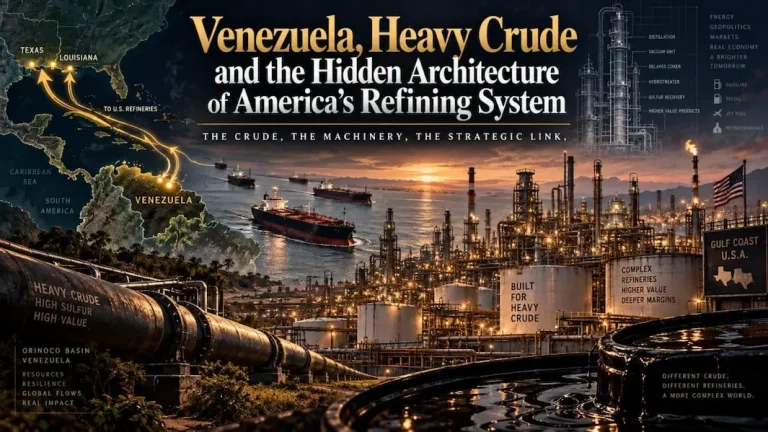
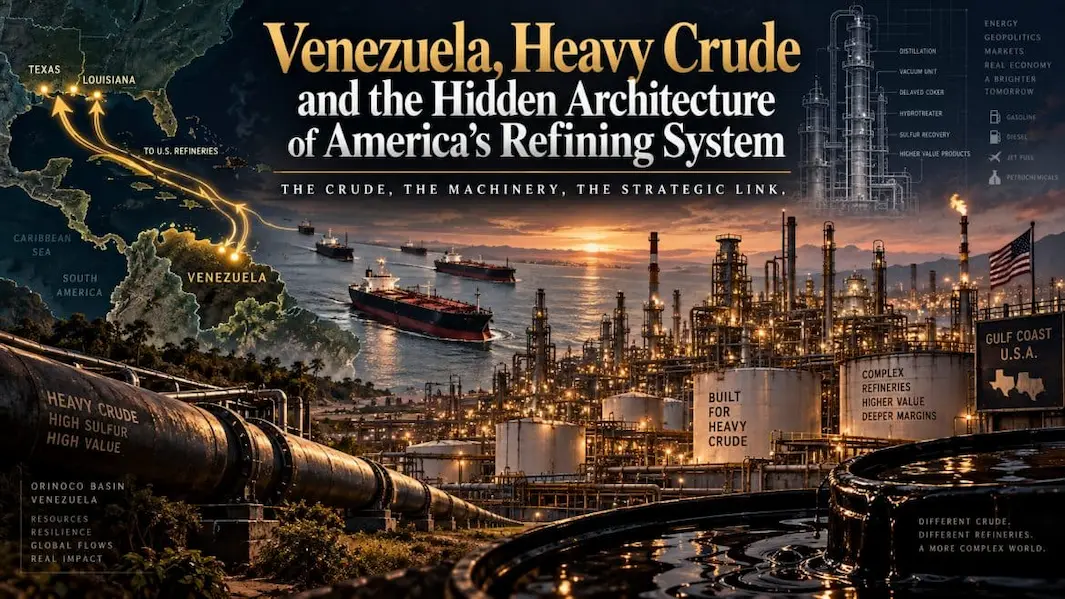
Venezuela matters to the United States for a reason that is frequently misunderstood, particularly when oil discussions become trapped inside the simplistic assumption that a country producing record quantities of crude should have no interest in importing additional barrels. America does not merely consume oil; it operates one of the world’s most sophisticated refining systems, and a substantial portion of that system was engineered around crude characteristics that differ sharply from the light, sweet shale oil produced in enormous quantities across Texas, North Dakota and other domestic basins. Venezuela’s importance therefore begins not with the size of its reserves, although those reserves are extraordinary, but with the physical characteristics of the oil sitting beneath its soil.
Much of Venezuela’s production is heavy and sour, meaning it is dense, difficult to transport and contains relatively high levels of sulfur, characteristics that make it troublesome for simple refineries but potentially extremely valuable to complex facilities equipped with cokers, hydrocrackers and sophisticated desulfurization systems. The distinction is important because heavy crude does not automatically produce more diesel, nor is light sweet crude incapable of producing diesel, as virtually every serious refining system can generate middle distillates from a range of feedstocks; the real question concerns refinery configuration, conversion capability and the economic spread between what a refinery pays for a difficult barrel and what it can ultimately sell after breaking that barrel apart.
That distinction places Venezuela directly inside the architecture of the American Gulf Coast refining system. For decades, sophisticated Gulf Coast refineries invested billions in equipment capable of processing heavy, sour crude that simpler facilities would struggle to handle economically. A complex refinery can take a discounted barrel containing large quantities of heavy hydrocarbons and, through expensive conversion processes, transform more of that material into higher-value products such as diesel, gasoline and jet fuel. The refinery’s advantage is therefore not that it possesses some magical ability to manufacture products unavailable to other refiners; its advantage lies in its capacity to buy a more difficult and often discounted feedstock, process it efficiently and capture the economic difference.
That is why Venezuela’s crude remains strategically relevant even while American oil production remains immense. The United States has become one of the world’s largest producers of light crude through the shale revolution, yet geological abundance does not automatically mean that every domestic barrel perfectly matches the requirements of every refinery. The result is a structural mismatch that often confuses observers: America can produce enormous quantities of oil while simultaneously importing heavy crude because portions of its refining system were designed around heavier feedstocks. Venezuela, Canada, Mexico and certain Middle Eastern producers therefore occupy an important place in the crude supply chain because they provide barrels that complement rather than duplicate the American shale system.
The Refining Mismatch Behind Venezuela’s Strategic Value
Venezuela’s relationship with Gulf Coast refining infrastructure illustrates this perfectly. The U.S. Energy Information Administration has repeatedly noted that Gulf Coast refineries are particularly well suited to processing the heavy crude Venezuela produces, while the restoration of Venezuelan exports has historically been constrained not by the absence of reserves but by deteriorating infrastructure, insufficient investment, shortages of diluent and years of operational decline.
The recent acceleration of Venezuelan exports reinforces the point. More than 500,000 barrels per day were reportedly moving toward the United States from Venezuelan production of roughly 1.25 million barrels per day, with American officials explicitly noting that much of the crude was heading toward refineries designed to process precisely that type of feedstock. This is where the geopolitical story becomes considerably more interesting than the usual argument about whether Venezuela simply possesses “a lot of oil.”
It possesses a great deal of oil, but the more important question is who controls the production vector, who finances the infrastructure and who ultimately receives preferential access to the barrels. The recently announced U.S.-Venezuela arrangement involving 17 oilfields and approximately 64 to 65 billion barrels of reserves demonstrates that this is no longer merely a commercial relationship built around individual export licenses. The agreement is structured around long-term access, production development and strategic control, with Reuters reporting that the United States would receive a 35% equity stake in the corporate parent structure, guaranteed access to part of production and preferential purchasing rights over additional output. The ambition is enormous, with Venezuelan officials discussing a production target exceeding 1.5 million barrels per day from the strategic fields involved in the broader development framework.
Reserves Are Not Production
Yet this is precisely where investors should separate the resource story from the production story, because Venezuela has never suffered from a shortage of hydrocarbons. It has suffered from the far more complicated problem of converting geological wealth into reliable industrial output.
Oil reserves are potential energy. Production requires functioning machinery, pipelines, power systems, drilling equipment, technical personnel, diluent supplies, export infrastructure, capital and, perhaps most importantly, enough political stability for investors to believe that the rules governing a project will still exist several years after billions of dollars have been committed. Venezuela possesses extraordinary underground wealth but has spent decades weakening many of the systems required to monetize it.
That reality makes the most optimistic headlines dangerous when interpreted literally. Production cannot simply be ordered into existence because politicians announce a target. Wells require workovers, pipelines require maintenance, damaged facilities require replacement and heavy crude frequently requires diluent before it can be transported and processed efficiently. The EIA’s earlier assessment of Venezuelan recovery captured the essential problem: sanctions relief could improve output, but years of underinvestment and deteriorating infrastructure meant that meaningful production expansion would require additional time and substantial capital investment. (U.S. Energy Information Administration)
The Long Road From Recovery to Expansion
This creates a much more realistic production framework. The first phase of recovery can occur relatively quickly because existing infrastructure, operating fields and partially dormant wells provide opportunities for incremental production gains through repairs, workovers and improved access to equipment and diluent. The second phase becomes more difficult because sustained growth requires drilling programs, expanded processing capacity, reliable transportation systems and large-scale capital expenditure. A genuine Venezuelan renaissance, one capable of restoring production toward historical levels associated with the country’s former oil prominence, would require years of disciplined investment and political continuity.
That last condition may prove harder than the engineering. Oil infrastructure can be repaired. Political systems are considerably more difficult to repair because capital does not invest merely in geology; it invests in expectations. If investors believe contracts may be rewritten, assets may be nationalized or governments may change the economic rules whenever commodity prices or political circumstances shift, the required return on investment rises dramatically. Venezuela therefore faces a psychological as well as industrial problem: before the country can fully monetize its resources, it must convince capital that today’s opportunity will still exist tomorrow.
Oil as a Geopolitical Instrument
This is where the geopolitical dimension becomes impossible to ignore. The new arrangement is occurring within a broader contest over energy influence involving the United States, China and Russia, with reports indicating that American-backed operators may assume control over fields previously associated with Chinese and Russian companies. (The Standard) The oil therefore represents more than fuel for American refineries. It represents geopolitical leverage, preferential access to strategic resources and the ability to redirect future production away from competing powers.
From a market perspective, however, the most immediate beneficiaries may not necessarily be oil producers. The real transmission mechanism could run through the refining industry. When heavy crude supplies become constrained while complex refining capacity remains limited, refiners capable of processing those barrels gain an economic advantage. Their profitability depends not simply upon whether oil prices rise or fall, but upon the relationship between crude acquisition costs, refinery utilization, product prices and crack spreads. A refinery can therefore prosper during periods when crude markets themselves appear difficult, provided refined products remain valuable relative to the feedstock entering the system.
The Investment Thesis: Conversion Capacity
That is why the investment thesis should not simply be described as bullish on oil. It is potentially bullish on conversion capacity. The critical question becomes which companies possess the infrastructure capable of transforming difficult barrels into scarce refined products and whether those products, particularly middle distillates such as diesel and jet fuel, command sufficiently strong prices to create exceptional refining margins. The Venezuelan story strengthens this thesis because greater access to heavy crude could improve feedstock availability for sophisticated American refineries, although the effect will depend heavily on actual production growth rather than political announcements.
There is, however, an important contradiction that investors should not ignore. Greater Venezuelan production could simultaneously benefit complex refiners through improved access to suitable feedstock while exerting downward pressure on crude prices if global supply increases substantially. Whether that becomes bullish or bearish for individual refiners depends upon the relative movement of crude prices and refined-product margins. Cheaper heavy crude combined with strong diesel prices would be extremely attractive. Falling product prices alongside rising crude availability would produce a very different outcome.
Headlines Move Faster Than Infrastructure
The psychology surrounding the story may ultimately create opportunities of its own. Markets frequently price geopolitical developments as immediate transformations because headlines compress time. A government announces access to billions of barrels, investors imagine production appearing tomorrow and political rhetoric converts a multi-year industrial reconstruction project into something resembling an overnight supply shock. Reality moves more slowly. The production vector may have changed direction, but direction and velocity are not the same thing.
Venezuela has the magnitude: approximately 65 billion barrels are associated with the recently announced fields, while the country possesses vastly larger total reserves. What remains uncertain is the velocity at which those reserves can be converted into sustainable production. Reuters and other reporting surrounding the agreement emphasize the complexity of the arrangement and the substantial legal, political and operational uncertainties still surrounding its implementation.
The Contrarian View: Follow the Production Vector
The contrarian interpretation, therefore, is not that Venezuela will suddenly flood the world with oil, nor that the recent agreements should be dismissed because production cannot immediately reach the most ambitious targets. Both extremes confuse possibility with probability. The more interesting thesis sits between them.
Venezuela is beginning from an extraordinarily low operational base relative to its resource wealth, while the United States possesses a refining system capable of consuming exactly the kind of heavy crude Venezuela produces. The strategic incentive for both countries is therefore obvious: Venezuela needs capital, infrastructure and reliable markets; the United States benefits from access to heavy crude suited to complex refining systems while simultaneously strengthening its geopolitical position in a region historically influenced by competing powers.
The resource is not the mystery. The infrastructure is, and that may be the central investment lesson hidden beneath the headlines: Venezuela’s future will not be determined by how much oil lies beneath the ground because the market already knows the reserves are enormous. The real question is whether capital, technology, infrastructure and political stability can finally move in the same direction long enough to convert potential energy into sustained production.
If that happens, the consequences will extend far beyond Venezuela. They will flow through American Gulf Coast refineries, global heavy-crude markets, diesel economics and the geopolitical balance of energy itself. For now, the smartest approach is to watch the production numbers rather than the political promises. (Reuters)
httpv://www.youtube.com/watch?v=7mC90Jinqi
Thought-Provoking Reads