
Why AI Hallucinates: The Dangerous Gap Between Sounding Right and Being Right
Aug 21, 2026
Artificial intelligence can produce an answer that appears complete in every respect, combining accurate facts with a convincing explanation, appropriate terminology and even references that seem to support the conclusion, yet a central part of that answer may be entirely false. This creates a problem that is more subtle than ordinary error because the weakness is often concealed by the quality of the language surrounding it, allowing plausibility to acquire the appearance of knowledge. The question is therefore not simply why AI makes mistakes, but why a system capable of processing enormous quantities of information can sometimes present uncertainty in a form that appears indistinguishable from certainty.
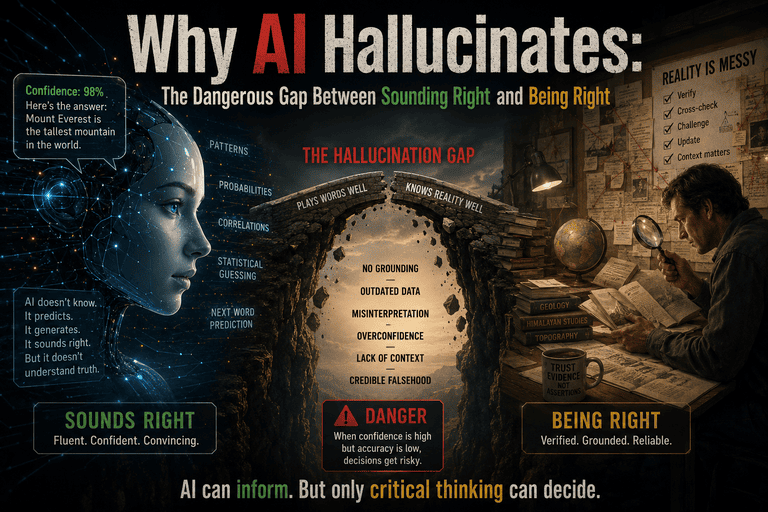
The answer begins with the distinction between generating language and establishing truth. Large language models are trained to identify and reproduce extraordinarily complex statistical relationships within text, enabling them to recognise concepts, relationships, patterns and structures that would be impossible to reduce to a simple database or collection of stored answers. However, the ability to generate the most plausible continuation of a sequence is not identical to independently verifying whether that continuation corresponds to reality, and the gap between those two processes lies at the centre of the hallucination problem.
The Difference Between Plausibility and Truth
A large language model is not simply a search engine and is not, despite a common description, merely a vector database with a conversational interface. Search engines retrieve information from external sources, while vector databases are retrieval systems designed to identify information with similar mathematical representations, whereas a language model encodes statistical relationships within a vast network of learned parameters and uses those relationships to generate new text.
This distinction matters because an answer can emerge from a genuine understanding of patterns without being supported by a verified fact. If a particular historical event, company, scientific concept or individual resembles thousands of other patterns contained within the model’s training, the system may generate a highly plausible continuation even when the exact information required to answer the question is missing, ambiguous or incorrectly represented.
The resulting answer may therefore contain a peculiar mixture of knowledge and invention. The structure can be correct, the surrounding context can be accurate and the explanation can follow perfectly reasonable logic, while a date, quotation, citation or connection between two events has been generated because it fits the pattern of what should plausibly appear rather than because the model has established that it is true.
Why AI Has an Incentive to Guess
One of the more important developments in the study of AI hallucinations is the growing recognition that the problem is partly connected to incentives. A model that is evaluated primarily on whether it produces the correct answer can be encouraged to guess when uncertainty exists, because a correct guess receives the same reward as a well-supported answer while an explicit admission of uncertainty may be treated as a failure.
The structure resembles an examination in which leaving a question blank guarantees no credit, while guessing occasionally produces a correct answer. Under those conditions, guessing can become statistically advantageous even when the underlying confidence is weak, particularly if the system is not separately rewarded for recognising the difference between established knowledge, reasonable inference and insufficient evidence.
This creates an important distinction between accuracy and calibration. A model may achieve a respectable overall accuracy score while still behaving poorly in situations where the information is incomplete, because the evaluation system can reward the final answer without adequately measuring whether the level of confidence attached to that answer was justified.
Fluency Creates an Illusion of Knowledge
The problem becomes more dangerous because human beings are highly sensitive to signals of competence that have little direct connection to accuracy. A clear explanation, confident grammar, logical sequencing and detailed terminology can all create an impression of authority, even though none of these characteristics proves that the underlying claim has been verified.
Language has always possessed this capacity. A poorly supported argument expressed with precision and confidence can appear more persuasive than a cautious argument supported by stronger evidence, particularly when the reader lacks the time or specialised knowledge required to verify every claim independently.
Artificial intelligence magnifies this tendency because it can produce polished explanations at extraordinary speed. The result is an unusual inversion of the traditional relationship between effort and authority, since a highly detailed answer that once implied substantial research may now be generated within seconds, making the appearance of intellectual labour a far less reliable indicator of whether the underlying information deserves trust.
The Most Dangerous Errors Are Almost Correct
An obviously absurd hallucination is relatively easy to identify because it creates friction between the answer and the reader’s existing knowledge. The more dangerous failure occurs when an answer is substantially correct but contains one fabricated quotation, one incorrect date, one invented source or one false connection that fits naturally into the surrounding argument.
This type of error is difficult to detect precisely because the accurate information surrounding it lowers the reader’s defences. Once an answer establishes credibility through a series of correct observations, an unsupported detail can pass unnoticed because the mind naturally extends the credibility of the whole explanation to its individual components.
The danger increases further when fabricated information becomes specific. A vague falsehood may invite scepticism, but a precise figure, publication date or apparently authoritative source can create the opposite effect, since specificity is often unconsciously interpreted as evidence that the speaker possesses direct knowledge of the subject.
Language Models Learn From What Is Said About Reality
There is also a deeper epistemic problem beneath the technical issue of hallucination. A language model is trained primarily on representations of reality contained within language, including facts, opinions, arguments, errors, myths, contradictions and repeated assumptions, rather than possessing direct access to reality itself.
Most of the time, this distinction is manageable because human knowledge is transmitted through language and reliable patterns tend to recur across many sources. The difficulty emerges when the available information is incomplete, when authoritative sources disagree, when a false claim has been widely repeated or when the question requires information that extends beyond what can reasonably be inferred from the material available to the model.
At that point, the system can still produce a coherent answer because coherence is a property of language generation, not a guarantee of truth. The model does not necessarily encounter a dramatic internal boundary between knowledge and invention; instead, the same machinery that produces a useful explanation may continue operating beyond the point where the evidence is sufficient.
Why AI Can Sound Certain When It Should Not
Modern AI systems can estimate uncertainty, express lower confidence, ask for clarification and increasingly use external tools to verify information. Nevertheless, these capabilities do not eliminate the underlying problem because confidence remains difficult to calibrate across the enormous range of subjects and situations a general-purpose system may encounter.
A statement that appears highly probable within the statistical structure of language is not automatically highly probable in the external world. Historical information may have been incorrectly repeated, recent events may have changed the relevant facts, and highly specific questions can expose gaps that are concealed when the model is discussing broader or more familiar subjects.
The objective should therefore not be to create an artificial intelligence that never acknowledges uncertainty, nor should uncertainty itself be interpreted as weakness. A more reliable system distinguishes between what is well established, what can reasonably be inferred, what requires external verification and what cannot be determined from the available evidence.
Why Explanations of Mistakes Can Also Be Misleading
A further complication appears after an AI system has made an error. When asked why the mistake occurred, the system may provide an explanation that sounds reasonable but is itself another generated response rather than a direct account of the computational process that produced the original answer.
An AI can correctly acknowledge that a statement was false without possessing complete introspective access to the precise interaction between its parameters, training patterns and contextual signals that resulted in the error. The explanation of the mistake may therefore be useful as a general description of possible failure modes, but it should not automatically be treated as a forensic reconstruction of the exact cause.
This distinction is important because language models are particularly good at producing explanations that fit a situation. The ability to generate a convincing account of why something happened should not be confused with direct access to the underlying causal mechanism, especially when the system is being asked to explain its own internal behaviour.
The Real Challenge Is Calibration
The future of reliable artificial intelligence is therefore unlikely to depend upon eliminating every error, because no complex system operating with incomplete information can achieve permanent infallibility. The more realistic objective is to improve calibration so that the system’s behaviour reflects the quality of the available evidence rather than merely the probability that a particular sequence of words will sound convincing.
This requires better evaluation methods, stronger incentives for abstention when evidence is insufficient, greater use of retrieval and verification where appropriate, and clearer distinctions between factual knowledge, inference and speculation. It also requires users to abandon the assumption that a polished answer represents the end of the research process, particularly when the information concerns financial decisions, medicine, law, science or any other field where a convincing error can have consequences beyond simple embarrassment.
Artificial intelligence is becoming increasingly capable of reasoning, searching, analysing and synthesising information, but those abilities do not remove the fundamental difference between generating a persuasive representation of reality and independently establishing what is true. The systems that prove most useful will not necessarily be those that always provide an answer, but those that become increasingly reliable at recognising when an answer is supported, when it requires verification and when the available evidence does not justify certainty.
Conclusion
The central danger of AI hallucinations is not that artificial intelligence can be wrong, because error is an unavoidable feature of every system that operates under uncertainty. The deeper danger is that fluency, intelligence and truth can resemble one another closely enough that the distinction becomes difficult to recognise, particularly when a false statement is embedded inside an otherwise accurate and highly coherent explanation.
A more mature approach to artificial intelligence therefore requires a shift away from judging systems solely by how often they produce useful answers and towards judging them by whether their confidence is proportional to the evidence supporting those answers. The most valuable AI may ultimately be defined not by its willingness to answer every question, but by its ability to recognise the boundary between knowledge, inference and the unknown.

Curious Findings