The Strange Geometry of Appreciation: Why People Notice What Is Missing, Not What Is Given
August 12, 2026
The Work Is Invisible Until Something Goes Wrong
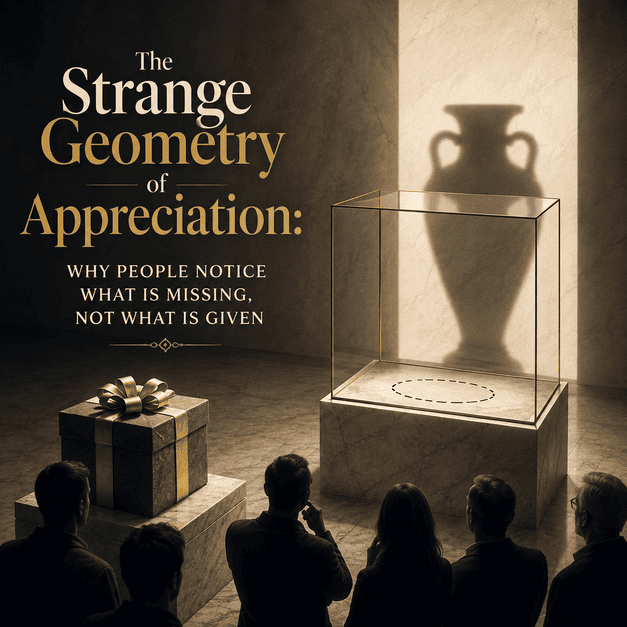
We all want the things we create to be appreciated, whether it is a book, an investment analysis, a business, a meal, a cake, a piece of music, or something as ordinary as making another person’s life slightly easier. Yet there is a strange asymmetry in human behaviour: when something works perfectly, most people barely notice it, because seamless delivery becomes the expected state of reality rather than something worth acknowledging. The moment something fails, however, attention suddenly appears, because error creates friction, and friction activates the mind in a way that perfection rarely does.
This is not necessarily cruelty, and it is not always ingratitude; much of it is psychology. Roy Baumeister and his colleagues documented the broad phenomenon that negative events and feedback often exert greater psychological weight than positive ones, which helps explain why one criticism can dominate someone’s attention despite dozens of positive experiences. The strange part is that the person receiving the criticism often assumes the critic has delivered some profound verdict about their worth, when frequently the criticism reveals far more about the critic’s current emotional state than it does about the quality of the work.
That is the first vector worth understanding: attention is not distributed according to value; it is distributed according to emotional intensity. A beautifully prepared meal produces satisfaction and then disappears into memory, while a meal that arrives late creates irritation that demands explanation, because the brain is much more interested in correcting perceived threats than celebrating normality. In markets, exactly the same mechanism appears when investors ignore years of gains but become obsessed with one bad quarter, one correction, or one ugly headline.
The Hidden Narcissism of Expectation
There is another layer that is more uncomfortable. Some people gradually develop the expectation that the world should make their lives easier, and once that expectation becomes normalised, effort disappears from their field of vision. They no longer see the person who prepared the analysis, researched the company, tested the system, baked the cake, cooked the meal, answered the question or solved the problem; they see only the finished product, as though it emerged naturally from the environment.
This can become a subtle form of self-centred behaviour without necessarily becoming clinical narcissism. The individual is not thinking, “How can I appreciate what someone else has done?” They are thinking, “How well did this serve me?” That difference is enormous because the first question recognises another person’s agency, while the second reduces the entire interaction to personal utility.
Mass psychology amplifies this tendency because expectations spread socially. Once a particular level of convenience becomes normal, yesterday’s extraordinary effort becomes today’s baseline, and today’s baseline becomes tomorrow’s entitlement. The vector therefore moves in one direction: effort becomes invisible as expectations rise. This is why technology produces such a strange psychological effect, because every innovation initially feels miraculous and eventually becomes something people complain about when it takes three seconds longer than expected.
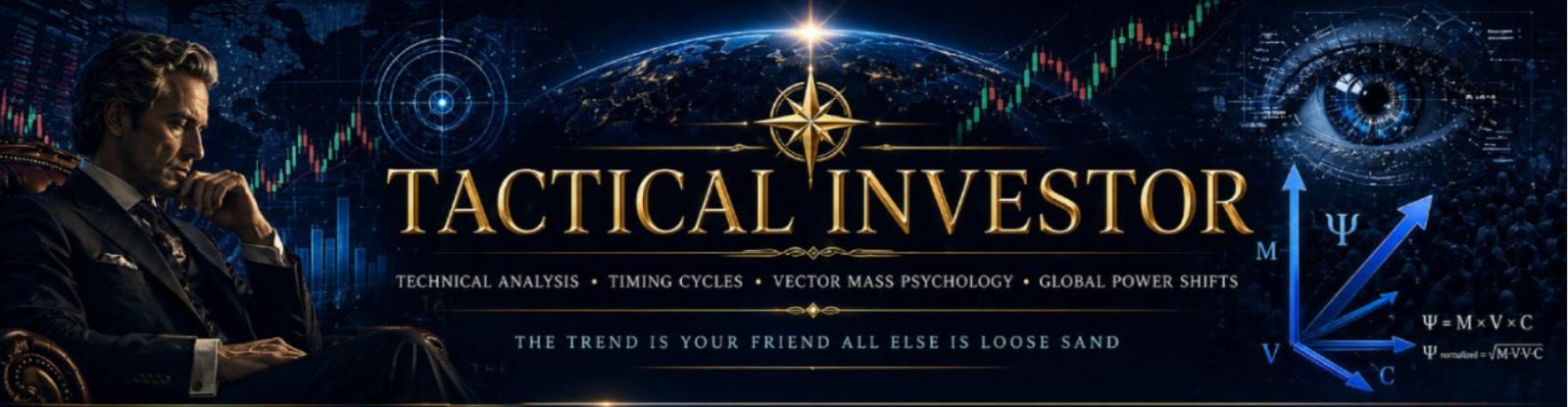
Tactical Investor’s work on crowd behaviour reaches the same structural conclusion from another direction: people frequently respond less to reality than to the emotional state surrounding reality, and the crowd can synchronise around expectations without recognising that it is doing so. The same geometry exists outside markets, because humans do not suddenly stop being human when they leave the trading screen.
Two Reasons People Stop Seeing the Work
The first group consists of people who are dissatisfied with their own circumstances and unconsciously expect external forces to compensate for that dissatisfaction. When someone feels that life has failed to deliver what they believe they deserve, another person’s effort can become psychologically irritating because it exposes a contrast: someone else is creating, progressing, improving or producing while they remain stationary. Instead of asking what can be learned from that difference, the dissatisfied person can redirect the discomfort outward, demanding more from others because changing themselves would require energy they are unwilling to spend.
The second group is even more interesting because they often know exactly what they need to change. They know they should learn more, become more disciplined, take responsibility, improve their health, develop a skill, manage their finances better or simply stop repeating the same behaviour, yet knowing and doing are separated by an enormous psychological distance. The easiest solution is therefore to outsource the uncomfortable part, expecting someone else to provide the shortcut, the answer, the motivation, the analysis or the structure that would remove the need for personal transformation.
This creates what I would call the Good Samaritan Vector. You help someone, they benefit, and because the benefit feels good, you help again; eventually the relationship quietly changes from assistance into dependency, and the person receiving the help begins treating your generosity as an obligation rather than a gift. Adam Grant’s work on givers, takers and matchers is useful here because he distinguishes genuine generosity from patterns in which giving becomes unsustainable, with some givers becoming vulnerable to exploitation or burnout when they fail to protect their own resources.
The lesson is not to stop helping. It is to understand the vector of the help. Assistance that increases another person’s agency is productive; assistance that permanently replaces another person’s agency becomes destructive. The Good Samaritan does not get destroyed because kindness is weakness, but because kindness without boundaries can create a system in which one person continually supplies energy while the other continually consumes it.
The Punters Want the Result, Not the Discovery
There is another irony in the way we search for insight because much of what we need is already sitting directly in front of us in price, volume, sentiment, positioning, liquidity, psychology and technical structure, yet investors continually search for the secret indicator that will reveal what nobody else has discovered. The problem is often not a shortage of information but an inability to recognise the structure contained within it, which leads us to keep searching for something new when the real advantage may come from seeing something familiar more clearly.
At the opposite extreme is the punter who wants nothing discovered at all because he wants the answer delivered, the trade handed over and the responsibility removed. Discovery requires effort and uncertainty, whereas consumption allows someone else to perform the difficult work and leaves only the attractive part, which is receiving the conclusion. Both extremes make the same mistake: one refuses to accept that the answer may already be visible, while the other refuses to look because seeing the answer creates responsibility.
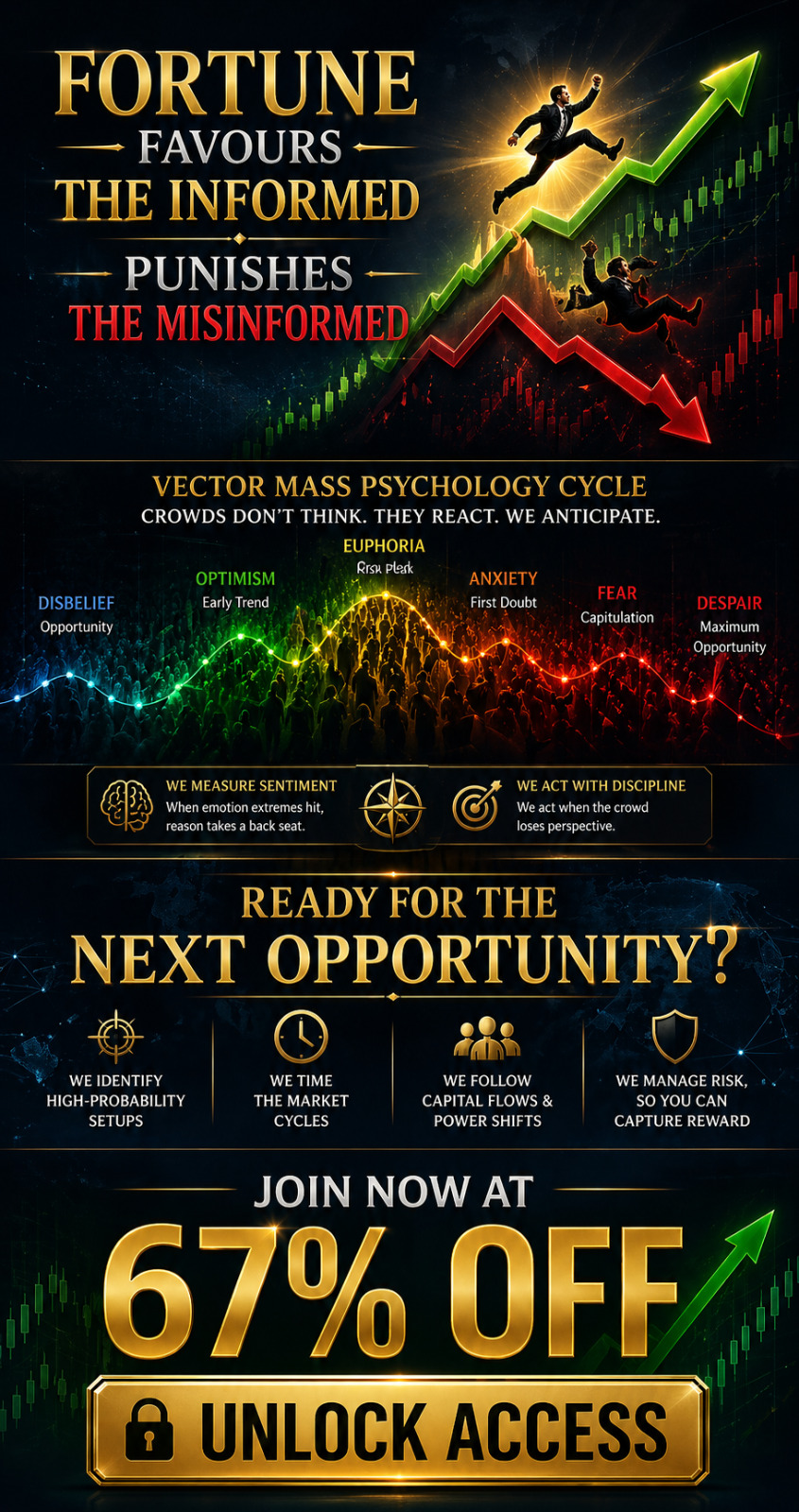
The mature position sits between them: look carefully at what exists before demanding something new. This is central to Vector Mass Psychology because the crowd is often drowning in information while failing to perceive the structure within it; the important question is therefore not simply what the crowd feels, but the direction, magnitude and coherence of the emotional force moving through it.
Stop Looking for More and Start Seeing Better
The same principle applies to appreciation because an enormous amount of cognitive energy can be wasted trying to determine whether other people have noticed, approved of, understood or valued what you are doing, when that energy could instead be directed toward observation, creation and refinement. Once you stop measuring the quality of your work through the reactions of an audience, attention begins returning to the work itself, and the vector shifts from validation seeking toward creation.
People are naturally attracted to vitality, but vitality usually appears through attention, curiosity, competence and genuine engagement rather than through someone trying to appear impressive. The person absorbed in improving something rarely spends much time wondering whether they appear meaningful because their attention is directed toward the work rather than the audience, and that is precisely why the work can begin to acquire a quality that cannot be manufactured through performance.
You cannot force another person to recognise value, just as you cannot force the market to recognise value on your preferred timetable, but you can control the quality of what you produce and where you direct your attention. Your job is not to make everyone appreciate the work; your job is to make the work worth appreciating.
Slowing Down Is How You Become Faster
Speed feels productive because movement is visible, but movement is not necessarily progress, and moving faster can simply allow you to make the same mistake at greater velocity. Investors chase the next headline, prediction, signal and opportunity while the critical information may already be visible in the trend, sentiment, positioning or behaviour of the crowd, because the obvious is easily overlooked precisely because it rarely arrives with urgency or novelty.
This is where Tactical Investor’s framework repeatedly returns to the same principle: the objective is not to chase motion but to understand its direction and recognise when the emotional force behind that motion reaches a meaningful point of extension. The same problem appears in ordinary life, where “I don’t have enough time” often means that attention has not been properly allocated, because when everything becomes important, nothing receives enough depth to be understood properly.
Slowing down is therefore not necessarily a reduction in productivity; sometimes it is simply the removal of wasted motion, allowing the important variable to become visible before another layer of noise obscures it.
The Geometry of Enough
Life, markets and human relationships contain competing vectors, with one pulling toward creation, curiosity, improvement and agency while another pulls toward consumption, comfort, validation and dependency, and although neither disappears completely, the vector receiving repeated attention becomes stronger. Attention is therefore not merely something we possess; it is something we allocate, and what we repeatedly allocate it toward eventually influences the direction of our behaviour.
This is why worrying excessively about appreciation is ultimately a poor trade, because you cannot force another person to recognise value any more than you can force the market to recognise value according to your preferred timetable. You control the quality of the work, the direction of your effort, the people and systems allowed to consume your energy and the degree to which your behaviour remains aligned with the outcome you want, while the reaction of the audience remains outside your control.
Some people will appreciate what you do and tell you, some will appreciate it silently, some will simply consume it and move on, and others will criticise it regardless of what you produce, but none of those reactions should become the measurement system for your own effort. Once the crowd becomes the instrument through which you measure your value, your behaviour begins adapting to its emotional response rather than to the quality of the underlying objective.
The Final Vector: Stop Chasing, Start Seeing
The deeper irony is that the more desperately we seek appreciation, speed, information and certainty, the less capable we become of seeing what is already there, because each additional demand consumes attention that could have been used to interpret the information already available. We add indicators when the problem is interpretation, demand more time when the problem is allocation and search for new information when the existing information has not yet been understood.
That is the geometry of the trap: more becomes less when the vector is wrong, while less becomes more when the vector is aligned. A trader who understands a few important variables deeply can see more than one buried beneath dozens of indicators, just as a creator who stops checking constantly for approval can redirect that attention toward making the work better.
So slow down, look again and study the obvious thing you dismissed because it appeared too simple, while watching the crowd without becoming emotionally dependent upon its reaction. In markets, watch the crowd rather than asking the crowd what to think; in life, do the same thing with your own attention, because once you can observe your psychological impulses without automatically obeying them, you regain a degree of agency.
Let them keep mouthing off. You can learn from it. The people who appreciate your work will find it, the people who need you to carry them will continue asking for more, and the people who criticise everything will continue criticising, but none of them should determine the direction of your effort. Your task is to preserve your attention, improve the work and recognise what is already visible before wasting energy searching for something that was never hidden in the first place.

Fresh Viewpoints