
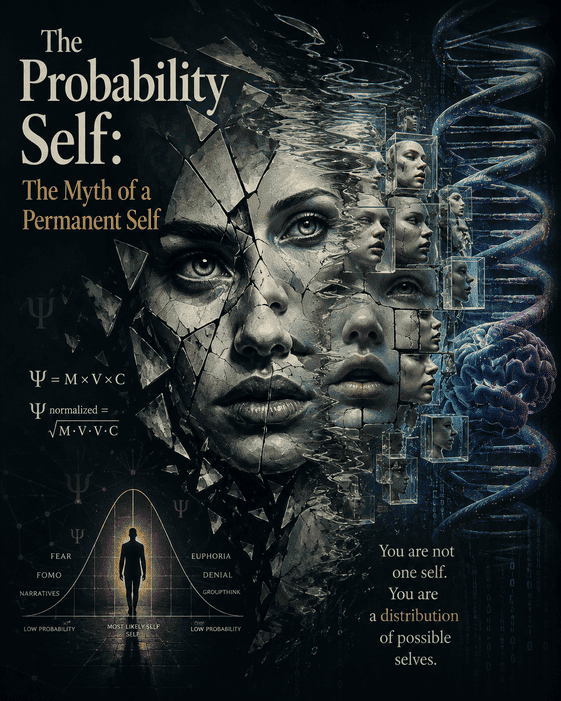
The Probability Self: The Myth of a Permanent Self
Aug 7, 2026
For most of history, identity has been treated as though it were a possession. We ask children who they are, adults what they have become and old men whether they remained true to themselves, all while quietly assuming that somewhere beneath changing circumstances there exists a permanent individual waiting to be discovered. The language itself reinforces the illusion. We speak of “finding yourself,” as though the authentic person has merely wandered into another room and forgotten the way home. It is an attractive idea because permanence offers comfort. Reality, however, appears considerably less accommodating.
Modern neuroscience, psychology and evolutionary biology increasingly describe the mind not as a singular executive directing a unified personality, but as a dynamic system composed of multiple interacting processes operating across different timescales. Memory competes with prediction, emotion competes with deliberation and habit competes with conscious intention, not because the mind is broken, but because evolution did not design a perfectly integrated organism. It assembled a remarkably effective collection of adaptive mechanisms, each solving different survival problems under different constraints, leaving what we experience as a coherent self-less like an enduring object than a temporary agreement negotiated among competing systems.
That perspective immediately resolves one of the oldest paradoxes in human behaviour. Every individual has experienced moments that seem completely out of character. The calm person erupts in anger, the generous friend becomes unexpectedly selfish and the disciplined professional makes a reckless decision that appears utterly incompatible with everything that came before it. Popular psychology often dismisses these moments as exceptions, lapses or hidden flaws, yet they may reveal something considerably more fundamental.
There may never have been one immutable self to betray in the first place.
The better question is no longer, “Who am I?”
It becomes,
“Which version of me is most likely to emerge under these conditions?”
That small shift transforms identity from a noun into a process.
The Brain Lives by Probability
The brain already behaves this way. Predictive Processing argues that perception itself is not passive observation but an active negotiation between expectation and incoming evidence, with the nervous system continually generating competing models of reality before updating them as prediction errors accumulate. What we perceive is therefore not reality delivered directly to consciousness, but the model currently explaining incoming information with the least error.
If perception itself is fundamentally probabilistic, why should identity be any different? The same brain that continually constructs its understanding of the external world may also be continually constructing its understanding of itself.
The Bayesian framework arrives at a remarkably similar conclusion through entirely different mathematics. Rather than treating beliefs as fixed truths, Bayesian reasoning continuously updates probabilities as new evidence arrives, suggesting that the mind rarely operates in certainty but instead in shifting degrees of confidence. Every experience subtly alters those probabilities, strengthening some predictions while weakening others as the internal model continually reorganises itself in response to new information. Identity therefore begins to resemble a weather system far more than a monument. Patterns emerge, patterns stabilise and patterns persist, yet they are never frozen.
The Probability Self
This is where the idea of The Probability Self becomes useful. Every individual contains a vast landscape of latent behavioural possibilities. Most remain dormant for years, some never emerge and others appear only under extraordinary circumstances. Heroism often lies invisible until catastrophe demands it, while cowardice may remain equally hidden until exactly the same moment. Compassion, cruelty, discipline, envy, creativity, resilience and despair are not distributed equally across humanity, yet neither are they completely absent from anyone.
Evolution favours flexibility rather than rigidity because the organism capable of adapting to changing environments generally survives longer than one optimised for only a single set of conditions.
Psychology has approached this conclusion from several directions without fully integrating it. Carl Jung argued that much of what we reject in others reflects aspects of ourselves that remain unconscious. Projection was never simply about misjudging other people. It suggested that the psyche contains possibilities the conscious mind refuses to acknowledge. Jung’s language often drifted towards symbolism, yet the underlying insight remains remarkably durable because our strongest emotional reactions frequently reveal less about the external world than about unresolved structures within ourselves.
A surprisingly modern echo appears in Internal Family Systems, developed by Richard Schwartz. The model proposes that the mind consists of multiple interacting parts rather than one unified personality, with Managers attempting to maintain order, Firefighters reacting impulsively to perceived threats and Exiles carrying emotional wounds. Whether one accepts the model literally is ultimately less important than recognising the recurring organisational principle that runs through it.
Identity behaves more like a coalition than a monarchy, with stability emerging through negotiated cooperation rather than permanent domination by any single component.
The People We Meet Are Mirrors of Possibility
This observation leads to a provocative but carefully grounded idea. When we encounter another person, we are rarely responding only to them. We are also responding to the probability they awaken within us.
The individual who inspires admiration often represents a possibility we hope to strengthen, while the person who provokes disproportionate irritation may activate a possibility we have spent years suppressing. This does not mean every criticism is projection, nor that every conflict reflects hidden self-recognition. Human beings genuinely encounter injustice, incompetence and malice. Yet the intensity of our emotional reactions often depends as much upon our internal architecture as it does upon the external event itself, because we never experience the world through a neutral mind. We experience it through a probability distribution continually shaped by memory, prediction and past experience.
Seen from this perspective, society begins to resemble something akin to an inverted hologram. A physical hologram contains the whole image distributed throughout every fragment, so that removing one piece leaves the complete image intact, albeit with diminished resolution. Human psychology appears to operate in the opposite direction. Every individual encounters fragments of humanity distributed across countless other people: the bully, the visionary, the cynic, the opportunist, the martyr, the builder, the manipulator and the destroyer. None represents our complete identity, yet every one of them may reveal a trajectory that already exists within our own behavioural landscape, making the crowd itself a map of unrealised probabilities.
Character Is a Probability Distribution
This perspective also helps explain the difference between moral performance and genuine character. Many people behave well because circumstances reward virtue. Far fewer have organised themselves so that virtue remains stable when incentives reverse. Character therefore consists less in possessing desirable traits than in determining which behavioural probabilities consistently dominate across changing environments.
Pressure does not usually create character. More often, it alters the probability distribution governing which latent tendencies emerge and that distinction explains why crises surprise us. Some individuals become unexpectedly courageous, while others collapse despite years of apparent confidence. Neither transformation necessarily appears from nowhere because the underlying possibilities were already present. Extreme circumstances simply changed which internal architecture became dominant.
Identity therefore becomes less about certainty than adaptive stability, because what persists is not an unchanging self, but a pattern capable of remaining coherent across changing environments. The version of ourselves that repeatedly emerges across changing environments gradually becomes what others recognise as our character, yet even that remains provisional because different incentives, relationships and environments continue reshaping the probabilities beneath the surface. The self remains dynamic, even when it appears consistent.
Complex Systems Think the Same Way
Complexity theory reinforces this perspective. Highly adaptive systems rarely depend upon centralised control. Instead, they maintain stability through countless local interactions producing emergent order, with ant colonies, immune systems, ecosystems, economies and financial markets all displaying behaviours that cannot be understood by examining individual components in isolation.
The human mind increasingly appears to belong within the same family of systems. Consciousness may not function as a supreme commander issuing instructions from above. It may instead operate as one participant within a far richer network of interacting processes continually negotiating with one another, so that our subjective experience feels unified not because only one voice exists, but because the negotiation is usually successful.
Evolutionary psychology adds another layer to the same picture. Many apparently contradictory tendencies coexist because they solved different adaptive problems throughout human history. Cooperation strengthens trusted groups, suspicion protects against exploitation, risk-taking discovers opportunity, caution preserves accumulated resources, aggression deters threats and compassion strengthens alliances. None of these strategies is universally correct because each becomes adaptive under different conditions, which is precisely why evolution favoured organisms capable of shifting between behavioural modes rather than rigidly adhering to only one.
The more we examine intelligence, biology and psychology, the less they resemble machines built from fixed components and the more they resemble adaptive systems continuously reorganising themselves around changing environments.
Identity as an Adaptive Architecture
Notice what has quietly happened. Identity has ceased to resemble an object and instead becomes an adaptive probability field, so that we no longer uncover a permanent self-buried beneath experience, but continually collapse into temporary configurations shaped by biology, memory, prediction, incentives, relationships and environment. Some configurations remain remarkably stable because the surrounding conditions remain stable, while others emerge only once in a lifetime before disappearing forever. The person acting today is entirely real, yet they are not exhaustive. They represent one expression among many latent possibilities organised within the same underlying architecture, which means the self is better understood as a stable pattern than a fixed possession.
This perspective carries an unexpected consequence. Personal growth no longer means eliminating undesirable aspects of ourselves as though the psyche were a machine requiring defective parts to be removed. It becomes something considerably subtler: the gradual reorganisation of probabilities, with destructive patterns losing influence because healthier relational architectures become progressively stronger. Stability is therefore achieved not by suppressing competing forces, but by integrating them into a more coherent equilibrium.
The goal is not perfection, but increasing the probability that our best architecture becomes the one that consistently emerges.
From the Individual to the Crowd
Yet even this remains incomplete, because no individual exists in isolation. Every Probability Self continuously interacts with millions of others, each carrying its own shifting landscape of expectations, incentives and behavioural possibilities. At that scale something remarkable begins to emerge, as individual psychology gradually gives way to collective dynamics and patterns that remain invisible within one mind become unmistakable across entire populations.
Markets panic, religions spread, ideas go viral, technologies diffuse, political movements accelerate and civilisations rise, stagnate and sometimes collapse, often following trajectories that no individual consciously intended, yet which emerge naturally from millions of interacting probability systems.
The pattern repeats once again. Complex behaviour emerges not because anyone designed it, but because relationships organise themselves into larger structures that no single participant fully controls. The same question therefore returns at a much larger scale. If one mind behaves as an adaptive probability system, what happens when millions of adaptive probability systems begin interacting simultaneously? That question carries us from the psychology of the individual into the psychology of civilisation itself.

What We’re Reading