
MTDL vs EMTK: The Better Business or the Better Opportunity? A TICAF Perspective
July 24, 2026
At first glance, comparing Metrodata Electronics (MTDL) with Elang Mahkota Teknologi (EMTK) appears to be a relatively straightforward exercise because both companies operate within Indonesia’s expanding digital economy and both stand to benefit from the country’s accelerating adoption of technology, artificial intelligence and digital services. That superficial similarity, however, masks a far more important distinction, namely that they create shareholder value through entirely different mechanisms, making a direct comparison surprisingly difficult unless one first understands precisely what an investor is actually buying.
Viewed through the Tactical Investor Capital Allocation Framework (TICAF), the objective is not to determine which company is objectively superior, because investment decisions rarely reduce themselves to identifying a single “best” business. Instead, TICAF asks whether capital is being allocated to the opportunity offering the most attractive balance between business quality, financial strength, valuation, long-term compounding potential, market psychology and opportunity cost, recognising that the highest-quality business does not always produce the highest long-term investment return.
This distinction becomes increasingly important as Indonesia’s digital economy matures because the market is gradually separating companies that generate wealth through predictable operating performance from those capable of creating substantial value by allocating capital into multiple independent growth engines. Investors frequently place both companies inside the same technology basket, yet doing so risks overlooking the very characteristics that make each investment attractive in the first place.
The Same Industry, Two Completely Different Business Models
The observable facts are relatively straightforward, although the conclusions investors draw from them often differ considerably.
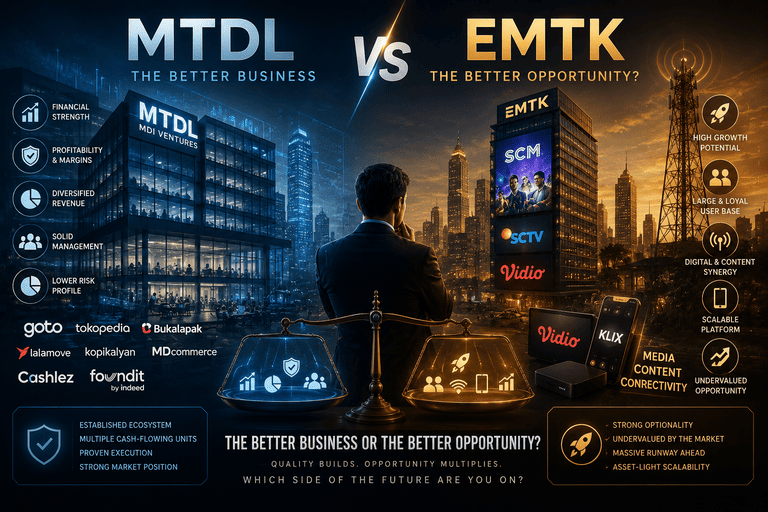
MTDL is, first and foremost, an operating business whose revenues are generated by providing enterprise technology infrastructure, cloud solutions, cybersecurity services, digital transformation consulting and artificial intelligence implementation, while simultaneously maintaining one of Indonesia’s largest technology distribution networks. Over many years management has consistently expanded the business into higher-margin activities without abandoning the disciplined operational execution that initially established the company’s reputation, producing a business that generates recurring cash flow, steadily growing earnings and a reliable dividend stream supported by real operating performance rather than financial engineering.
EMTK operates according to an entirely different model because its primary role is not simply to maximise operating earnings from a single business but to allocate capital across an expanding ecosystem of digital assets that includes media, fintech, streaming platforms and several privately held businesses whose future value may only become fully recognised through monetisation events, continued operational growth or eventual public listings. Recent developments surrounding Superbank, together with persistent market speculation regarding a future IPO for Vidio, have further reinforced the idea that significant portions of EMTK’s value may still remain partially hidden inside its broader corporate structure.
Both companies therefore participate in Indonesia’s digital transformation, but they simply monetise that transformation in fundamentally different ways.
Why The Market Finds One Easier to Value Than the Other
Financial markets have always displayed a preference for businesses that are easy to understand because predictable cash flows fit comfortably inside traditional valuation models, allowing analysts to estimate future earnings with a reasonable degree of confidence even when economic conditions fluctuate.
MTDL fits almost perfectly into that framework. Investors understand enterprise technology spending, recurring corporate customers, expanding demand for cloud migration, cybersecurity implementation and AI integration, all of which combine to produce a relatively transparent investment case where improvements in operating performance translate directly into stronger earnings and, eventually, higher shareholder returns. The market therefore has relatively little difficulty assigning an appropriate valuation because the underlying mechanics remain visible through conventional financial analysis.
EMTK presents a more complicated challenge because holding companies rarely trade according to the simple arithmetic of adding together the value of their underlying assets. Instead, investors must estimate the future worth of businesses operating at different stages of maturity while simultaneously attempting to evaluate management’s ability to continue allocating capital successfully across an evolving digital ecosystem, an exercise that inevitably introduces uncertainty and often results in conglomerate discounts even when the underlying assets continue appreciating.
The narrative therefore becomes remarkably simple.
- MTDL rewards certainty.
- EMTK asks investors to believe that optionality itself possesses value long before the market fully recognises it.
Business Quality and Investment Opportunity Are Not the Same Thing
One of the most common mistakes investors make is assuming that the highest-quality business must automatically represent the best investment, when history repeatedly demonstrates that valuation, expectations and future optionality often matter just as much as operational excellence.
Measured purely as an operating business, MTDL receives the advantage without requiring much debate. Management has established a long record of disciplined execution, earnings remain comparatively predictable, cash generation continues supporting both reinvestment and dividends, while the company’s strategic expansion into artificial intelligence consulting, cloud infrastructure and cybersecurity strengthens rather than complicates the underlying business model. Investors purchasing MTDL know exactly which engine is producing shareholder returns, and that clarity naturally deserves a premium valuation.
EMTK, however, should not be evaluated according to the same criteria because its investment case rests upon a different mechanism entirely. Rather than attempting to maximise returns through a single operating business, management seeks to create value by developing multiple businesses simultaneously, allowing successful subsidiaries to increase in value independently while providing opportunities for future monetisation, partnerships or public listings that may unlock value currently hidden within the broader corporate structure. The distinction may appear subtle but, from an investment perspective, it changes everything.
Optionality Is Difficult to Price Until It Suddenly Isn’t
Markets generally perform remarkably well when valuing assets producing observable cash flows because those cash flows provide tangible evidence upon which conventional valuation models can operate. They become considerably less effective when attempting to price future possibilities whose probability cannot yet be measured with precision.
This explains why EMTK continues attracting investors willing to tolerate greater uncertainty.
Imagine a scenario in which Superbank continues expanding its market position, Vidio successfully completes a public listing, DANA strengthens its competitive position within Indonesia’s rapidly growing digital payments ecosystem and several smaller businesses inside the group continue compounding quietly over the next decade. None of these developments individually guarantees extraordinary shareholder returns, yet collectively they could fundamentally alter how investors perceive EMTK, transforming it from what many still consider a traditional media company into one of Indonesia’s largest diversified digital investment platforms.
Markets frequently rerate holding companies only after individual assets become independently visible: By then, much of the opportunity has already disappeared.
Applying The Tactical Investor Capital Allocation Framework
Using TICAF produces an outcome that initially appears contradictory but ultimately reflects one of investing’s most important principles, namely that business quality and investment opportunity often move independently rather than together.
MTDL
| TICAF Dimension | Score |
|---|---|
| Business Quality | 93 |
| Asymmetry | 65 |
| Vector | 92 |
| Conviction | 94 |
MTDL achieves one of the highest overall business quality scores because virtually every important operating metric points in the same direction, including management execution, financial strength, recurring earnings, capital discipline and long-term positioning within Indonesia’s expanding enterprise technology market. Its asymmetry score, however, remains comparatively lower because investors already recognise these strengths, meaning today’s share price reflects much of that quality and consequently limits the probability of dramatic future rerating.
EMTK
| TICAF Dimension | Score |
|---|---|
| Business Quality | 91 |
| Asymmetry | 90 |
| Vector | 92 |
| Conviction | 90 |
EMTK scores marginally lower on business quality simply because evaluating a diversified holding company inevitably involves greater complexity, while simultaneously achieving a substantially higher asymmetry score because multiple independent value-unlocking events remain possible over the coming decade. Investors therefore exchange a measure of certainty for significantly greater optionality, a trade-off that can prove exceptionally rewarding when management continues allocating capital successfully across several expanding digital businesses.
The Better Business Is Not Always the Better Investment
Ultimately, the comparison between MTDL and EMTK is not really about choosing one company over the other. It is about recognising that different businesses create wealth through different mechanisms and that successful capital allocation depends upon matching those mechanisms with the investor’s objectives rather than simply purchasing whichever company appears strongest on traditional financial metrics.
An investor seeking stability, predictable earnings growth and consistently disciplined execution will probably find MTDL difficult to overlook because few technology businesses listed in Indonesia combine operational quality, financial resilience and long-term consistency so effectively.
An investor seeking the possibility of materially outperforming the market over the next decade may reasonably arrive at a different conclusion because EMTK offers exposure to several independent engines of value creation, each possessing the potential to unlock shareholder value in ways conventional earnings models struggle to capture until those developments become unmistakably visible.
Viewed through the Tactical Investor Capital Allocation Framework, the conclusion becomes less paradoxical than it first appears. MTDL remains the superior operating business, deserving the highest marks for quality and execution, while EMTK arguably represents the superior long-term investment opportunity because markets consistently find it easier to value certainty than optionality, even though history repeatedly demonstrates that optionality, when supported by capable management and disciplined capital allocation, often becomes the source of the market’s largest long-term winners.

Interesting Reads