
Perception Shapes Reality
June 11, 2026
Perception rules everything.
If a person believes the world is dark, hostile, and falling apart, then that is the world they will experience. You can present data, statistics, evidence, and counterarguments, but most of that information will be filtered through the lens they already possess. The facts may remain unchanged, yet the conclusion often stays the same because perception acts as the gatekeeper.
The same principle applies to markets.
When prices fall, one investor sees disaster unfolding in real time. Another sees opportunity arriving at a discount. The event is identical. The interpretation is not.
This is where many people make a critical mistake. They assume they are responding to reality when, more often than not, they are responding to their interpretation of reality. Memory, experience, emotion, belief systems, expectations, fears, and desires all sit between the event and the conclusion. What most people call reality is often a psychological translation of reality.
That distinction matters more than most realize.
A fearful person can walk into a room and sense hostility where none exists. Their eyes work perfectly. Their ears function normally. The distortion occurs during interpretation. Fear becomes the translator, and the translation changes the message.
Markets behave in exactly the same way.
How Crowd Perception Moves Markets
During powerful bull markets, investors develop a remarkable ability to explain away risk. Weak earnings become temporary setbacks. Excessive valuations become proof of strength. Dangerous speculation becomes innovation. Every piece of information passes through an optimistic filter.
Then the cycle turns.
Suddenly the same crowd develops an equal talent for pessimism. Positive developments are ignored. Negative developments are magnified. Opportunity becomes danger. Value becomes a trap. The facts often change far less than the interpretation.
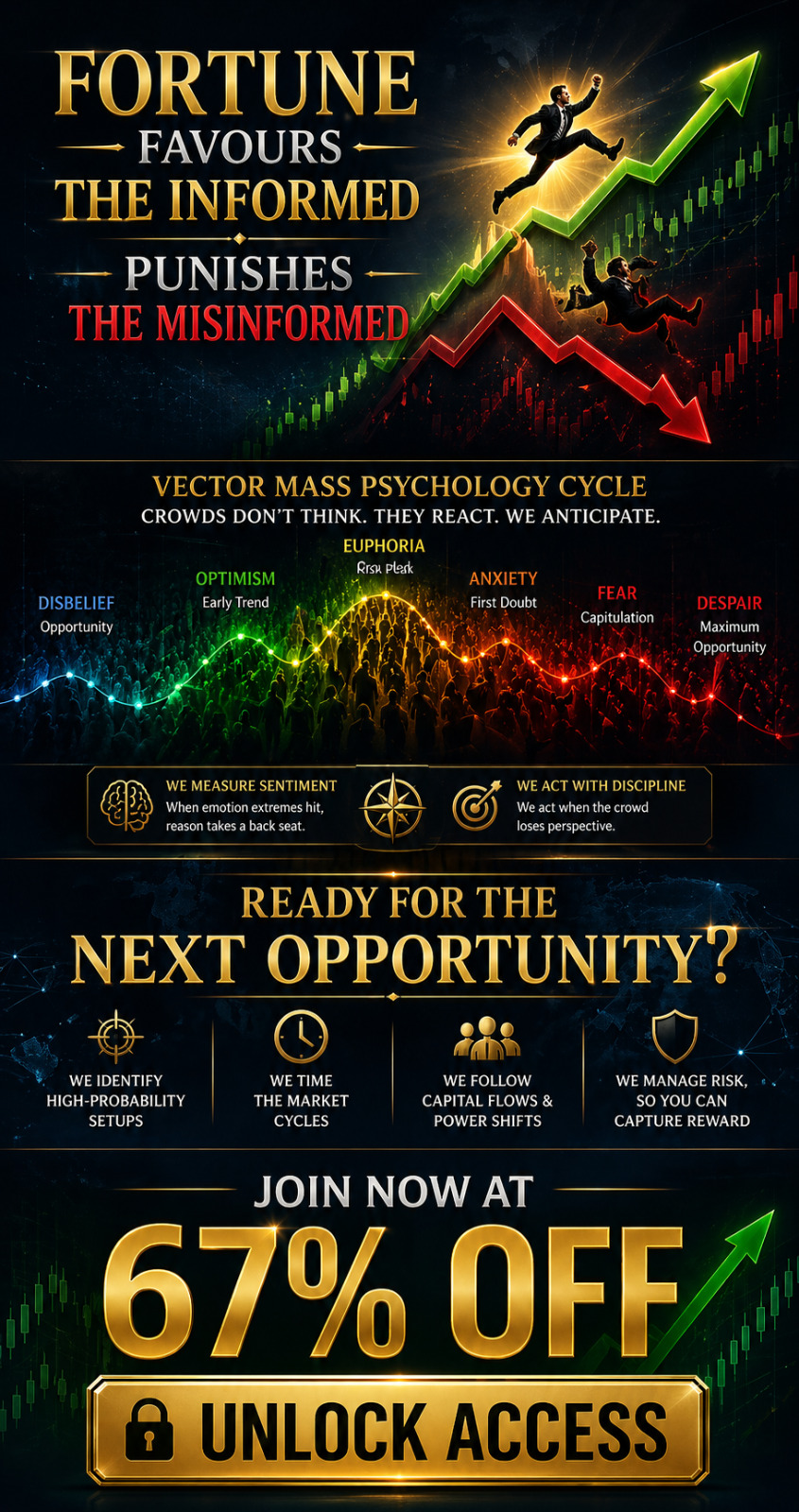
This is why mass psychology matters so much.
Markets are not driven solely by economic reality. They are driven by collective perception. People act based on what they believe is happening, not necessarily what is happening. When enough people share the same belief, that belief begins to shape outcomes.
Confidence encourages spending.
Spending supports growth.
Growth reinforces confidence.
Fear works the same way in reverse.
Fear reduces spending.
Reduced spending weakens growth.
Weak growth reinforces fear.
Perception begins as an opinion and eventually produces consequences that feel completely real.
Truth, Consensus, and Investor Psychology
Now consider something even more uncomfortable.
When society labels someone irrational, what does that actually mean?
Does it mean they are wrong?
Or does it simply mean they disagree with the majority?
History is littered with examples where the crowd was spectacularly wrong. Entire populations once accepted ideas that later proved false. Consensus creates comfort, but comfort is not evidence. Popularity is not proof. Large numbers of people believing something tells us what is fashionable, not necessarily what is true.
That does not mean the crowd is always wrong. Far from it. Most outsiders are not visionaries. Many are simply wrong in isolation instead of wrong collectively.
The important point is that truth and popularity are separate variables.
Investors who fail to understand this spend their lives following emotional currents created by other people.
Investors who understand it begin asking different questions.
When the crowd becomes euphoric, they ask what is being ignored.
When the crowd becomes terrified, they ask the same question.
When everyone sees certainty, they search for doubt.
When everyone sees disaster, they search for opportunity.
Why Trend Followers Read Behavior Differently
The goal is not to become a permanent contrarian. Blind contrarianism is just another form of crowd behavior. The goal is to understand how emotion influences perception and how perception influences decisions.
This is one reason trend followers often outperform emotional investors over long periods. They are less interested in who is right and more interested in understanding where capital is flowing. They understand that perception moves markets long before reality catches up.
The crowd obsesses over narratives.
Trend followers study behavior.
The crowd argues about opinions.
Trend followers watch money move.
The crowd seeks certainty.
Trend followers seek probability.
That difference sounds small. In practice, it is enormous.
The Real Edge in Markets
Most fortunes are not made because someone possessed superior information. They are made because someone interpreted the same information differently from the crowd. When fear reached an extreme, they saw an opportunity. When optimism reached an extreme, they saw danger.
The event was identical.
The perception was different.
Perhaps that is the closest thing to an edge that exists in markets.
Not predicting the future.
Not discovering secret information.
Not finding the perfect indicator.
Simply recognizing that perception is not reality and that the crowd routinely mistakes one for the other.
The moment an investor understands that distinction, they become harder to manipulate, harder to frighten, and harder to seduce.
And in a world where entire industries profit from controlling perception, that may be one of the most valuable skills a person can develop.

The Insightful Journey to Profound Understanding