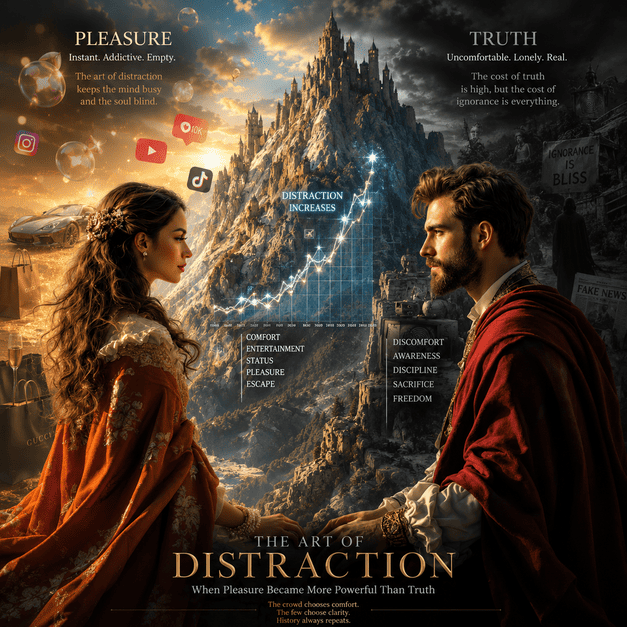
The Art of Distraction: When Pleasure Became More Powerful Than Truth
July 18, 2026
The Gospel of Misdirection
Every civilisation eventually discovers its preferred narcotic. Some intoxicate themselves with conquest, others with religion, wealth, or ideology. Ours has found something subtler and far more effective: misdirection. It is the systematic redirection of attention away from what matters and towards what merely stimulates, the replacement of understanding with emotional occupation. We increasingly live in a world where power no longer needs to silence dissent because it has learned to drown it beneath an endless torrent of distraction, outrage, and spectacle. The modern citizen is not imprisoned by walls but surrounded by narratives, each demanding immediate emotional investment while quietly discouraging sustained thought.
This marks a profound evolution in the architecture of power. Tyrannies once relied upon visible coercion because force was the only language they possessed. Modern influence operates differently. It understands that people fiercely defend conclusions they believe they reached independently. Give them a story that flatters their identity, identifies an enemy, promises moral purpose, and confirms their existing beliefs, and they will carry that story further than any government directive ever could. The ideal subject is therefore not the obedient citizen but the emotionally engaged one, permanently convinced that every reaction is an expression of personal freedom while remaining unaware that the range of available reactions has already been carefully narrowed.
The greatest illusion of our age is not that people are deceived, but that they mistake emotional intensity for independent thought. They believe outrage proves awareness, certainty demonstrates intelligence, and constant engagement signifies freedom. In reality, emotional capture has become the currency through which influence is bought, sold, and maintained. Whoever commands attention increasingly commands behaviour, because perception always precedes action.
The Politics of Emotional Capture
Politics has always depended upon emotion, but it increasingly depends upon monopolising it. Successful movements no longer compete primarily over policy, economics, or governance. They compete for ownership of identity. Every election becomes civilisation’s last stand, every disagreement a moral emergency, every compromise a betrayal of something sacred. The objective is not simply to persuade opponents but to ensure supporters remain permanently mobilised, emotionally invested, and psychologically unavailable for independent reflection.
This explains why modern political movements often resemble opposing religions despite advocating entirely different programmes. Each side presents itself as the final defence against catastrophe, cultivating grievance as carefully as previous generations cultivated patriotism. The psychological mechanics remain remarkably similar regardless of ideology. Tribal belonging replaces careful analysis because belonging satisfies emotional needs that evidence alone rarely can. Once identity becomes fused with belief, disagreement ceases to feel intellectual and begins to feel existential.
History repeatedly demonstrates that populations become easiest to manipulate when they are convinced they are resisting manipulation. Ancient rulers understood this through spectacle. Modern systems achieve the same outcome through information abundance. Citizens become so overwhelmed by competing narratives that they gradually abandon the difficult task of verification altogether, retreating instead towards whichever interpretation offers the greatest emotional comfort. The result is a society permanently debating symptoms while quietly ignoring structure, passionately defending positions that often strengthen the very systems they imagine themselves opposing.
The magician has always understood this principle. Audiences never watch the hand performing the trick because they are too busy watching the hand invited to entertain them. Modern politics follows precisely the same logic. Public attention remains fixed upon the spectacle while the architecture surrounding the spectacle quietly expands beyond examination.
When Pleasure Replaced Fear
For most of history, power relied upon fear because fear produced obedience quickly and visibly. Yet fear possesses an important weakness. It eventually provokes resistance. Pleasure rarely does.
The most significant transformation in modern influence is therefore the gradual replacement of coercion with reward. Rather than forcing behaviour through punishment, contemporary systems increasingly shape behaviour through gratification, allowing individuals to experience compliance as choice rather than obligation. People defend systems that satisfy their desires with considerably greater enthusiasm than systems that merely restrict them.
The foundations of this transformation became visible during the experiments of James Olds and Peter Milner in the 1950s. By stimulating specific reward centres within the brains of laboratory rats, they discovered that the animals repeatedly activated the mechanism providing pleasure, frequently neglecting food, water, and even basic survival. The experiment became famous not because it revealed something unusual about rats, but because it exposed something deeply familiar about the biological machinery governing motivation itself. Under the right conditions, immediate reward overwhelms almost every competing instinct.
Subsequent research involving deep-brain stimulation occasionally revealed comparable tendencies in human subjects. Individuals receiving stimulation to particular neural pathways sometimes became intensely attached to the experience, repeatedly seeking activation despite recognising its artificial nature. These cases were rare, medically complex, and conducted under highly controlled conditions, yet they demonstrated a broader principle extending well beyond neuroscience. Human beings are remarkably susceptible to systems capable of reliably generating pleasurable anticipation, particularly when those systems require little effort and provide immediate feedback.
The lesson was never about electrodes. It was about incentive. Whenever reward becomes sufficiently accessible, the human mind begins reorganising itself around obtaining it, often sacrificing long-term judgement for immediate reinforcement without fully recognising that the trade has taken place.
The Economy of Attention
Long before neuroscience entered public consciousness, the digital economy had already discovered its commercial equivalent. Social media platforms, recommendation engines, notification systems, and algorithmic advertising transformed intermittent reinforcement into one of the most profitable business models ever created. Their product is not information, communication, or entertainment alone. Their true product is sustained attention.
Every notification, recommendation, headline, and carefully timed alert represents another attempt to prolong engagement. The objective is not necessarily ideological manipulation. It is optimisation. Systems rewarded for increasing attention naturally evolve towards whatever consistently holds it, regardless of whether the underlying stimulus is curiosity, outrage, fear, affirmation, envy, or tribal conflict. Emotional intensity simply proves more profitable than emotional balance.
Over time this creates an environment in which attention itself becomes increasingly programmable. Individuals believe they are freely navigating an open landscape of ideas while sophisticated recommendation systems continuously reorganise that landscape according to predicted behavioural responses. The feed becomes less a reflection of reality than a reflection of probability, presenting not necessarily what is true, but what is most likely to maintain participation.
This process gradually reshapes identity itself. What begins as occasional engagement becomes habitual behaviour, habitual behaviour matures into dependence, and dependence slowly integrates into personal identity until people no longer distinguish between independent preference and algorithmically reinforced inclination. The individual continues believing every decision is freely chosen because the influence operates through preference rather than prohibition.
Perhaps the greatest innovation of the digital age is not artificial intelligence itself but the commercial industrialisation of behavioural prediction.
The Marketplace of Emotion
Modern markets increasingly trade psychological states rather than physical products. Companies sell confidence, belonging, identity, prestige, security, and escape long before they sell tangible goods. Political campaigns monetise outrage, media organisations monetise uncertainty, entertainment monetises distraction, and technology companies monetise attention itself. The underlying commodity remains remarkably consistent: human emotion.
This creates powerful incentives to understand behaviour with increasing precision. Every improvement in predictive modelling, machine learning, behavioural economics, and personalised recommendation systems increases the economic value of anticipating not merely what people will purchase, but how they will think, react, and feel. Influence gradually shifts from broadcasting identical messages to entire populations towards delivering individually calibrated experiences designed to maximise engagement for each unique personality.
Artificial intelligence accelerates this transition. As systems become increasingly capable of recognising behavioural patterns, emotional states, and cognitive preferences, persuasion becomes progressively personalised. The future may not resemble mass propaganda but individually optimised narratives, each subtly adapted to the emotional architecture of the person receiving them.
That possibility deserves attention not because it guarantees a dystopian future, but because every technological advance creates new incentives alongside new opportunities. History repeatedly demonstrates that innovations developed for convenience, medicine, education, or communication rarely remain confined to their original purpose. Once a technology proves capable of influencing behaviour, commercial, political, and institutional incentives inevitably explore its broader applications.

The Neural Frontier
The next stage of influence is unlikely to depend entirely upon screens because the technologies shaping attention are steadily moving closer to the machinery that produces attention itself. Advances in neurostimulation, brain-computer interfaces, artificial intelligence, and personalised medicine are driven by legitimate ambitions: restoring movement to paralysed patients, treating depression, slowing neurological disease, and repairing damaged nervous systems. These developments represent genuine scientific progress, and they deserve recognition for the lives they may improve. Yet history teaches a persistent lesson. Technologies rarely remain confined to their original purpose. Once a tool demonstrates the ability to influence behaviour, commercial, political, and institutional incentives begin exploring every possible application.
The issue is therefore not whether neural technologies are inherently dangerous but whether societies possess institutions capable of resisting the incentives surrounding them. If future systems can continuously monitor mood, attention, stress, and cognitive performance while delivering increasingly personalised interventions, the distinction between therapy and optimisation begins to blur. A technology designed to restore normal function can gradually become one designed to maximise compliance, productivity, or engagement, not through conspiracy but through the ordinary logic of markets responding to demand.
The vector is worth watching because it follows a familiar historical pattern. Every generation adopts technologies that promise convenience, efficiency, or wellbeing, only to discover that the same technologies quietly reshape habits, expectations, and social structures in ways nobody originally anticipated. The printing press transformed religion, radio transformed politics, television transformed culture, and the internet transformed attention itself. Neural technologies, should they become commonplace, may ultimately transform something even more fundamental: the relationship between thought and external influence.
The danger is rarely dramatic. It arrives incrementally, wrapped in improvements so useful that questioning them appears irrational. The most durable systems of influence are not imposed against public resistance but welcomed because their immediate benefits are obvious while their cumulative costs remain almost invisible.
Rat Park and the Forgotten Lesson
The obsession with reward often obscures an equally important discovery. During the famous Rat Park experiments, researchers found that addiction could not be understood simply as a chemical phenomenon. Rats confined to isolated cages repeatedly consumed addictive substances, but when placed in enriched environments containing companionship, stimulation, play, and opportunities for exploration, compulsive consumption declined dramatically. Environment altered behaviour as profoundly as chemistry itself.
That finding should have transformed the public conversation about addiction because it shifted attention away from substances and towards conditions. Human beings, like every social species, require purpose, belonging, meaningful relationships, and opportunities for agency. Remove those foundations and artificial rewards become increasingly attractive because they compensate, however imperfectly, for something deeper that has been lost.
Modern civilisation has produced a curious inversion. Never before have people been so extensively connected while simultaneously reporting such persistent loneliness. We carry devices capable of reaching thousands of individuals instantly, yet genuine community often feels increasingly fragile. We mistake communication for connection, visibility for belonging, and interaction for intimacy, overlooking the uncomfortable reality that none of these pairs are interchangeable.
Digital life solved the problem of isolation by replacing it with perpetual engagement, yet engagement and connection obey different psychological laws. Endless stimulation can occupy attention indefinitely while leaving the deeper human requirements for meaning, responsibility, and shared purpose largely untouched. We become permanently connected to networks while gradually disconnected from one another.
Perhaps this explains why the demand for stimulation appears almost limitless. Pleasure fills the space that purpose once occupied, but only temporarily. Every reward fades, requiring another, then another, until the pursuit of stimulation quietly replaces the pursuit of fulfilment. The cycle resembles addiction not because technology itself is addictive, but because empty psychological spaces rarely remain empty for long.
The Economy of Misdirection
This is where misdirection reaches its highest form. Earlier systems of control sought to restrict information. Modern systems increasingly overwhelm it. The objective is no longer to prevent people from seeing reality but to ensure they never remain focused on it long enough to understand it. Every controversy competes with another controversy, every crisis with another crisis, every outrage with another outrage, until attention fragments into thousands of disconnected moments incapable of forming coherent judgement.
The consequence is profound. Citizens become extraordinarily informed about events while remaining remarkably uninformed about structure. They know today’s scandal, this week’s controversy, and tomorrow’s outrage, yet struggle to recognise the incentives quietly connecting them. They mistake movement for progress because constant stimulation creates the comforting illusion that something meaningful is always happening.
The magician has refined the trick. Rather than hiding the illusion, he performs it continuously until the audience forgets there was ever anything else worth watching. Every new distraction buries the previous one beneath another layer of emotional urgency, leaving little room for reflection because reflection produces no advertising revenue, generates no engagement metrics, and rarely goes viral.
This explains why modern influence feels less oppressive than addictive. People willingly participate because participation itself becomes rewarding. Every opinion earns affirmation, every outrage attracts allies, every performance receives an audience. The machinery no longer demands obedience. It rewards engagement, and engagement gradually produces obedience as an unintended consequence.
The genius of misdirection has never been deception alone. It is participation. The illusion succeeds because the audience eagerly assists in maintaining it.
The Last Illusion
Every civilisation imagines itself uniquely enlightened, convinced that previous generations succumbed to forms of manipulation that modern intelligence has permanently outgrown. Yet history offers remarkably little support for such confidence. Human beings remain governed by the same emotional architecture that shaped ancient empires, medieval kingdoms, and industrial societies. Only the instruments surrounding that architecture have evolved.
Our age has not eliminated propaganda. It has personalised it. It has not abolished manipulation. It has automated it. It has not removed coercion. It has simply discovered that pleasure, convenience, and emotional affirmation usually achieve what fear accomplishes far less efficiently. The prison has not disappeared. It has become increasingly comfortable.
This does not require dystopian certainty to recognise. Most systems evolve through countless individual decisions, commercial incentives, technological innovations, and political compromises rather than grand conspiracies. Nobody needs to control every lever when enough institutions independently benefit from keeping attention continuously occupied. The outcome emerges naturally because the incentives align.
The real danger, therefore, is not artificial intelligence, social media, neuroscience, or any single technology in isolation. It is the gradual convergence of systems that become increasingly effective at understanding human behaviour while remaining increasingly profitable when that understanding is used to shape it. The more accurately desire can be predicted, the easier it becomes to influence choice without ever appearing to remove it.
That is the final illusion. People continue believing they are becoming more autonomous because they possess more options, while rarely asking who designed the environment in which those options appear. Freedom slowly becomes confused with convenience, stimulation with fulfilment, and constant engagement with meaningful participation.
History may ultimately judge our civilisation by a simple irony. We feared the return of visible tyranny while quietly constructing systems that required remarkably little force because they discovered something far more effective. The perfect prison does not frighten its inhabitants. It entertains them. The perfect censor does not silence uncomfortable thoughts. It buries them beneath endless distraction. The perfect manipulator does not hide the cage.
He convinces you it is the most comfortable place you have ever lived.