

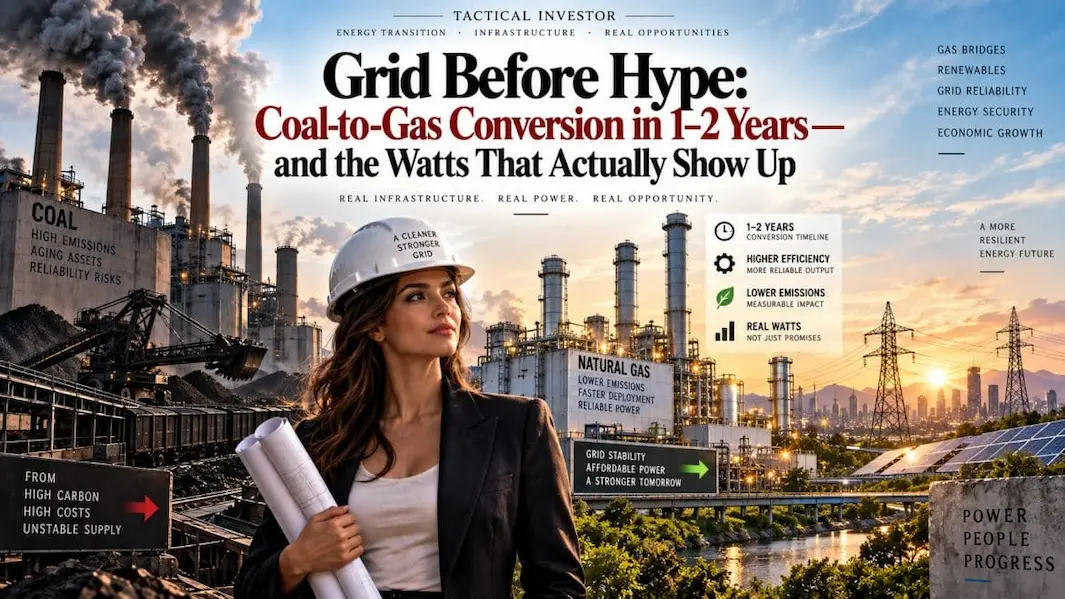
Grid Before Hype: Coal-to-Gas Conversion and the Watts That Actually Show Up
September 18, 2026
The power grid does not run on announcements, investment promises, or projections of future demand; it runs on electricity delivered when consumers need it, and the widening gap between data-centre expansion and dependable generation is forcing utilities to confront a basic infrastructure problem: new capacity takes time, while electricity demand is already rising. The United States Energy Information Administration expects electricity consumption to reach record levels in 2026 and 2027, driven partly by data centres and manufacturing, while its forecasts also anticipate declining coal-fired generation under baseline assumptions, demonstrating that rising demand does not automatically translate into a revival of every existing coal asset. The investment question is therefore not whether the grid needs more power, but which projects can deliver it on a commercially viable schedule, using infrastructure that already exists rather than relying on capacity that remains years away.
The Real Bottleneck Is Time, Not Headlines
Data centres need dependable electricity, but the generation source matters less than its ability to deliver power at the required location, scale, price, and reliability, which is why natural gas, nuclear energy, renewables, storage, and existing thermal plants all compete within a much larger infrastructure transition. The EIA’s 2026 outlook identifies natural gas, solar, and wind as major sources of future generating-capacity growth, while its higher-demand scenario indicates that existing gas-fired plants would provide much of the additional generation if electricity demand grows faster than expected. That distinction matters for investors because a broad increase in electricity demand can benefit several competing technologies simultaneously, while the value of an individual project still depends on fuel costs, transmission access, permitting, construction schedules, and the economics of the local market.
Coal-to-gas conversion enters this equation as a potential way to reuse existing industrial sites, grid connections, and selected power-generation equipment, although the phrase covers projects with substantially different engineering requirements, capital costs, emissions profiles, and completion schedules. The opportunity is not that every coal plant can be converted quickly or cheaply, but that some sites may offer infrastructure advantages over entirely new developments, particularly when transmission access and established industrial facilities would otherwise take years to reproduce. The central investment discipline is to distinguish a credible, engineered project from a broad narrative about energy scarcity, because a power shortage can raise the value of dependable generation without making every proposed conversion commercially attractive.
What Coal-to-Gas Conversion Actually Means
There are two principal approaches, and they should not be treated as interchangeable because one modifies an existing coal-fired boiler while the other replaces major generating equipment with a different power-generation configuration.
Boiler conversion or co-firing involves modifying an existing boiler to burn natural gas alongside coal or, in some cases, converting it to burn gas instead of coal, with the feasibility depending on boiler design, combustion equipment, emissions controls, operating requirements, and the economics of the resulting fuel mix. Co-firing can provide operational flexibility and reduce certain emissions relative to coal-only operation, but it does not automatically create a large increase in generating capacity, and the achievable benefits depend on the specific plant and retrofit design.
Repowering involves retiring or removing coal-fired equipment while retaining selected infrastructure, potentially including the steam turbine, switchyard, cooling systems, land, and grid interconnection, and installing gas turbines with heat-recovery equipment to create a combined-cycle configuration. This approach can increase output and thermal efficiency relative to the retired plant, but it is a substantial construction project rather than a simple fuel switch, and its schedule depends on equipment availability, engineering complexity, permits, gas supply, construction resources, and grid requirements.
The historical record confirms that coal-to-gas transitions are established engineering pathways rather than an entirely new concept, with the EIA reporting that 103 U.S. coal-fired plants were converted to or replaced by natural-gas-fired plants between 2011 and 2019. Of those transitions, some involved converting existing boilers, while others replaced retired coal facilities with new natural-gas combined-cycle plants, and the latter group added more generating capacity than the coal units they replaced because of improvements in turbine technology. That history demonstrates technical precedent, but it does not establish that every future project can be completed within a fixed one-to-two-year window or achieve comparable economics.
The One-to-Two-Year Thesis Needs Conditions
A one-to-two-year timeline is best understood as a potential project-specific target rather than a universal conversion schedule, because the starting condition of the plant determines whether the work is a manageable retrofit or a major redevelopment requiring extensive engineering and procurement. A site with usable interconnection capacity, available gas infrastructure, suitable equipment, completed engineering, and a realistic outage window may move considerably faster than a project that must secure new pipelines, resolve environmental requirements, replace major components, or negotiate grid upgrades. Investors should therefore demand evidence of project readiness, including engineering milestones, procurement commitments, permitting status, construction sequencing, and a credible date for commercial operation, rather than accepting a short timeline simply because the project is described as a conversion.
The historical record also warns against assuming that repowering automatically preserves the original plant’s capacity or operating economics, since the EIA’s data show that the combined-cycle replacements completed between 2011 and 2019 increased aggregate capacity compared with the retired coal plants, but those projects involved new gas-fired equipment rather than a uniform, low-cost modification of existing boilers. The relevant comparison is therefore not simply the cost of converting a coal plant against the cost of building a new plant, but the total cost and delivery schedule of each viable alternative, including fuel infrastructure, grid connection, emissions controls, reliability requirements, and the value of capacity delivered on time.
Efficiency Matters, but Economics Decide
Natural-gas combined-cycle plants can achieve substantially higher thermal efficiency than many older coal units because they use gas-turbine exhaust heat to generate additional electricity through a steam cycle, although actual performance varies with equipment design, operating conditions, ambient temperature, and plant configuration. Efficiency can reduce the amount of fuel required per unit of electricity, but it does not guarantee lower generation costs under every market condition, because the price of natural gas, capacity payments, maintenance expenses, carbon rules, and wholesale electricity prices all influence project returns. The practical question is whether the proposed plant can produce dependable power at a competitive total cost while meeting the reliability and emissions requirements of the grid it serves.
The more compelling advantage of an existing site may be the infrastructure already in place, including a grid interconnection, switchyard, cooling systems, land access, roads, and an established industrial workforce, but these assets create value only when they remain suitable for the proposed project and can be reused without costly upgrades. Transmission access is particularly important because generation capacity located far from demand can be less valuable than a smaller project that can deliver electricity into a constrained region, while gas pipeline capacity and firm fuel arrangements can determine whether a plant can operate when electricity demand and fuel demand rise together. Existing infrastructure can shorten the development process, but it cannot eliminate engineering, regulatory, procurement, or fuel-supply constraints.
The Policy Environment Is Not a One-Way Bet
U.S. energy policy has shifted substantially, but investors should distinguish federal announcements from enforceable rules, state requirements, court decisions, and the regulatory treatment of individual projects, because each can alter the economics or timing of a conversion. In June 2026, the Department of Energy announced $3.6 million for nine design and engineering projects intended to support refurbishment or retrofits of existing coal-fired power plants, including work addressing reliability, flexibility, performance, and wastewater systems, which signals federal interest in modernizing existing facilities but does not establish that every project will receive funding or proceed to construction.
The legal environment remains consequential, as demonstrated by the September 2026 ruling in which a federal appeals court invalidated the federal order requiring Michigan’s J.H. Campbell coal plant to remain open beyond its scheduled retirement, illustrating that emergency reliability arguments do not necessarily override statutory limits or state-level disputes. The case also highlights the financial exposure associated with extending the life of an aging plant, since the cost of continued operation, required maintenance, fuel, and regulatory compliance can become a burden for ratepayers when the economics no longer support the facility. For investors, policy support can create opportunities, but it must be assessed alongside legal authority, state regulation, project-specific economics, and the risk that a proposed intervention will be challenged or reversed.
The Conversion Checklist: What Must Be Proven
A credible project should begin with a technical assessment of the site’s interconnection capacity, switchyard condition, cooling-water availability, land requirements, pipeline access, and the equipment that can realistically be retained, because an existing coal facility is not automatically suitable for a gas conversion simply because it occupies valuable grid-connected land. The engineering plan should specify whether the project involves boiler conversion, partial co-firing, or full repowering, while documenting expected capacity, operating flexibility, emissions changes, outage requirements, and the equipment that must be replaced before commercial operation.
The fuel plan should establish whether the site can secure sufficient natural gas at the required pressure and volume, whether pipeline capacity is available during periods of peak demand, and whether firm transportation or backup arrangements are necessary to maintain reliable operation. The financial plan should then connect capital expenditure, fuel costs, maintenance, expected utilization, wholesale market exposure, financing terms, depreciation, and regulatory recovery into a coherent project model, because a conversion that can be built quickly may still destroy value if its operating costs exceed the value of the electricity it produces.
The final test is whether the schedule survives contact with procurement and construction, including turbine availability, heat-recovery equipment, specialist labour, environmental approvals, grid coordination, and the seasonal windows during which existing units can be taken offline. Projects should be evaluated through documented milestones rather than a single headline completion date, with investors distinguishing early-stage proposals from projects that have secured permits, ordered major equipment, arranged fuel supply, and established a credible construction sequence.
Coal Prices and Equities: Read the Divergence Carefully
Coal equities can move ahead of benchmark prices when investors anticipate improving margins, stronger demand, supply constraints, or better capital returns, but a rising share price alongside a weak commodity benchmark is not sufficient evidence that a sustained recovery has begun. The divergence may reflect expectations about future pricing, company-specific developments, changes in costs, dividend policy, buybacks, or positioning, and each explanation carries different implications for the durability of the move. The analytical task is to identify what is driving the divergence and whether the underlying operating data are beginning to confirm the market’s expectations.
A disciplined monitoring process should combine commodity prices with company fundamentals, trading volume, market breadth, and evidence of changing supply-demand conditions, while treating technical signals as inputs to risk management rather than reliable forecasts of future prices. A broad advance across coal producers and power-related equities may indicate that investor interest is expanding beyond a few individual names, but the signal becomes more informative when accompanied by improving realized prices, stronger cash generation, manageable leverage, and credible evidence that demand is tightening relative to available supply. Without that confirmation, price strength can remain a positioning event rather than the beginning of a durable earnings cycle.
Curve, Freight, and Physical Flows
Commodity tightness often appears first in the relationships between nearby and deferred prices, regional benchmarks, transportation costs, and physical inventories, which is why the shape of the futures curve can provide information that a single headline price cannot. Backwardation, in which near-term prices exceed deferred prices, can indicate stronger immediate demand relative to available supply, although it must be interpreted alongside inventory levels, seasonality, contract specifications, and the structure of the market being observed. A change in the curve is therefore a signal to investigate rather than a standalone instruction to buy.
For internationally traded coal, regional pricing benchmarks, freight rates, import volumes, and utility stockpiles help reveal whether demand is strengthening in the places that matter to producers, while currency movements and transport bottlenecks can alter the value received by exporters even when benchmark prices rise. China and India remain important markets to monitor, but their import data should be read alongside domestic production, policy changes, electricity generation, and inventory trends rather than treated as a direct measure of global scarcity. The objective is to establish whether physical conditions are improving enough to support earnings, not to mistake a temporary price spike or freight disruption for a structural supply shortage.
Three Scenarios for the Power and Coal Complex
Gradual infrastructure expansion would involve selected conversion and repowering projects advancing through engineering and construction while data-centre demand, manufacturing activity, and grid investment increase the need for dependable capacity, creating opportunities for companies that can deliver projects on schedule and operate them profitably. Under this scenario, returns would depend on project execution, regional electricity prices, fuel contracts, and capital discipline rather than on a uniform rally across all coal and gas-related assets.
A tighter power-market scenario would emerge if electricity demand rises faster than new capacity can connect, existing generation becomes more heavily utilized, and fuel or transmission constraints increase the value of dependable output in specific regions. The EIA’s higher-demand analysis illustrates how additional load could increase natural-gas generation and, in some regions, increase coal generation through greater use of existing spare capacity, although that scenario is conditional rather than a guaranteed forecast. Such conditions could improve the economics of selected existing plants, but the beneficiaries would depend on location, available capacity, fuel access, and market structure.
A project-economics squeeze would occur if construction costs rise, turbine delivery schedules lengthen, gas infrastructure proves inadequate, regulatory requirements change, or electricity prices fail to justify the capital committed, leaving developers with delayed projects and lower returns despite strong demand headlines. Commodity producers could also face weaker prices if economic growth slows, coal demand declines faster than expected, or supply expands enough to offset consumption growth, meaning that infrastructure demand and coal-equity performance should not be treated as identical investment themes. The appropriate response is to size exposure according to the evidence, preserve capital when the project or market thesis deteriorates, and avoid assuming that every energy constraint will translate into higher shareholder returns.
Where Investors Should Focus
The investment universe spans several distinct exposures, including natural-gas producers, pipeline and gas-infrastructure operators, turbine and power-equipment suppliers, engineering and construction firms, utilities, independent power producers, and coal companies whose earnings depend on a different set of commodity and operating conditions. These businesses may participate in the same broad electricity-demand trend, but their returns are driven by different combinations of capital expenditure, contract structures, fuel prices, regulation, utilization, balance-sheet strength, and project execution. Investors should therefore identify the actual source of earnings exposure before treating a company as a beneficiary of coal-to-gas conversion or data-centre power demand.
For utilities and independent power producers, the central questions concern the cost of new capacity, the value of existing interconnections, regional electricity prices, fuel security, and the regulatory treatment of investment, while equipment suppliers and contractors depend more directly on order books, manufacturing capacity, project margins, and delivery schedules. Coal producers require a separate analysis of benchmark prices, realized selling prices, production costs, transportation, customer demand, and capital allocation, because a conversion from coal to gas may support the power system while reducing the long-term demand for coal at the affected facility. The strongest analytical approach is to connect each company’s revenue and cash flow to a specific mechanism rather than buying a broad narrative about electricity scarcity.
Grid Before Hype
The grid’s problem is not a shortage of ambitious announcements, but the difficult task of connecting dependable generation to the places where electricity is needed, at a price that consumers and businesses can sustain. Coal-to-gas conversion and repowering can contribute to that process where existing infrastructure, engineering conditions, fuel access, and project economics support the investment, but neither the technology nor the one-to-two-year timeline should be treated as universally applicable. The decisive evidence lies in projects that move from proposals to permits, procurement, construction, and commercial operation, with costs and delivery schedules that survive scrutiny.
For investors, the opportunity is to distinguish real capacity from promised capacity, regional constraints from national headlines, and improving fundamentals from speculative positioning, while recognizing that gas infrastructure, renewables, storage, nuclear power, and existing thermal plants may all participate in the changing electricity system. For operators, the priority is to select sites where existing assets create a genuine advantage, establish reliable fuel and grid access, and demonstrate that the project can deliver dependable electricity at a defensible cost. The watts that matter are the watts that arrive, and the investment value belongs to projects that can prove they will arrive on time, operate reliably, and earn an adequate return.