

Nov 02, 2025
The Crest Before the Bend
Every generation baptises its own delusion as destiny. Investors, journalists, and policymakers all swear this time is different, then proceed to build monuments from the same sand. The mirror disagrees. It reflects not innovation but repetition disguised as progress.
We hover now at a summit dressed in confidence metrics and quarterly miracles. U.S. equity ownership among the top decile exceeds 90%, retail sentiment measures rival the 1999 highs, and margin debt as a share of GDP glints near record territory. Volatility is tranquil, like a lake moments before an undertow. The Nasdaq trades at forty times free cash flow, and yet the mood is serene—proof that euphoria, not fear, now sets the yield curve’s tone.
Foreign capital rushes in again, just as it did in 1968, 1986, 1999, and 2021, seduced by American liquidity theatre. Central banks choreograph the same soft-landing ballet, whispering that inflation is “contained” and balance sheets are “resilient.” The press nods. Algorithms clap. Politicians grin for the closing bell.
But mirrors do not lie, and charts do not forget. Every immaculate peak in history was applauded as a triumph of ingenuity, not a prelude to correction. The market, like the empire, never admits it is tired. It simply begins to repeat its greatest hits—slower, flatter, more desperate.
The last time the curve bent this way, the decade that followed rewired the entire system: currency regimes collapsed, wage controls failed, and faith in central planning imploded. Those who mistook the shimmer for permanence became its cautionary tale.
Peaks rarely whisper. They mock.
Source: https://finance.yahoo.com
Mirror Crest
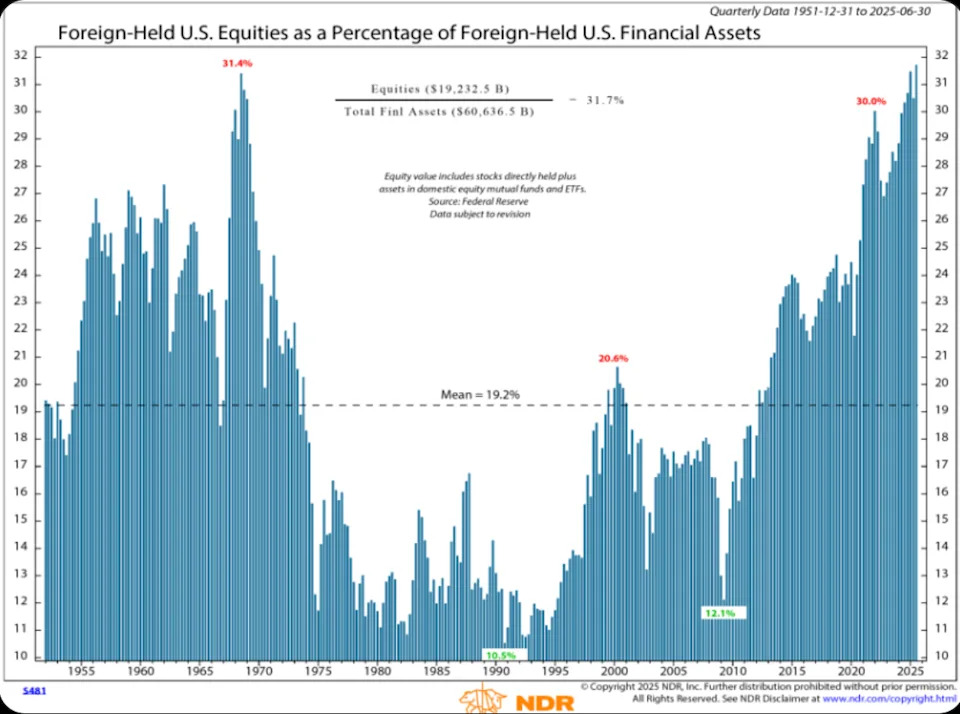
The image feels like it could fold in on itself, a copy laid over another without seams. Enthusiasm reaches nearly thirty per cent, concentration tightens around a few key icons, and foreign portfolios appear U.S.-heavy. Experts cheer the summit, yet the last similar summit gave birth to the 1970s inflationary grind.
Drift Begins
1965–1968 drifted on dazzling narratives, while margins thinned quietly under the noise. 2022–2025 repeats the melody, with profits stretched by buybacks, pricing power, and cost deferrals. Price and story walk ahead, cash flow breathes behind.
Liquidity Mirage
Foreign inflows feel endless because price rises validate allocation. In the late 1960s, money aggregates swelled, and today, balance sheets and fiscal outlays amplify the effect. Liquidity plays sculptor, valuation plays marble.
Terrain Shifts
Bretton Woods cracked the dollar’s terrain, and currency became the battlefield rather than the treaty. Our era faces a different fracture, where fiscal needs pull on the currency while geopolitics saws at trust. Sun Tzu would warn that terrain decides battles before swords meet.
Coil One: Inflation Pulse
By 1969, inflation was embedded in wages and contracts, not just headlines. Our present coil tightens through services, housing, and supply re-routing, which hardens price stickiness. Once expectations reset, central banks chase rather than lead.
Coil Two: Policy Whiplash
Authorities toggle between growth rescue and price restraint, and coherence erodes. The late 1960s mixed credit brakes with fiscal gas, a recipe that cooked stagflation. Today’s toggling repeats the taste, only with larger deficits and louder politics.
Coil Three: Dollar Bend
The dollar sagged after convertibility ended, slicing foreign real returns. A strong dollar peak invites a later bend that tests conviction. Currency losses travel faster than earnings, so foreign allocators trim first and explain later.
Crack in Leadership
In 1973 and 1979, oil shocks broke market leadership twice, not once. Expect a multi-peak crescendo rather than a single dramatic exit. Narrow winners suffer first because every portfolio leans in the same direction.
Snap One: Valuation De-rating
Multiples compress before earnings fall, as the belief reprices faster than factories can adjust. The 1970s took valuations from regal to ordinary, then to cheap. In the analogue, foreign equity share slides toward the mean first, not the trough.
Snap Two: Earnings Reality
Margins normalise as input costs and wages refuse to roll over. Creative accounting may delay recognition, but cash statements reveal the truth with cold clarity. Multiple compression meets earnings compression, and foreign selling accelerates.
Snap Three: Flow Regime Flip
A decade’s habit suddenly feels reckless, and model weights rewrite themselves. Quantitative and policy risk combine into forced rebalancing, which appears to be a choice but behaves like gravity. Foreign shares step below the 19.2 per cent mean and continue to decline.
Dislocation One: Currency Realignment
New pegs and quiet accords shaped the aftermath of the 1970s, while today’s realignment will be messier and more digital. Reserves diversify, trade blocks settle in mixed baskets, and the dollar’s path zigzags. Each zig steals a year of equity enthusiasm.
Dislocation Two: Capital Scarcity Premium
Volcker imposed a Price for capital, and scarcity rebuilt trust the hard way. Our future requires a real-term premium that stops games and funds work. When money costs something, stories pay rent or move out.
Dislocation Three: Portfolio Migration
Commodities and non-U.S. equities enjoy their turn at the microphone. U.S. bonds regain their purpose once yields beat inflation accurately, not artificially. Foreign share of U.S. equities grinds toward 12 per cent, then briefly kisses 10.
Civic Strain, Market Consequence
Ibn Khaldun mapped how fiscal pressure and social cohesion move in cycles. Rising debt service taxes erode patience, while institutions become increasingly procedural and slow. Markets price that sociology, not just spreadsheets, and discounts widen accordingly.
Trough Psychology
By 1990, the world felt tired of the U.S. equity narrative, which set the stage for renewal. Troughs arrive when nobody argues anymore because fatigue has replaced conviction. Hume would remind us that passion drives trade, yet only habit rebuilds it.
Rebuild Under New Rules
Globalisation and tech diffusion rebuilt the share after 1990, but under different institutions and costs. The 2040s rebuild comes after currency clarity, credible budgets, and broader leadership. Foreign share rises from 10–12 per cent toward the mean, not to a euphoric crest, because scars teach.
Signposts that confirm the analogue
Term premium holds above inflation without policy winks. The dollar peaks then weakens in deliberate waves, not panics. Leadership broadens only after the second shock, not the first. The equity risk premium lifts and stays elevated for an entire political cycle. Foreign share breaks below 19.2 per cent, not as a dip but as a structural migration: what was once a floor becomes the ceiling.
This is the map: drift breeds symmetry, coils form through inflation and policy contradiction, snaps cut through valuation and earnings, and dislocation rips across currency and flows. The crest dazzles, but the last identical silhouette ushered in a decade where illusions burned slowly, not suddenly. Policy became irrelevant, liquidity betrayed its adherents, and markets learned that denial is the most expensive position of all.
The mirror does not negotiate. It records conviction, then shatters it on schedule. Those who mistake reflection for future get carved into the cycle’s turning—those who read the terrain move before the break.