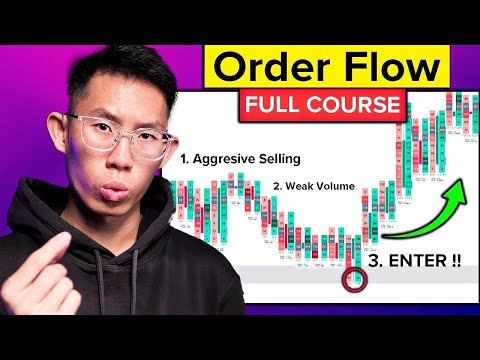

What is Order Flow Analysis: A Deep Dive into Core Economic Factors
Updated Jan 20, 2026
WARNING: The market isn’t a machine running on predictable code—it’s a living, breathing organism. It pulses with the collective heartbeat of millions of participants, reacts to fear and greed in real time, and remembers every major inflection point in its history. Underestimating this complexity is like standing at the edge of a black hole, staring into the void while it’s already begun pulling you in. So what is order flow analysis? It’s not just another technical indicator to stack on your chart. It’s the language of the market’s deepest intentions, the subtle signals broadcast before major moves, the invisible architecture connecting every buyer, seller, and the vacuum of uncertainty between them. Trade without understanding it, and you’re flying blind. Misread it, and you’ve become someone else’s exit liquidity.
The Battle Beneath the Surface
What you see on your screen—the candlesticks, the moving averages, the volume bars—represents only the surface of what’s actually happening. The real war is being fought in the order books, where massive institutional orders collide, absorb one another, and sometimes vanish entirely like particles in a quantum field. Understanding order flow analysis means learning to see through this surface illusion. It’s not just about tracking where price is headed; it’s about understanding who’s driving that move and how much firepower they’re using.
Picture two armies clashing in a fog-covered valley. The price action you see on your chart is like hearing distant echoes of that battle. But order flow? That’s the actual movement of troops, the shifting of supply lines, the mounting tension right before one side breaks through. It’s the study of intent—watching market participants telegraph their positions through the size and placement of their orders. When institutional players move, they create wakes in the market like whales cutting through the ocean. Order flow analysis teaches you to read those wakes and anticipate the waves they’ll create.
There’s a catch, though. This battlefield is reactive. The moment you spot something in the order flow, algorithms and high-frequency traders are seeing it too, already adjusting their strategies in milliseconds. This is the central paradox of order flow analysis—it reveals truth, but only to those who can process and act on that truth faster than the market can adapt to its own transparency.
The Contrarian’s Edge: Reading Pressure, Not Just Price
Most retail traders are price chasers. They buy breakouts, follow moving average crosses, and pile into momentum trades like moths drawn to a flame—completely oblivious to the underlying forces that created that flame in the first place. The contrarian operates differently. They understand that order flow analysis isn’t about predicting the next candle—it’s about reading pressure points. It’s about spotting the exact moment when supply and demand fall out of balance, creating exploitable inefficiencies that vanish as quickly as they appear.
Take the concept of absorption as an example. When a large buy order hits the market, inexperienced traders see price rising and instinctively jump in, chasing what looks like momentum. The contrarian is watching something entirely different. They’re monitoring the order book and noticing that sell orders are quietly absorbing all that buying pressure, preventing price from advancing any further despite the influx of demand. This is a critical signal that the move is exhausted—a setup for a short position while the crowd is still buying. Order flow analysis transforms market noise into a detailed map of supply and demand dynamics that most participants never see.
But mastering this approach requires more than just software and indicators. It demands intuition developed through thousands of hours of screen time. You need to think like a chemist studying reactions, understanding that order flow isn’t static—it’s a living chain reaction where one participant’s action triggers responses from dozens of others. To truly master order flow analysis is to become fluent in the market’s native language, the one spoken beneath all the surface-level technical patterns everyone else is trading.
Patterns Within Patterns: The Fractal Nature of Markets
Markets exhibit fractal characteristics—repeating patterns that appear at every timeframe, from the one-minute chart to the monthly. Order flow analysis operates at the intersection of these fractals, where micro-level structures reveal macro-level truths. The bid-ask spread, the depth visible in the order book, the velocity at which trades execute—these are all puzzle pieces. Seeing the complete picture requires studying individual components while never losing sight of how they connect to form the larger whole.
Think of a river system viewed from above. The main channel splits into countless smaller tributaries, each carving its own unique path through the landscape, yet all ultimately flowing toward the same ocean. Order flow analysis tracks these tributaries of liquidity as they move through the market. It identifies where the flow runs strong, where it weakens, and most importantly, where it’s about to reverse direction. This isn’t fortune-telling—it’s real-time detection. You’re not guessing what might happen tomorrow; you’re understanding what’s happening right now with such clarity that tomorrow becomes almost inevitable.
Here’s where things get tricky. The fractal edge is also where chaos lives. Tiny shifts in order flow can cascade into massive price movements, just as that famous butterfly flapping its wings can theoretically trigger a hurricane on the other side of the globe. Markets exist in this strange duality—they’re simultaneously predictable and unpredictable, structured yet chaotic. Order flow analysis thrives precisely in this contradiction, finding repeatable patterns where others see only random noise.

Market Mechanics: How Every Action Creates Ripples
The market functions like a quantum system in certain ways—every action influences every other action, often in non-obvious ways. Buyers and sellers aren’t isolated actors making independent decisions; they’re interconnected, and the behavior of the collective shapes individual choices. Order flow analysis is fundamentally the study of this interconnectedness, of how individual orders ripple through the market ecosystem, creating waves of liquidity and imbalance that skilled traders can ride.
Consider market impact. A single large order doesn’t just move price linearly—it distorts the entire market structure around it, pushing prices away from equilibrium in ways that can be measured and anticipated. This impact compounds exponentially as other participants react to the distortion, amplifying its effects. Order flow analysis quantifies this impact, allowing you to anticipate not just where the market is, but how it will respond to your own participation. This distinction is crucial. It’s not enough to know current conditions; you need to understand how your presence will alter those conditions.
This is where order flow analysis transforms from a passive observation tool into an active strategic weapon. By understanding how orders interact and influence one another, traders can position themselves not as helpless observers swept along by market currents, but as informed participants capable of reading those currents and navigating them to their advantage. You’re no longer just reacting to the market—you’re engaging with it on a deeper level.
The Path to Mastery Through Complexity
To truly grasp what order flow analysis is, you need to understand it’s not simply another indicator to add to your toolkit. It’s a fundamental shift in how you perceive markets. It requires embracing contradiction, finding signal in noise, and acting decisively when others are paralyzed by uncertainty.
Markets don’t reward those seeking simple answers. They favor participants who can navigate complexity and turn chaos into opportunity. Order flow analysis is your key to that navigation, but it’s not a shortcut. It demands serious commitment—the discipline to study patterns for hours, the intuition that develops from experience, and the willingness to think differently from the crowd. This approach isn’t for everyone. But for those who put in the work to master it, the edge it provides can be transformative.
Here’s the uncomfortable truth: the market doesn’t care about you. It’s indifferent to your hopes, your fears, your financial goals. It’s a system that operates according to its own logic, cold and mechanical in many ways. But within that complexity lies genuine opportunity—for those bold enough and prepared enough to seize it. The question isn’t whether the opportunity exists. It’s whether you’re willing to develop the skills to recognize and capture it when it appears.