

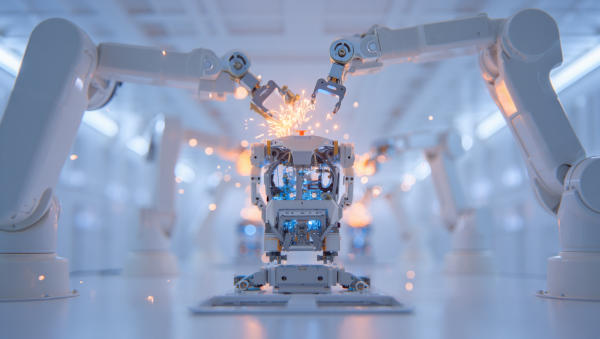
The Rise of Robotics Stocks: Where Growth Could Accelerate Next
Feb 10, 2026
Robotics has always carried a strange duality. On one hand, it feels mechanical and predictable—machines repeating motions with cold precision. On the other, it’s a field built on the kind of ambition that rewrites entire industries. The rise of robotics stocks sits right in that tension. You can’t discuss the sector without hearing the familiar promises: faster factories, safer workplaces, automated everything. Yet beneath that surface sits something more human than most people admit—a quiet, almost primal desire to outsource our fragility.
Look closely at a warehouse where robotic arms sort packages at speeds no human could match. You expect to see efficiency; what you actually see is a world shifting its centre of gravity. Robots are not replacing labour—they are replacing uncertainty. Investors sense this. They feel the pull of a future where precision matters more than mood, where throughput is unaffected by sickness or fatigue. But investing in robotics is not as simple as betting on machines that move smoothly. The real story is the psychology of backing a technology that forces us to question our assumptions about control, timing, and progress.
Robotics stocks have surged because their destiny feels inevitable. But inevitability is a dangerous word in markets. It seduces. It dulls caution. It makes trends feel like laws. And this is where a deceptively technical topic begins to mirror something deeper about how people behave when money crosses paths with belief.
The Bridge: When Machines Expose Human Patterns
Robotics thrives on traits that the human mind struggles to maintain consistently: endurance, precision, discipline, and timing. Machines excel because they have no ego, no hesitation, no confusion between feeling and fact. That is precisely why robotics investing becomes more than a simple sector play. It becomes a mirror. The traits that make robots valuable are the same traits most investors lack when it matters.
You can watch a robotic arm repeat a perfect cycle a thousand times and feel a quiet admiration. But somewhere in that admiration sits a faint discomfort: machines don’t second‑guess themselves. Humans do. And that gap, as small as it looks, opens into a psychological canyon when money enters the picture. Robotics investing forces you to confront that canyon, whether you intend to or not.
As the sector accelerates, the market surrounding it behaves with all the usual volatility—hype cycles, overreaction, disbelief, and eventual clarity. That rhythm echoes every trading dynamic we already know: the swarm toward a story, the sudden fear when that story stutters, the long tail of winners that survive the drama. Robotics isn’t the exception. It’s the stage.
The First Mirror: Momentum Without Memory
Robots don’t remember their previous missteps. Investors do. And that memory often cripples them. When a robotics stock rallies 40% in three months, human minds recall all the times they “missed” a similar move. They overreact. They push the stock higher because it eases the sting of regret. But regret is not a strategy. It’s a ghost. And ghosts are expensive trading partners.
The robotics sector is full of companies whose share prices surged far faster than their revenues—machine‑learning firms, automation suppliers, industrial robotics makers. Momentum traders piled in, fuelled by headlines predicting a world where manual labour disappears entirely. The trouble begins when momentum faces friction. A single weak quarter, a missed contract, a rumour about slowing demand—and the same traders flee with equal speed. Markets behave like crowds: predictable in aggregate but chaotic moment to moment.
The irony is that robots themselves operate on momentum too—but physical momentum, not psychological. A robotic arm doesn’t hesitate mid‑swing because the last swing was imperfect. It completes the motion. Humans, in contrast, pause right when they should continue and continue right when they should pause. Investing in robotics stocks means learning to separate machine‑like consistency from human panic. Most never do.
The Second Mirror: Precision as a Discipline
Every robotic system is built on limits. Maximum torque. Minimum clearance. Error thresholds measured in millimetres. Precision is not optional; it is the price of existence. Markets reward the same discipline in investors, but few apply it. They rely on instinct and emotion, not calibrated rules. The result is predictable: selling too early, buying too late, holding losers longer than they should, and convincing themselves that patience is a strategy even when it masks fear.
The robotics sector exposes this contrast brutally. Consider companies producing micro‑sensors for automation. Margins shift by tenths of a percent. Lead times determine survival. In such environments, sloppy thinking breaks quickly. Investors who simply “like the tech” get crushed. Investors who understand numbers—not narratives—tend to survive.
Precision in trading isn’t about perfect timing. It’s about defining your boundaries: when you buy, when you cut a position, when you ignore noise, when you trust the long view. The very mindset that drives robotics engineering—constraints, clarity, iteration—is the mindset most traders avoid because it demands uncomfortable honesty. Markets don’t punish lack of intelligence nearly as much as they punish lack of discipline.
The Third Mirror: Adaptation and the Cost of Being Late
Robots adapt slowly in physical terms, but rapidly in developmental terms. Once a better design emerges, the world shifts. Old models disappear like rain on hot pavement. Investors face the same dynamic. Trends don’t announce themselves. They coalesce silently, then arrive all at once. Miss the turn, and you’re not behind by months—you’re behind by years.
The robotics boom is not driven by a single catalyst. It’s driven by converging forces: ageing populations, rising labour costs, supply‑chain fragility, and the need for predictable output in unpredictable environments. These forces don’t reverse simply because markets wobble. They compound. And those who recognise the direction early benefit disproportionately. Those who wait for the headlines often become liquidity for those who acted earlier.
Adaptation in markets mirrors adaptation in robotics: the upgrade always arrives sooner than comfort allows. Investors who treat trends like fads miss the structural nature of the shift. Automation isn’t a fashion—it’s a correction to economic friction. That correction rewards endurance, not drama.
The Fourth Mirror: The Patience Machines Already Understand
Robots don’t get bored. Humans do. And boredom is an expensive flaw. Many investors abandon long‑term plays because the move takes longer than they hoped. They chase action. They chase noise. They trade for stimulation, not growth. The robotics sector punishes this mindset harshly. True compounding in robotics comes from companies building foundational pieces: sensors, actuators, control systems, industrial software. They grow steadily, not theatrically.
Consider firms supplying automation to logistics giants. Their contract cycles are measured in years, not weeks. Revenue builds like sediment. It’s not glamorous. It’s not viral. But when the shift reaches critical mass, these slow‑burn companies deliver the kind of returns that look effortless in hindsight. Patience is not passive. It is active restraint—the most underappreciated skill in markets.
Machines don’t rush. They execute. Investors rarely do. And the difference becomes a gap you can measure in USD returns.
Back to the Beginning: Seeing Robotics Clearly
When people talk about robotics stocks, they often speak in predictions: this industry will dominate manufacturing, this company will reinvent logistics, this robot will change medicine. But the real insight doesn’t sit in predictions. It sits in pattern recognition. Robotics is not merely a sector with growth potential. It’s a sector that reveals something about how we think.
If you can understand why robots succeed—discipline, clarity, consistency—you understand why most investors fail. If you can understand why automation is accelerating—structural forces, not hype—you understand why the market rewards those who look beyond noise. And if you can learn to watch the sector without projecting your narratives onto it, you begin to invest like someone who has separated emotion from opportunity.
The rise of robotics is not a story about machines replacing people. It’s a story about markets exposing minds. And once you see that, investing in robotics stocks becomes less about predicting technology and more about understanding yourself. The growth will come. The question is whether your thinking will allow you to stay long enough to benefit.