

S&P 500 Outlook: Why Structure Matters More Than Reaction
May 20, 2026
Start with structure, not the reaction. The suggested range for the S&P already assumes something most people miss. The system bends before it breaks. A move toward 6,000–6,100 is not collapse in this context. It is pressure being released after a long stretch of stability. The broader range, 6,500 to 7,500 with a possible overshoot, fits a market that is still absorbing stress rather than failing under it.
That matters because it changes how the decline should look.
If we see that lower band, it is more likely to arrive through drift than panic. Breadth has not collapsed. Liquidity has not vanished. When those two hold, declines tend to come late and controlled, not as immediate cascades. Tactical Investor has pointed this out repeatedly. Late-cycle weakness often looks like slow erosion followed by sharp but contained resets, not a straight-line crash.
So the question is not whether the market can drop. It can. The question is how it gets there.
Oil Supply Disruption: Why This Shock Does Not Resolve Cleanly
This is not a headline-driven scare. The numbers tell you that. You are looking at a system where up to 10–15 million barrels per day face disruption, in a channel that normally carries roughly 20 million. Strategic reserves can smooth the edges, but they don’t replace flow. They buy time, not stability.
That creates a bottleneck, not a temporary dislocation. And bottlenecks behave differently. They don’t resolve quickly because they sit inside physical systems. Shipping lanes, infrastructure, refining capacity, all of it moves slower than the market prices it.
That is where most people get misaligned. They expect resolution to follow the same speed as the reaction and it doesn’t.
Replacement Supply: Why Russia, Venezuela, and Iran Cannot Close the Gap
The natural response is to look for replacement. Russia looks large on paper, but it is already constrained. Sanctions, logistics, internal pressures, all of it limits flexibility. It is producing, but not holding meaningful spare capacity that can be deployed cleanly.
Venezuela offers incremental barrels, but the crude is heavy, infrastructure is degraded, and scaling takes time. It helps at the margin. It doesn’t close the gap. Iran is not the supply solution. It is the control point. Its importance comes from geography, not volume. It sits on the valve. So even under optimistic assumptions, the gap between disrupted supply and replaceable supply remains wide, and gaps like that don’t close quickly.
Market Timing vs Physical Reality: The Timeline Mismatch
This is where the timeline mismatch come into play and they matter. Markets price shock immediately. Panic unfolds over days or weeks. Stabilization can begin within a month or two. But the physical system, shipping, infrastructure, production, takes months, sometimes longer, to normalize.
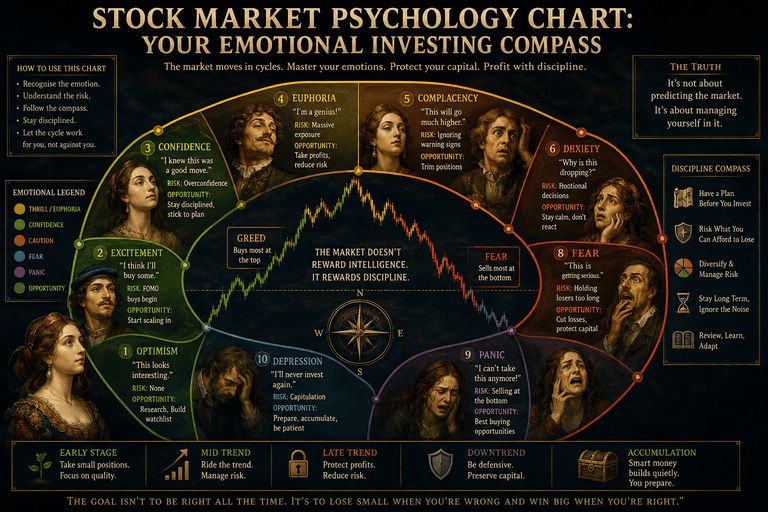
That creates two timelines running at once. Price moves fast. Reality moves slow. Tactical Investor has emphasized this repeatedly. Markets do not wait for resolution. They turn when uncertainty stops expanding, not when the system is fixed. Once the rate of deterioration slows, price begins to stabilize, even if the underlying structure is still damaged.
1970s Oil Crisis Comparison: The Same Geometry, Compressed
The comparison with the 1970s is not about recreating identical events but recognising the same underlying geometry. Markets bottomed long before oil prices normalised because investors eventually realised conditions were no longer deteriorating at the same pace. Inflation remained elevated, supply constraints persisted and uncertainty was still widespread, yet expectations had already begun adjusting to a slower rate of deterioration. Markets respond less to absolute conditions than to changes in momentum.
The same principle applies today, although the cycle unfolds far more quickly. Information moves instantly, liquidity responds within hours and positioning can unwind in days rather than months. What once took nearly a year can now compress into a matter of weeks, provided the financial system itself remains intact. Credit markets and liquidity conditions therefore matter far more than headlines because genuine crises emerge when financial plumbing breaks, not simply because uncertainty remains high. At present, that plumbing is under pressure but continues functioning, leaving the market in a phase of controlled stress rather than systemic collapse.
Oil Creates Second-Order Pressure
Oil rarely hurts markets directly. Its influence spreads through second-order effects as higher energy prices reshape inflation expectations, monetary policy, corporate margins and consumer spending. Those pressures emerge gradually, which is why markets often experience an initial shock, followed by a relief rally, before the economic consequences begin appearing in earnings, inflation data and business activity.
That distinction explains why Tactical Investor places greater emphasis on vectors than headlines. Short-term vectors can reverse violently as sentiment shifts, but medium-term vectors driven by liquidity, monetary policy and earnings tend to reassert themselves once the emotional reaction fades. Today, the short-term vector remains capable of powerful countertrend rallies, while the medium-term trend still argues for caution. That tension is precisely what creates elevated volatility.
The Signal That Matters
The most important signal rarely appears in the headlines. Markets turn when bad news continues to arrive but prices stop responding as though each development changes the investment landscape. That shift usually feels quiet, almost insignificant, because perception is still anchored to yesterday’s fears even as capital quietly begins repositioning. By the time the news finally improves, the market has already moved.
Final Read
A move toward 6,000 remains consistent with the broader structure, but the path is more likely to be uneven than catastrophic. The oil shock is real, supply constraints cannot be resolved overnight and geopolitical tensions may persist far longer than investors expect, yet none of those conditions must disappear before markets begin stabilising. Markets discount the future, not the present, which is why they often recover while the news remains overwhelmingly negative.
The critical variable is not whether uncertainty disappears but whether it continues expanding. Once the rate of deterioration begins slowing, expectations adjust, selling pressure eases and capital gradually returns long before confidence does. That is the paradox investors repeatedly miss. They wait for clarity before acting, yet clarity is the market’s reward for those who bought earlier. By the time the outlook feels comfortable, expectations have already shifted, prices have already adjusted and the greatest opportunity has usually passed.

From Doubt to Vision a Journey of Clarity