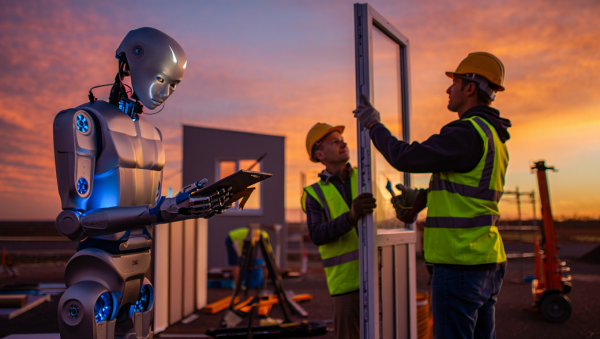
Robot-Built Houses: The Deflationary Shock That Will Crush Real Estate Costs
Jan 8, 2026
In the quiet corners of the construction industry, a structural shock is forming. It is not making headlines on the nightly news yet, but the tremors are unmistakable to anyone paying attention to the supply chain. New construction robots are already proving they can build a house in roughly 24 hours. One spider-legged, 3D-printing robot, known as “Charlotte,” can lay down structural walls using local materials, cutting out traditional assembly, transport, and heavy-machinery steps. (3D Printing Industry)
This is not just a cool gadget. It is an economic weapon. If robot-built houses scale, the cost of shelter—the single largest expense for the average human being—could collapse. Imagine firms buying batches of these robots, churning out dwellings in days rather than months. Even if it takes a week per house, the cost reduction would be dramatic. We are staring at a future where the marginal cost of a new home trends toward the cost of raw materials and energy, stripping out the massive premiums for labor, time, and inefficiency.
The Sears Kit Home Moment of the 21st Century
We have been here before. This is the Sears Kit Home moment of the 21st century, but with higher stakes. In the 1920s, you could order a house from a catalog for roughly $2,000. It would arrive by rail, a logistics triumph of pre-cut lumber and precise instructions. It was the democratization of housing. So, why did it stop? It wasn’t a failure of the product. It was a failure of permission. Zoning laws, construction unions, and local protectionism killed the efficiency of the kit home to protect the margins of the incumbents.
Now, robot-built houses like Charlotte are coming to finish the job that Sears started. But the dynamic has changed. The labor shortage in construction is now chronic; there are no workers left to protect. The robots don’t sleep, they don’t strike, and they don’t get injured. The question is no longer about technology; it is about regulation. Will the zoning laws break under the pressure of a housing crisis, or will the robots simply build around them? History suggests that when the deflationary force is this strong, the dam eventually breaks.
The Great Bifurcation: Inflation for Assets, Deflation for Goods
This technological shift matters profoundly for inequality and social structure. We have long argued the US had become a bifurcated economy: aggregate wealth is high, while the masses own little, invest little, and barely scrape by. The gap between the rich and the poor is simply huge. Under the regime of robot-built houses, we may see inflation and deflation co-existing in a way that confuses traditional economists: inflation in financial assets (stocks, bonds), but aggressive deflation in real goods like housing and manufactured essentials.
This creates a paradox. If housing becomes cheap, the primary savings vehicle of the middle class—home equity—stops appreciating. It might even depreciate. A world of cheap, abundant housing is a utopia for the renter and a nightmare for the leveraged owner. The destruction of “scarcity value” in real estate would be the greatest transfer of wealth in modern history, moving leverage away from landlords and toward those who control the automation.
The Human Cost: The Death of Mediocrity
If this wave breaks, the class of mediocre workers, which makes up the majority, will take the first hit. This is the brutal reality of the “robot dividend.” Automation goes after the repetitive skills roles with surgical precision. Construction was long considered safe from automation because it was “unstructured”—a job site is messy, chaotic, and unpredictable. Robots like Charlotte change that. They walk over debris. They adapt.
The survivors will be the highly adaptable who can ride the wave instead of being crushed by it. But for the average laborer, the leverage is gone. Evidence already mounts that robotic deployment boosts productivity sharply. A recent study shows that a 1% increase in AI adoption in firms is linked to a 14.2% jump in total-factor productivity. (MDPI) That productivity is real, but it doesn’t necessarily result in higher wages for the guy pouring the concrete. It results in higher margins for the guy owning the robot.
On a global scale, some regions, especially manufacturing hubs, may lead this deflationary wave. Consider a country with a large, well-educated pool of STEM talent that aggressively deploys robots and AI across factories. The convergence of cheap robotics hardware, scale, and human capital can turbo-charge manufacturing output and undercut global costs. China is already doing this—not just for margin, but for survival against a demographic cliff. (chinadailyhk) They are automating to replace the workers they never birthed.
The Kodak Moment for AI Hardware
While robot-built houses represent the rise of physical automation, the digital infrastructure powering this revolution is facing its own crisis. AI is being blown into a mythic creature, priced for a future that cannot exist on today’s infrastructure. The truth is simple. The hardware will age out faster than most can imagine. The infrastructure people worship today—the H100 GPUs, the massive data centers—will rot under them long before they even notice.
This is the Kodak moment for compute. Just as film cameras became obsolete overnight, today’s cutting-edge AI chips are depreciating assets masquerading as growth stocks. One day, companies will brag about their cutting-edge systems, and the next, those same systems will feel like rusted machinery from another era. The depreciation curve of this hardware is a cliff. The ground will shift, and the crowd will still be smiling, unaware that the floor has already given way.
The Investment Landscape: Real Assets vs. Paper Promises
So, where does the money go? At the same time that robot-built houses drive down the cost of living, financial-asset inflation will run for those still plugged into market speculation. But that phase fades. The next leg will belong to real assets. Commodities will gain traction by default. We are already seeing the early pulse in gold, silver, coffee, cocoa, and copper. Palladium is starting to wake up. Almost every other commodity will follow as the dollar weakens.
The dollar weakens for two core reasons. First, the United States prints oceans of paper to sustain its debt. Second, and worse, it produces fewer real goods each year. When you print money to buy things you no longer make, you import inflation. But if robots start making those things cheaper, you get a tug-of-war between monetary inflation and technological deflation. The winner? The raw materials required to build the robots and the houses.
The future is not a straight line. It is a jagged fracture. On one side, the cost of essentials collapses thanks to automation. On the other, the value of the currency collapses thanks to debt. In the middle, the human worker fights for relevance. Watch the robots. Watch Charlotte. She isn’t just building walls; she is dismantling the old economy.